

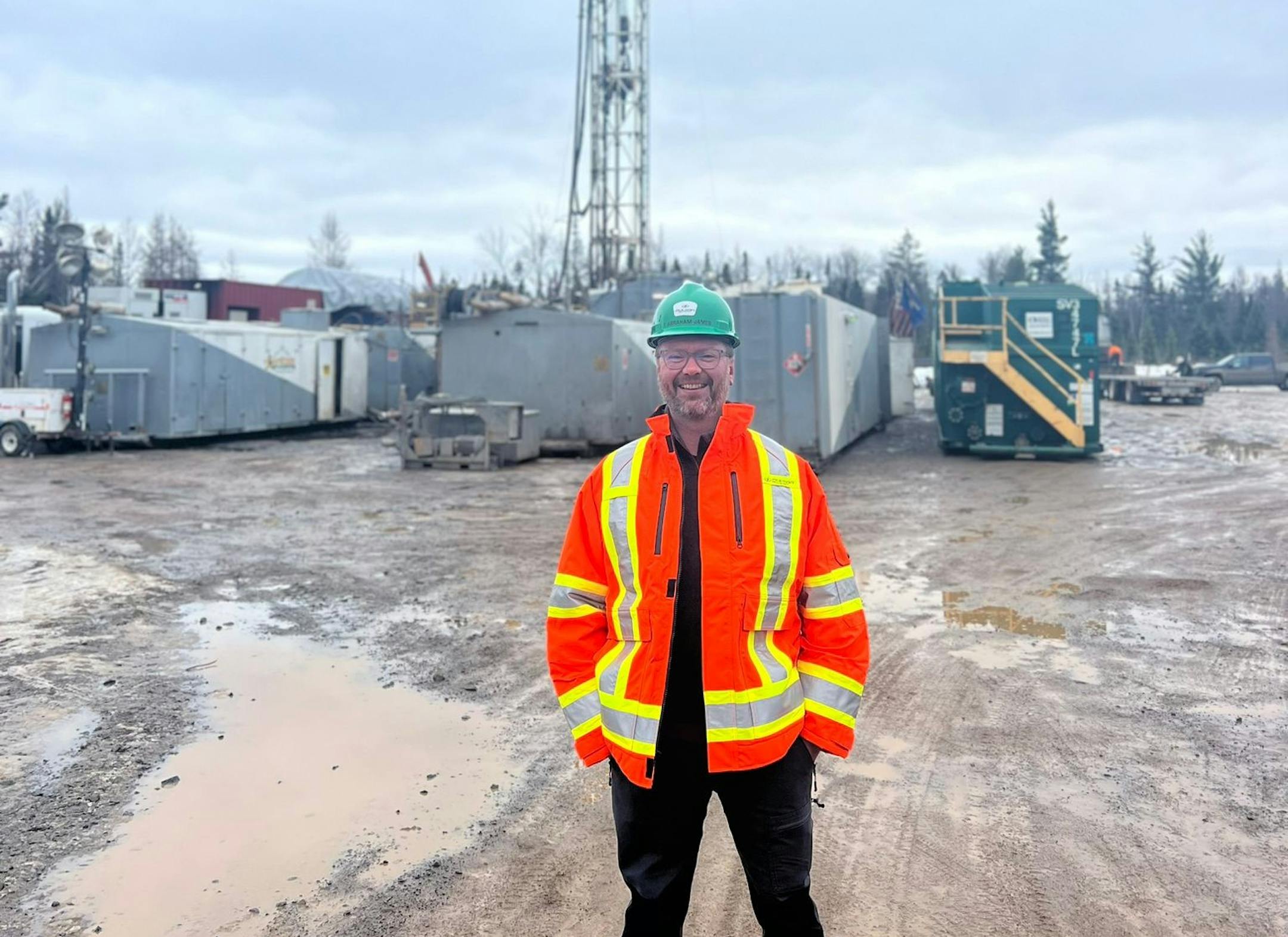
A helium exploration company is expanding its search for the buoyant gas in northern Minnesota, sinking 10 new wells to determine if there’s enough to bottle and sell.
Thomas Abraham-James, the CEO of Pulsar Helium, said the company has found helium concentrations as high as 14% in its two wells southeast of Babbitt. Usually, helium is a byproduct of natural gas extraction, making up 1% or less of what comes out of the ground. In this case, the inert gas is hiding in the seams of fractured rocks underground.
The gases linger between roughly 3,000 and 6,000 feet deep, according to a presentation the company has compiled for investors. Pulsar will start drilling new wells at the end of September.
Early results show the helium floats to the surface naturally, and wouldn’t require fracking to extract it, Abraham-James said. “The question we now need to answer is, ‘What is the size of the prize?’ ” he added.
In 2011, a different company that was digging for platinum and palladium near Babbitt got a surprise when gas came “absolutely screaming out of the hole,” according to a member of that exploration team.
That gas was helium, an artifact of decaying radioactive elements deep underground. Helium isn’t just used in balloons — it can be used to help cool machinery, etch supercomputer chips and flush fuel from rockets. To sell it, the gas would have to be cooled and liquefied, Abraham-James said.
He did not reveal the locations of the new drill sites, but he said they will be focused in the Bald Eagle Intrusion, a funnel-shaped geologic formation. It stretches from Bald Eagle Lake in Superior National Forest some 17 miles southwest, across Voyageurs Highway to the Sand Lake Peatland Scientific and Natural Area.
The Bald Eagle Intrusion is part of the larger Duluth Complex, where some companies are trying to open copper and nickel mines. The complex was created as a part of the midcontinent rift, an alley of volcanoes and fissures in the earth’s crust that ripped across the area 1.1 billion years ago.


