
Fast Rochester computer's trick: Oil

December 18, 2008 at 6:05AM
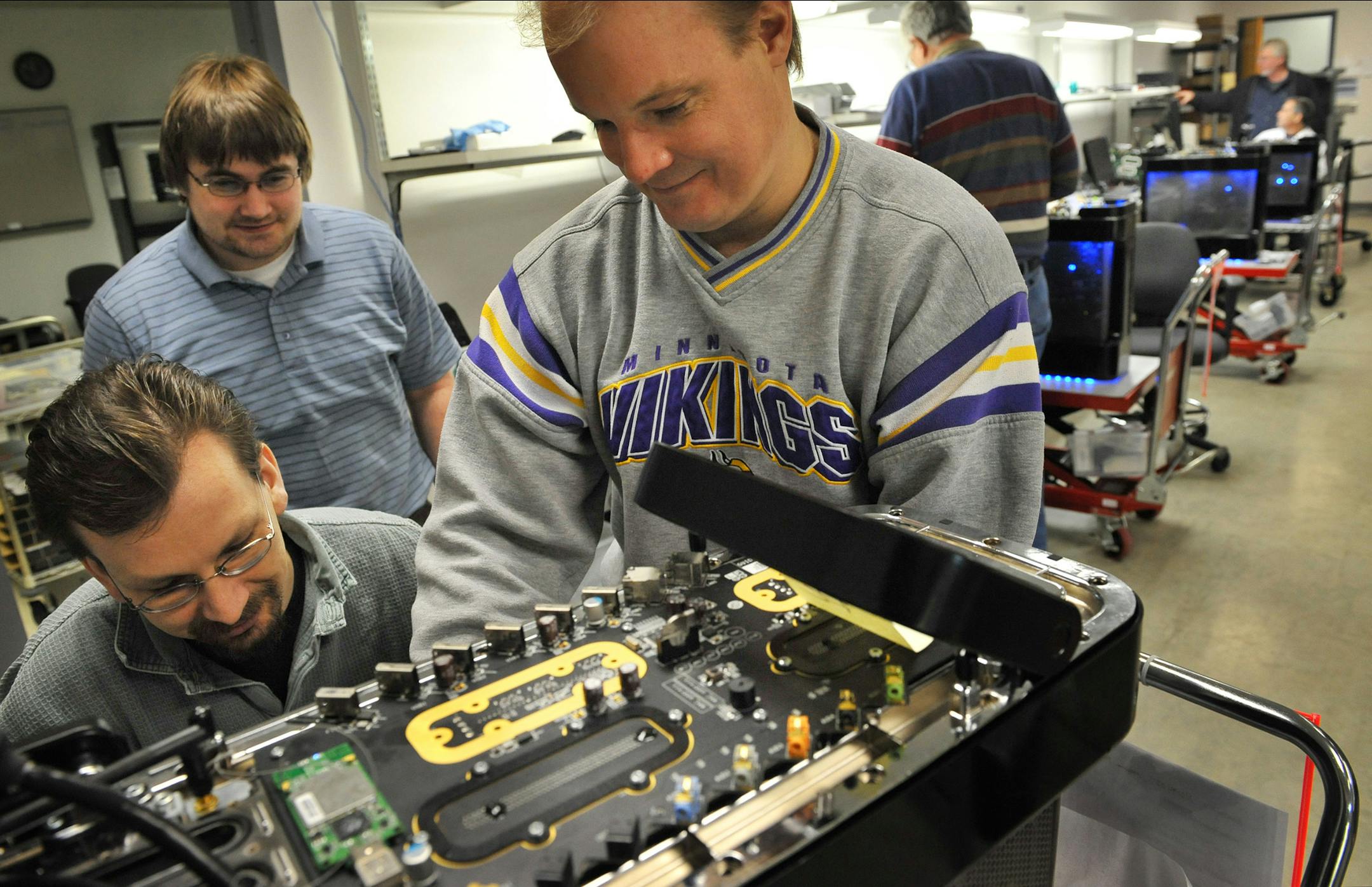
Jerry Bernhagen, left, Jim Wilson and Sean Hocum of Hardcore Computer Inc. prepared a Reactor computer for testing by Maximum PC magazine. The computer's key components are submerged in cooling oil, which allows them to be "overclocked" to run at much faster speeds than conventional air-cooled PCs.
Jerry Bernhagen, left, Jim Wilson and Sean Hocum of Hardcore Computer Inc. prepared a Reactor computer for testing by Maximum PC magazine. The computer’s key components are submerged in cooling oil, which allows them to be “overclocked” to run at much faster speeds than conventional air-cooled PCs. (Star Tribune/The Minnesota Star Tribune)

ROCHESTER - From its large size and sleek aluminum casing to the eerie blue glow emanating from the hard drive, the Reactor is a computer that confidently looks the part.

But for all of its technical aesthetics, the computer's most intriguing feature is the oily, sticky goo enveloping the system's guts, an innovation that's earned Hardcore Computer Inc. plaudits in the high-tech gaming world.

The Rochester-based start-up's "liquid immersion cooling technology" significantly boosts the performance of high-end computers by reducing the excess heat that these power-sucking machines typically generate. As a result, graphics look sharper, audio sounds clearer and hard-core gamers sleep easier (assuming, of course, that they actually sleep.) D5 Ø

High-performance computers make up only 1 or 2 percent of the $100 billion PC market in the United States, according to NPD Group Inc, a research firm based in Port Washington, N.Y. But serious gamers tend to pluck down thousands of dollars each year to upgrade to the newest and fastest equipment, said Dan Mallin, a Minneapolis angel investor in tech companies.

And for good reason.

"They are always trying to win" the game, said Mallin, who is not financially connected to Hardcore.

Gaming "is a massive market," said Hardcore president and co-founder Daren Klum, noting that "World of Warcraft" alone attracts 11 million PC or Mac users. "To push the envelope even on that game, it takes a high-end machine to get the user experience people want. Heat is the biggest limiting factor to computers."

Hardcore's technology is attracting both investors and gaming enthusiasts. Since 2007, the company has raised more than $3 million from firms like StarTec Investments and SDWA Ventures. Reactor has won glowing notices from the G4 cable network and Maximum PC magazine, which described Reactor as "a rig that pushes the boundaries of cool."

But while Reactor's casing is bulletproof, the company clearly is not. Hardcore faces stiff competition from Alienware and Voodoo PC, owned respectively by Dell Inc. and Hewlett-Packard Co. And Reactor's eye-popping price tag -- up to $10,000 -- can seem impractical, especially during an economic downturn. Gamers, for instance, can build computers that cost less than Reactor. Even so, Hardcore has sold dozens of Reactor units since sales began in October.

"The market for high-end PCs and hardware may witness some setbacks during the coming months," said Aimee Roberts, an analyst with research firm Frost & Sullivan. "Avid gamers are increasingly moving toward [home-built] systems, which can ... generate a gaming PC at a fraction of the price." But not a liquid-cooled one.

Back to the future

Frustrated with slow computers, Klum and Chad Attlesey, both avid gamers, started Hardcore in 2006 to build a computer with a cooling system that could eliminate performance-killing heat. Their first prototype, a series of water-filled tubes connected to a heat sink and run through a radiator, was impractical to mass produce, Klum said.

That's when it hit him: "Can't we just dunk it?" Klum recalls asking Attlesey.

As it turned out, Attlesey once worked with the legendary Seymour Cray, the Minnesota computing pioneer considered the father of the supercomputer. Cray founded Cray Research in Eagan. In 1985, the company introduced the Cray-2, a supercomputer immersed in a fluorocarbon coolant.

For Reactor, Hardcore uses an oil-based mineral liquid that does not conduct electricity, meaning the entire motherboard can be submerged in the liquid without short-circuiting. Unlike other computers that use liquid-cooling technologies, Reactor's design allows all of its guts -- voltage adapters, RAM, video cards -- to be cooled, boosting its performance up to 4.0 GHz of processing power.

"Attack of the Show," a popular tech show on the G4 network, tested Reactor and declared it "hands down the fastest PC we have ever seen."

But some industry publications are questioning Reactor's big price tag.

"The gimmick of oil-based cooling doesn't sweeten the deal enough to make this $10,000 machine an instant buy," sniffed PCWorld magazine. "You can find a faster PC that's far easier to upgrade for thousands less."

Hardcore, however, does not envision limiting Reactor's market solely to gaming. The company plans to sell the PC to medical imaging, video production and engineering firms, and to the military, said Hardcore CEO Al Berning.

"It's a perfect two-way play where we get into the market with solid attention to gaming space but also parallel-market to companies that need high-performance computing," Berning said.

As computers become more powerful, they generate more heat. Joy Lindsay, president and co-founder of StarTec Investments, said Hardcore can scale up Reactor and target the large corporate server market.

"We knew that [Hardcore] had a unique technology," said Lindsay, who invested $100,000 in the company. "You have to be intrigued by the idea of some type of oil/mineral-submerged computer. I thought it was a great opportunity."

Thomas Lee • 612-673-7744

about the writer

about the writer

THOMAS LEE, TLEE@STARTRIBUNE.COM

More from Business

See More
card image
card image