

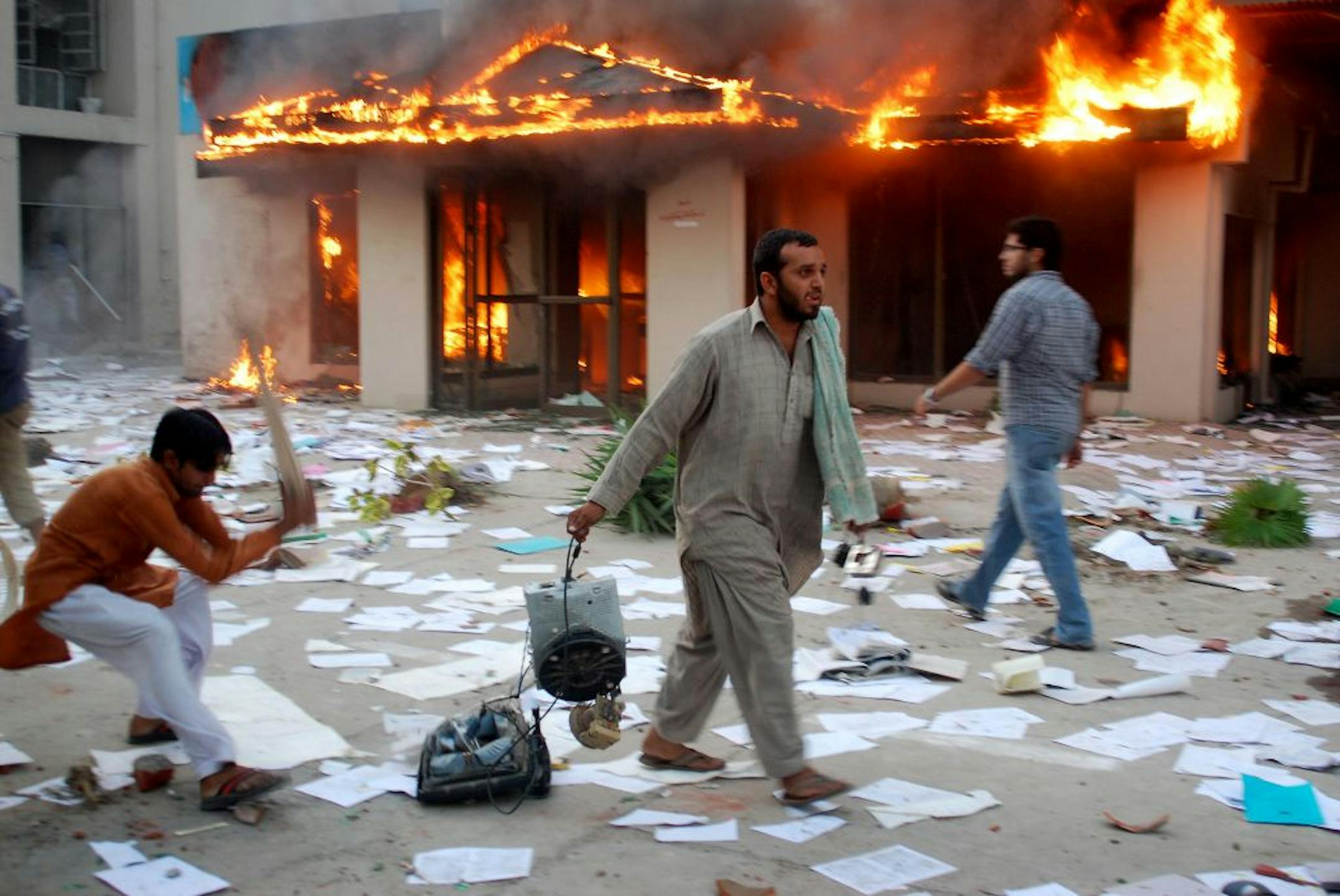
Although Pakistan makes international news for terrorist attacks, anti-American demonstrations and its alleged support for insurgents in Afghanistan, it is the basic inability to switch on a light that is pushing this volatile country closer to the edge. Popular anger over Pakistan's crippling electricity shortage boiled over onto the streets last week, with riots that paralyzed whole cities, unleashing running battles with the police and causing widespread damage to government offices.
It is clear why the people are angry. In many of the towns in revolt, they have gone 20 hours a day without power in still-sweltering Pakistan. What is more, the government of President Asif Zardari has done little as the energy crisis has grown, dithering over its strategy even as it cooks up schemes for new power plants to enrich its cronies. In the process, the government has squandered billions of dollars.
This week's demonstrations were the most serious protests against the government since a movement in 2008 to reinstate a sacked chief justice. The opposition leader, Nawaz Sharif, whose political performance had been lackluster at best, quickly embraced the protesters, quipping that the "Zardari network" is more dangerous to the country than the Haqqani network, an Afghan jihadist group based on Pakistani soil.
The energy deficit, in both electricity and natural gas, means that businesses have to shut for part of each week, forcing many to go bankrupt. Power shortages are estimated to be slicing 3 to 4 percent off GDP.
"The textile industry of Punjab is doomed," said Shabbir Ahmed, chief executive of Bashir Printing, a textile dyeing and printing factory in Faisalabad, in Punjab province. His plant now shuts for two days a week for lack of natural gas. Even when there is gas, he says, the electricity is cut four times a day.
For ordinary people, the frustrations are endless. Refrigerators become useless. Water runs out because it relies on electrical pumps. Children do their homework by candlelight.
Insufficient capacity is not even the biggest problem. That is a $6 billion chain of debt, ultimately owed by the state, that is debilitating the entire energy sector. Power plants are owed money by the national grid and the grid in turn cannot get consumers (including the Pakistani government) to pay for the electricity they use. Last week, the financial crunch meant that oil supplies to the two biggest private power plants were halted, because the state-owned oil company had no cash to procure fuel.
The central government also continues to subsidize the cost of electricity to the tune of billions of dollars a year. That money, say the government's critics, could be better used to pay its bills and thereby free up unused capacity in power plants that are mothballed because of non-payment and disrepair. Cutting subsidies to people's electricity bills, however, could lead to even more unrest. Critics argue that the government's hand-to-mouth policymaking is self-defeating, and illustrates its general lack of planning.


