

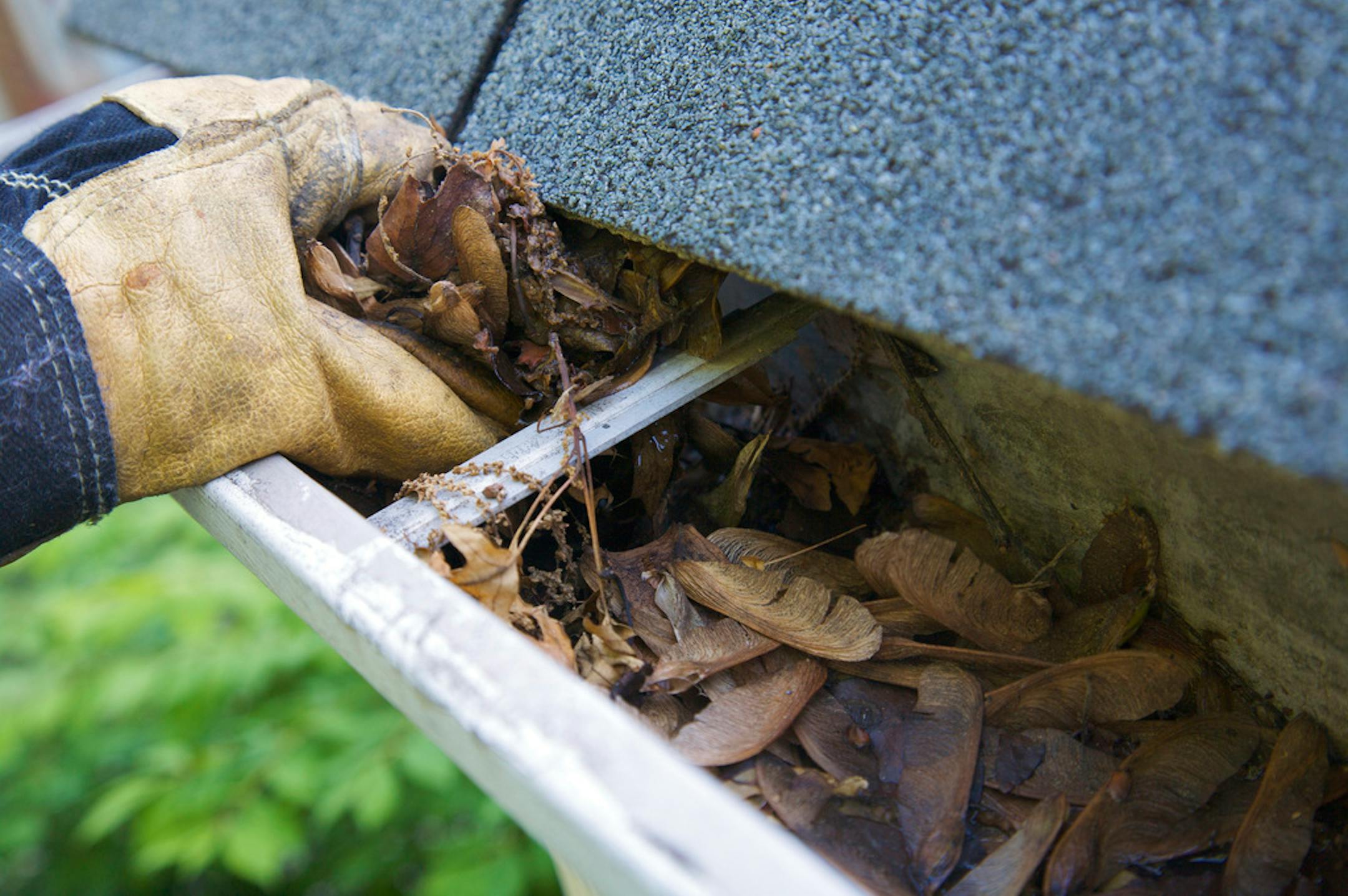
Q: Gutter cleaning companies are always trying to sell me on getting mine serviced multiple times each year. How often should I be cleaning them? And when is the best time to do it?
A: For some houses, a yearly gutter cleaning gutters is sufficient. For others, twice a year might not be enough. The truth is that gutters should be cleaned as often as necessary to keep rain runoff flowing through the downspouts, rather than cascading over the lip of the gutters or backing up and soaking the edge of the roof.
Plugged gutters can lead to all sorts of maintenance issues that cost far more time and money to fix than what you save by skimping on gutter cleaning. When they function correctly, gutters collect water at the edge of the roof and channel it into downspouts, then drain pipes or at least onto ground that should slope away from the house. But if the gutters and downspouts clog, rain just slides off the roof and lands on the ground, splashing mud against the bottom of the walls, causing the paint to peel. Or the water might flow out of a clogged gutter at the low spot, which should be at the downspout but could be in the middle of the span if the gutters have sagged.
When people try to figure out why their basements are flooding, it’s often because downspouts became clogged and the gutters did not function properly. Water in a basement or crawl space can lead to mildew problems in the house and even rot out the roof from underneath, because it travels up through the house as water vapor, then condenses on the underside of the roof sheathing, leaving it damp for weeks in cold weather.
Clearly, it’s important to keep gutters from clogging. But how often to clean really does vary. Nearby trees make a huge difference. Pine trees and virtually all other conifers shed needles year-round, though it’s usually heaviest in the fall. Most deciduous trees — including conifers such as larch, dawn redwood and bald cypress — drop all their leaves or needles in the fall. But a few deciduous trees, such as certain beech and oak varieties, as well as live oaks, southern magnolias and other broadleaf evergreens, shed leaves mostly in the spring when buds for new leaves push the old leaves away. The case for cleaning gutters in the spring in addition to the fall becomes especially strong if you have a lot of leaf drop in spring and nearby trees are also producing a lot of pollen.
Weather patterns also matter. If you live where rain falls almost exclusively in the winter, as in much of the arid West, cleaning gutters just in the fall might be enough. An annual cleaning might also be all you need if you live where storms tend to blow in from the southwest and the tall trees near your house are on the northeast side.
The best way to determine how often to clean gutters is to look at them. But what if the gutters are so high that there is no easy, safe way to inspect them? From the ground, you can look during a storm to see if water is spilling over the gutters. That might happen even with clean gutters during a record-breaking deluge, but if it happens during a typical storm in your area, it could be a sign that the gutters are plugged. Or it might mean your gutter system wasn’t designed correctly and you need more downspouts or deeper gutters that hold more water. If the overflow happened because the gutters sagged, you might just need to add a few more spikes or brackets, but it’s more likely that the existing spikes or brackets didn’t hold because they were fastened to wood that rotted, which can happen if gutters back up repeatedly.
Or, instead of trying to gauge how often to clean gutters by inspecting during storms and hoping you catch issues before problems escalate, you can clean twice a year, or hire someone to do it, and note what each cleaning finds. If you or the pro find a lot of debris in the fall but little in the spring, you have the answer to your question: You probably need to do it just once a year. If there is a lot of debris in both the fall and the spring, try three cleanings next year and adjust your annual maintenance calendar according to what you find.


