

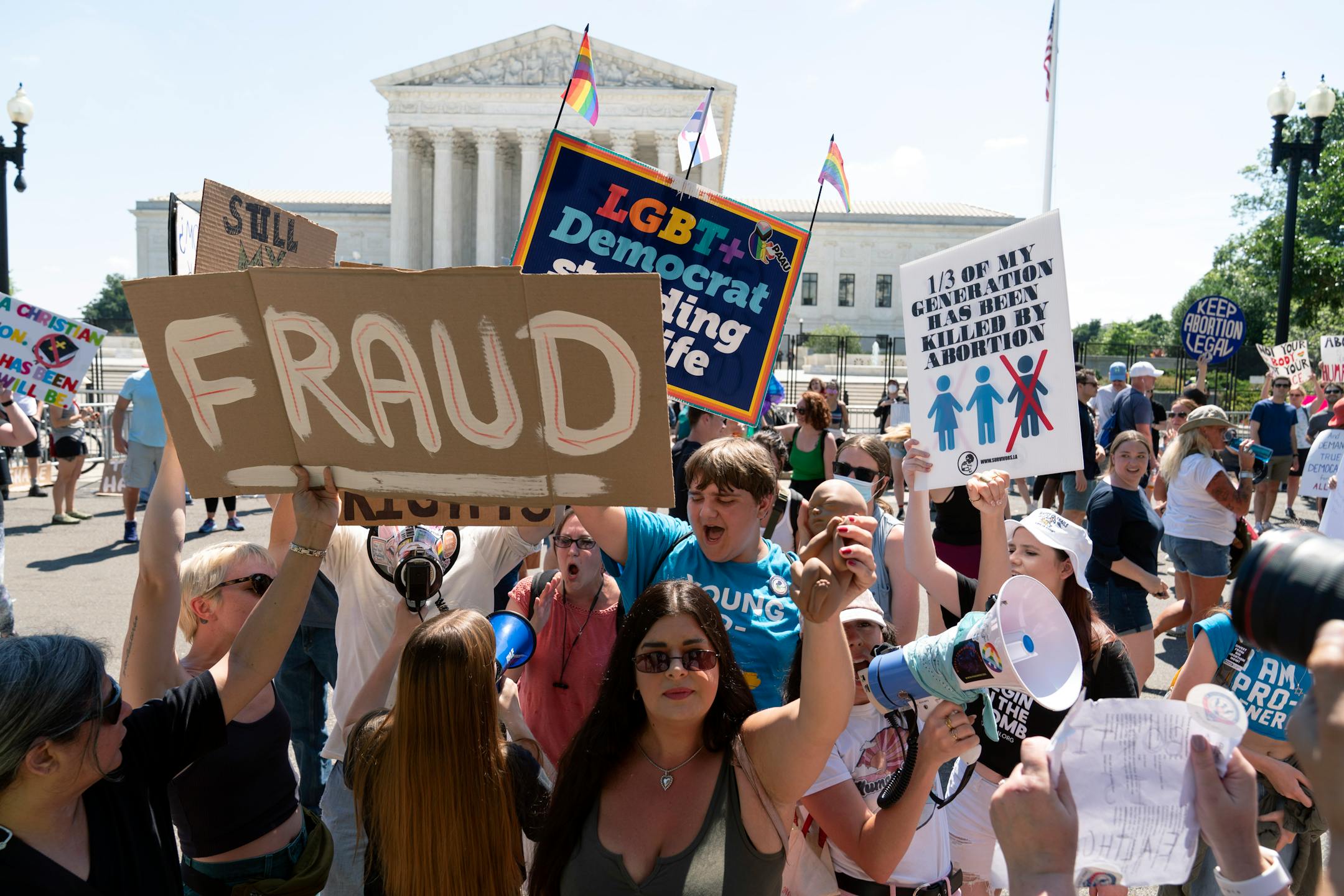
At a Senate Banking Committee hearing shortly after the leak of the Supreme Court draft opinion overturning Roe v. Wade, Treasury Secretary Janet Yellen warned that curtailing the right to an abortion "would have very damaging effects on the economy." Women denied abortions would lose educational opportunities and see their "odds of living in poverty" or their "need for public assistance" rise. And this would have follow-on consequences for their children, who would then "grow up in poverty and do worse themselves."
Yellen's comments offer a useful place to start the final essay in my series unpacking the major abortion rights arguments that have circulated since the Dobbs decision. The first two columns were focused on physical and psychological issues, arguments about the personal burdens borne by women asked to carry unwanted pregnancies to term.
This one will focus more on economic and sociological issues, and particularly the belief that crucial elements in our current American way of life — economic prosperity, female opportunity, social stability — depend on the ready availability of abortion.
This belief has several points in its favor. First is the general reality that, while many other developed countries have somewhat more restrictive abortion laws than the most liberal U.S. states, almost none have the sweeping bans pursued by the anti-abortion movement, the kind that attempt to limit abortion to the most exceptional or dangerous situations. In general, prosperity, modernity and abortion rights policies appear as a package deal.
There are a few notable outliers — Ireland before 2018, Chile for the moment, Poland — but overall, the anti-abortion movement's goals are genuinely revolutionary, even utopian, relative to the pattern of the post-1960s developed world. And a certain skepticism is always appropriate when someone's proposed system doesn't have many existing models and the world as we know it tends the other way.
Then there is the specific evidence that the use of abortion can be associated with better socioeconomic outcomes for individual women. In the last column in this series, I mentioned the Turnaway Study, an investigation comparing the lives of women denied abortions to similarly situated women who obtained them, arguing that its evidence doesn't necessarily support the simple abortion rights frame in which it is often placed. But that study does buttress Yellen's economic claims, showing that women turned away from abortion do face subsequent socioeconomic hardship relative to women who obtain one. So if you simply generalized from those individual outcomes to the societal level, you would expect an anti-abortion society to be somewhat poorer and more stratified.
Indeed, even firm opponents of abortion sometimes allow that this might be the case. In an essay in the New York Times, Matthew Walther argued that opponents of abortion needed to be prepared for the reality that "an America without abortion" might well "mean more single mothers and more births to teenage mothers, increased strain on Medicaid and other welfare programs, higher crime rates, a less dynamic and flexible workforce, an uptick in carbon emissions, lower student test scores and goodness knows what else." The principle that one must not kill an unborn child, he argued, will necessarily disrupt a society built on denying an unborn right to life, and thus opponents of abortion need to be prepared for a difficult transition to the more just and decent society they seek.
There is wisdom in this perspective; a movement with utopian ambitions needs a recognition that it's seeking a genuinely different society as well as a different set of laws.


