
Brown: When constitutional guardrails fail, we all lose

Checks and balances aren’t about politics; they’re fundamental.

Columnist Icon
The Minnesota Star Tribune
October 11, 2025 at 8:30PM
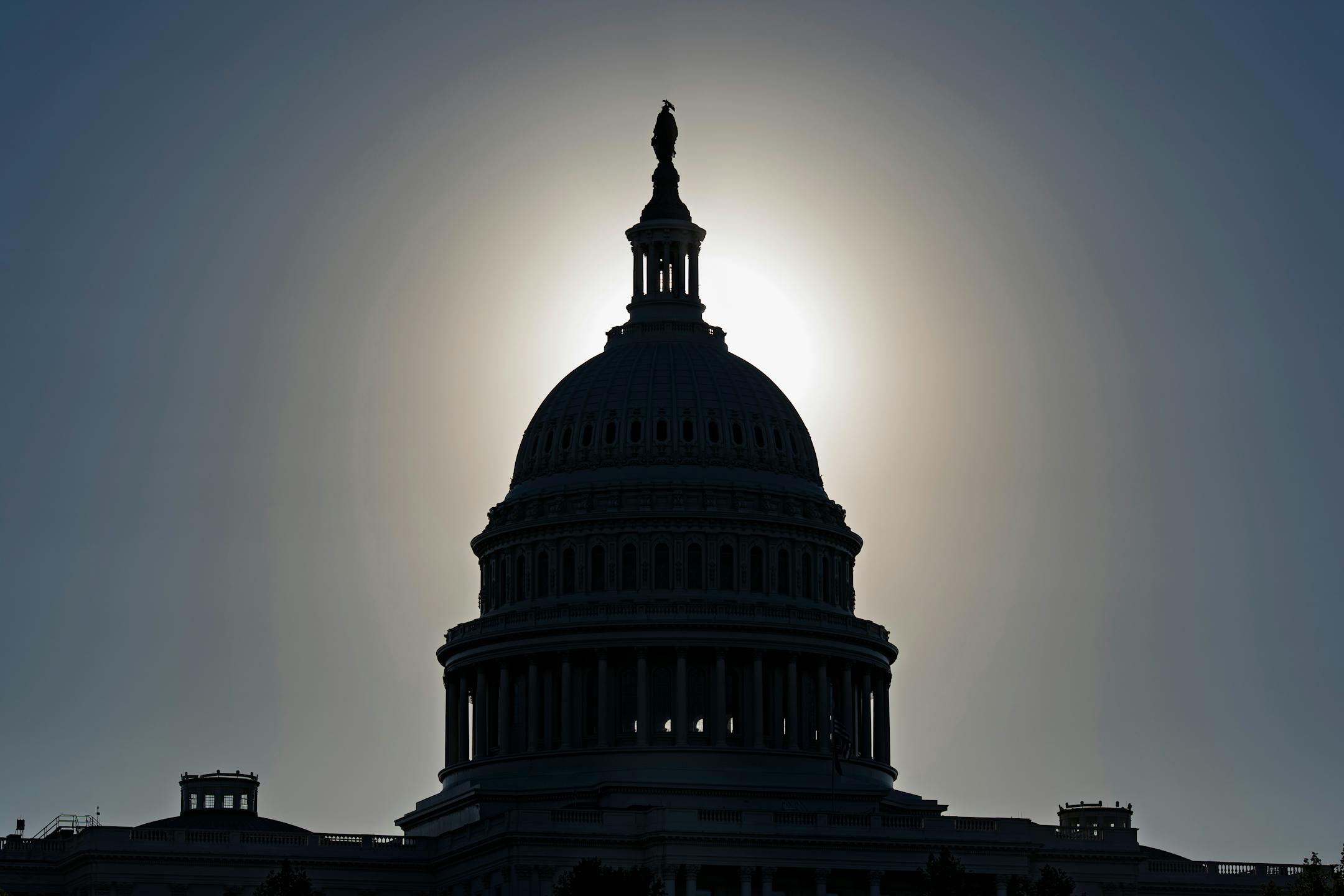
The U.S. Capitol is silhouetted by the glare of the morning sun in Washington, D.C., on Oct. 10. (J. Scott Applewhite/The Associated Press)

Opinion editor’s note: Strib Voices publishes a mix of commentary online and in print each day. To contribute, click here.

•••

Not long before the internet, a traveling salesperson peered through the trailer house door at my unkempt hair and Coke-bottle glasses and told my parents that this boy would need a set of encyclopedias to reach his full potential. The prediction proved true.

The volume covering topics U-V would become my favorite. Under “United States, federal government” I learned about the three branches: judicial, legislative and executive. The Constitution balances the will of the many with the rights of the individual.

After a trip to Washington, D.C., in second grade, the encyclopedia became a playbook. I created a government out of small toys, including a fuzzy owl president (so wise) and complete executive cabinet composed mostly of Happy Meal toys. My congress was representative of what I could rustle up from under my bed.

My parents endured a press conference as I appointed a pink pterodactyl eraser to the Supreme Court.

For the past 10 years, the kid I was then has been screaming from inside of me as the systems that once provided order to our nation have given way to self-serving chaos.

Apparently I’m not alone.

“Not only the norms, but the separation of powers and checks and balances; it’s gotten out of whack,” said Timothy R. Johnson, a professor of political science and law at the University of Minnesota. Johnson has published six books and more than 70 articles about the Supreme Court.

“What’s happening now is more pronounced than anything that’s happened before,” said Dr. Cynthia Rugeley, a native Texan who chairs the political science department at the University of Minnesota-Duluth. “[President Donald Trump is] really just seeing how far he can go with presidential power, and he’s been pretty successful in going a long way.”

It’s important to remember that policy differences, even conflicting values, are a healthy part of American life. When I talk about unprecedented threats to our system of government, I’m talking about the structural framework that has endured almost 250 years. This framework has protected viewpoints across the political spectrum; its inherent rights gradually expanded to all.

But last week, the Justice Department was weaponized to indict political opponents of the president. This happened not because of clear evidence and a carefully built case but because the president publicly ordered the attorney general to do so a few weeks ago.

In previous times, this would have been regarded as obviously illegal, but last year the Supreme Court gave the president substantial immunity in his communication with the Justice Department. Whatever the justices’ intent, they legalized and legitimized the sort of vindictive justice found in authoritarian states like Russia.

This year, the president expanded the use of executive power while the Supreme Court methodically reduced the independent, nonpartisan intent of federal agencies. This makes everything from federal law enforcement to health research more partisan and less reliable.

Finally, the president sent the National Guard into cities where troops weren’t needed or wanted as a display of power and intimidation.

This is bigger than mere politics. What’s happening now will negatively affect everyone at some point, including those whose policy views more closely match the president’s.

As the federal government shutdown grinds into its third week, we are reminded that the congressional oversight of the executive branch has completely failed, and not just recently.

“It’s [Congress’] responsibility to keep a check on this,” said Rugeley. “And they’re not doing it. It’s probably more pronounced now because President Trump is stretching the bounds of executive power, but it’s something [Congress has] been criticized for going back to the 1990s.”

As presidential power grew, President George W. Bush’s administration advocated for the “unitary executive,” a concept now backed by the conservative majority on the Supreme Court, mostly appointed by Bush and Trump.

Trump relies almost exclusively on executive power. His approach to Congress is to threaten opponents with jail and allies with primary challenges. So far, it’s been working.

For Republicans, it might be tempting to say that this is only bad for Democrats, but Johnson warns against that thinking.

“President Trump has more power than any president ever had, but Democrats will have the power to use it next,” said Johnson. “That’s where the real breakdown is, because everyone is going to play in the new system.”

This precise scenario was envisioned by our nation’s founders, which is why they gave so much power to Congress and the Supreme Court.

Simply put, it doesn’t have to be this way.

It’s going to be a long, fraught year before the next federal midterm election, and three years before another presidential election. That’s enough time for things to get worse if Congress and the court won’t do their jobs.

Despite this, Johnson said American elections have the protection of important safeguards that don’t exist in other countries that slid into authoritarianism.

“You can cast aspersions on whether elections are legitimate, but at the local level you have Democrats and Republicans and independents running local elections,” said Johnson. “It is so incredibly decentralized that it’s almost impossible to rig an election. It’s almost impossible to vote illegally, or twice, or if you’re dead. That’s the one place where I think that norms and rules of law will stand up.”

American government has always been messy, and we’ve endured fevers of populist and nationalist movements before. This current moment might be unprecedented, but we can make it survivable for all — no matter our political views.

Looking back, the fundamental flaw in my childhood “government” was that there was only one voter: me. Government works perfectly when everyone agrees, but we never will. Not ever. And that kind of unity carries it own dangers. Thus, we must allow power to shift safely and legally without violence or threats.

about the writer

about the writer

Aaron Brown

Editorial Columnist

Aaron Brown is a columnist for the Minnesota Star Tribune Editorial Board. He’s based on the Iron Range but focuses on the affairs of the entire state.

See Moreicon