

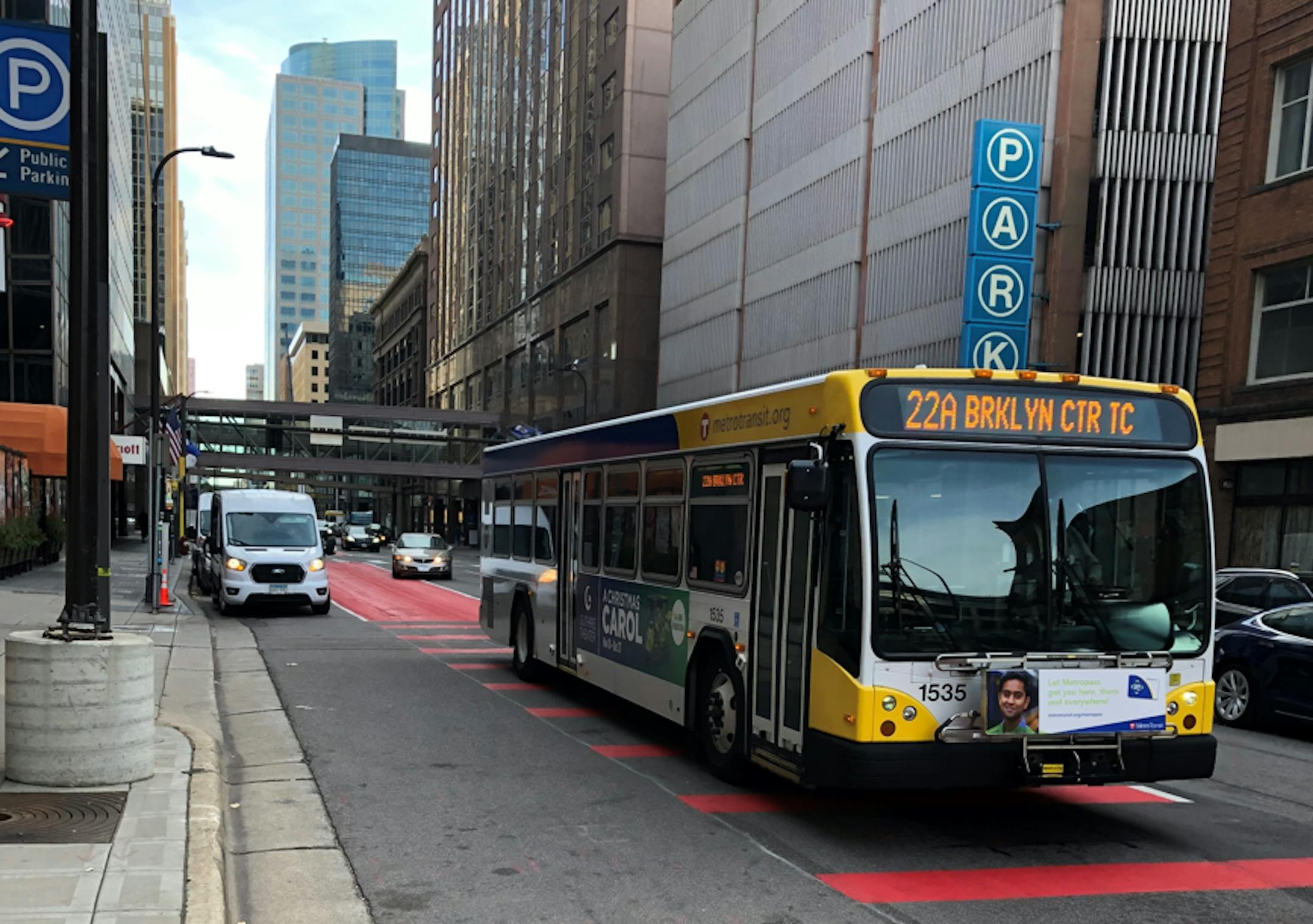
Lanes reserved exclusively for transit buses first appeared on Minneapolis streets about seven years ago as part of a pilot, but are now commonplace on some of the city’s busiest streets.
The lanes painted in red — officially called Transit Priority Lanes — allow city buses to drive in their space and theoretically improve travel times by not having to mingle with other traffic.
You’ll find them on 7th Street in downtown Minneapolis and on segments of Chicago, Hennepin and Lyndale avenues south of downtown. They have been added to a good portion of Lake Street where Metro Transit’s B-Line operates, and on parts of Hennepin and 1st avenues in northeast where the new E rapid transit line will run starting in December. And they arrived in the east metro along much of the Gold Line, the rapid transit line running from downtown St. Paul to Woodbury.
With the network of Transit Priority Lanes expanding, Drive reader Steve Brandt asked about making a turn onto a street marked with one of those bright-red-painted lanes.
“I was taught that when making a left or right turn, one should turn into the nearest lane,” he asked the Drive in an email. “When making a right turn onto a street where the nearest lane is a red bus-only lane, legally should I turn into that lane or the nearest lane to the left of that?”
Similar to interacting with bike lanes marked in green, motorists may use bus-only lanes to make a right turn at an intersection when the lane is designated with a sign permitting the movement, said Pete Hosmer, who runs A+ Driving School headquartered in White Bear Lake.
Bus lanes are painted solid red, but just like bike lanes marked in green, they will have a broken or hashed markings designating the spot where drivers can legally enter the lane to make a right turn.
Signs that say “Buses and right turn only” are often posted to let motorists know it’s fine to do so, said Matt Moseley, supervisor of driving programs at AAA Minneapolis.


![With a light snow falling, it was a perfect day for hitting the slopes at Welch Village ski area Friday afternoon. ] Brian.Peterson@startribune.com Welch, MN - 01/22/2016](https://arc.stimg.co/startribunemedia/WDDT2KH5IGVBQIONI7FDCBPIQA.jpg?&w=436&ar=3:2&fit=crop)

