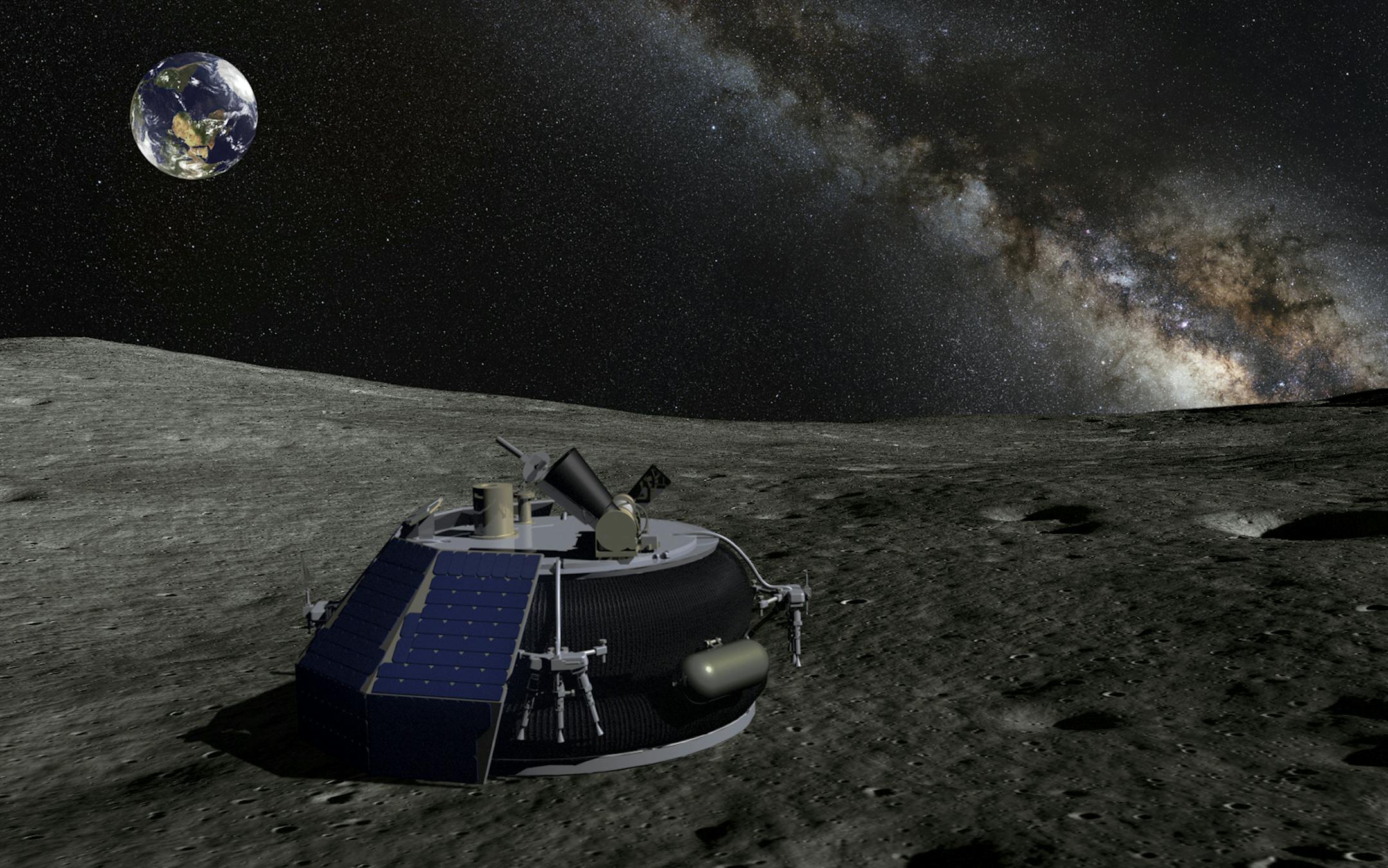
A small start-up has received the green light from the federal government to do something NASA has not done for more than four decades: land on the moon.
Moon Express, based in Cape Canaveral, Fla., announced Wednesday that it had received approval from the Federal Aviation Administration to set a robotic lander on the moon.
That feat would win the Google Lunar X Prize competition for the first private organization to reach the moon and an accompanying $20 million reward.
But more than the prize, company officials say that it will be the opening of a profitable frontier for entrepreneurs. "Rephrasing John F. Kennedy, we choose to go to the moon not because it's easy, but because it's a good business," said Naveen Jain, the Moon Express chairman. "Everything we fight over — whether it's land or it's fresh water, whether it is energy — is in abundance in space." Moon Express has a ways to go before it can reach the lunar surface, which it hopes to do next year. It still has to assemble the lander. The rocket that it plans to launch on has yet to fly even once.
And one of its competitors could beat it to the moon — and to the $20 million.
The approval reflects an effort to encourage 21st-century commercial space endeavors while staying within an international space treaty written 49 years ago when outer space was a rivalry between the United States and the Soviet Union, and the idea of a start-up going to the moon an unlikely fantasy.
"There are a lot of things in the treaties we're testing the limits of right now," said Henry Hertzfeld, a professor of space policy and international affairs at George Washington University in Washington, D.C. "We're trying to define them in ways that will encourage private investment and private opportunities but not violate any international agreements."
At present, commercial ventures have gone as far out as geosynchronous orbit, the telecommunication satellites that fly 22,236 miles above the Earth. Moon Express wants to go 10 times as far, to the moon, a place where just three nations have landed: the United States, the Soviet Union and, more recently, China.