
Burcum: Tears, workarounds and 1990s screens push county staff to the limit

Policymakers know that the operating systems used for Minnesota public assistance programs are antiquated. But I was still startled to see them up close.

Columnist Icon
The Minnesota Star Tribune
September 28, 2025 at 11:00AM
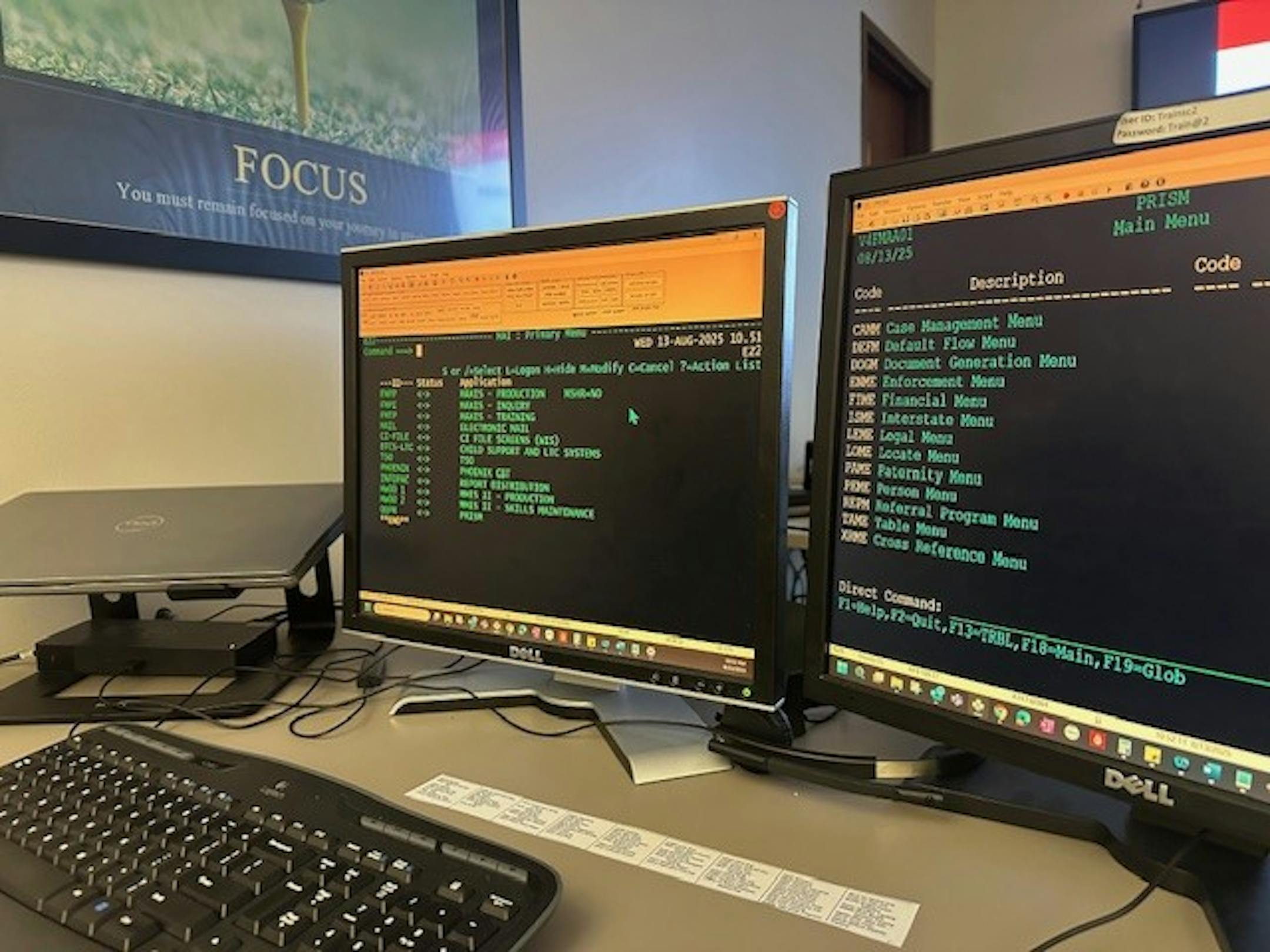
These are the outdated data systems county workers have to use to determine Minnesotans’ eligibility for food, medical and other assistance. (Jill Burcum/The Minnesota Star Tribune)

Opinion editor’s note: Strib Voices publishes a mix of commentary online and in print each day. To contribute, click here.

•••

“Antiquated” is the word often chosen by Minnesota policymakers to describe the information systems used to determine public assistance eligibility.

But it’s one thing to hear about it, and another entirely to see up close just how decrepit and inefficient the systems are, as I did recently.

Former legislator Laurie Halverson understood this too when she became a Dakota County commissioner. She’s now spreading the word in hopes of creating the legislative and executive branch momentum to bring the systems known as SSIS, MAXIS and METS into the modern era.

Or, at the very least, pushing the state Department of Human Services (DHS) to more quickly utilize the nearly $200 million state lawmakers appropriated in 2023 for information technology (IT) upgrades.

That’s why Halverson invited me to take a field trip to one of her south suburban service centers. Waiting inside was a small training room with several of the dedicated county staff who rely on SSIS, MAXIS and METS as they work in child protection and determine needy Minnesotans’ eligibility for food, medical and other assistance.

Their job helping struggling families is already tough. The startlingly dated IT systems processing clients’ information makes it even more challenging.

SSIS, which stands for Social Services Information System, has been employed in case management more than 26 years. MAXIS, an eligibility and public benefits system, clocks in at 36 years. METS, which has a key role in determining eligibility for Affordable Care Act subsidies, is the youngest program, having been in use for over 12 years.

The result is unsurprising: Staffers who are there to help Minnesotans instead spend their days battling systemic slowness, endless workarounds, the need to enter duplicate information, or the inability to add personal information that could change benefit eligibility, such as a family adding another child.

MAXIS requires fluency in cryptic keyboard commands because it’s so old it doesn’t allow for a computer mouse to move the cursor around.

All of this makes it difficult to train and retain workers. Staffers told me tears are an unfortunate part of new recruits’ training process. I believe it.

I came to this as somebody who’s not a techie but has used computers my entire career. Yet sitting at Kathleen Walls’ desk for a MAXIS demonstration was humbling.

Walls, a public assistance trainer for Dakota County, set up a fictional client seeking food assistance.

The first thing you notice is the monochrome interface on Walls’ monitors. I started working in the early 1990s and had immediate flashbacks to Atex, an early newsroom word-processing system used before desktop computers.

My first question to Walls: What year is this? Because it sure looks like it’s 1992.

Walls gave me a knowing smile and then started going through the mysterious maneuvers needed to navigate panel after panel for “a pretty simple case.” She would quiz me periodically.

I couldn’t even hazard a guess. Areas on the screen where key commands are given aren’t made obvious. The “enter” key doesn’t do what it normally does on a modern operating system, and there are two of them that do different things. Walls seemed to be speaking a different language as she whisked through four-letter functions such as FMTP, FMPP or STAT.

“Our training period for financial workers is about four months,” Walls said. “And you can expect to be proficient within one to two years. One year, if you’re a stellar superstar, two years if you’re an average human being.”

Even with mastery, such dated operating systems create a need for workarounds, sometimes including manual processing and specialized tech support. System programming too often does not keep up with changing federal and state policies, requiring staff to research policy and procedural changes by program to ensure accuracy of eligibility results.

I asked Dakota County officials for a rough estimate of inefficiencies’ costs. They said “it’s not possible to measure them all.” But they gave me four examples of inefficiencies occurring in programs using MAXIS and METS and put the cost at $1.6 million a year.

The recently passed “Big Beautiful Bill” will further add checking medical assistance work requirements to staff workload.

The Association of Minnesota Counties (AMC) is sounding the alarm. “The neglect of these system compounded by additional burdens put on by recent state and federal legislation pose a real risk of an entire collapse of our ability to do our mandated functions, and we are not seeing the necessary urgency to tend to these deficiencies,” said Executive Director Julie Ring.

AMC also is pushing the state DHS to move faster on spending the roughly $200 million approved in 2023. A legislative presentation made by DHS in February suggests that just $15.9 million has been tapped.

I asked DHS for comment, and officials said $15.9 million was spent in fiscal 2024. Expenditures increased this year but final data isn’t available.

DHS officials added that about $50 million of the $200 million was for IT projects what is now the Direct Care and Treatment agency. While the remaining $151.9 million may seem like a lot of money, officials said “it won’t address all the identified needs. For example, there was no funding to modernize MAXIS, which is used by state and county workers to determine eligibility for public assistance.”

Rep. Steve Elkins, DFL-Bloomington, visited the same Dakota County training room shortly after I did. He reached out to compare notes. We had the same reaction.

“I knew it was bad. I didn’t realize it was this bad,” he said. Elkins is a subject matter expert, having worked in health information technology.

Legislators should follow Elkins’ lead and pay a visit to county social services staff. You don’t understand the urgency and need for additional solutions until you see harmful obsolescence in person.

about the writer

about the writer

Jill Burcum

Editorial Columnist

See Moreicon