
BNSF, labor union reach tentative deal to allow train operations with 1 employee

Tentative deal with union would permit it, for trains controllable remotely.

July 19, 2014 at 2:56AM
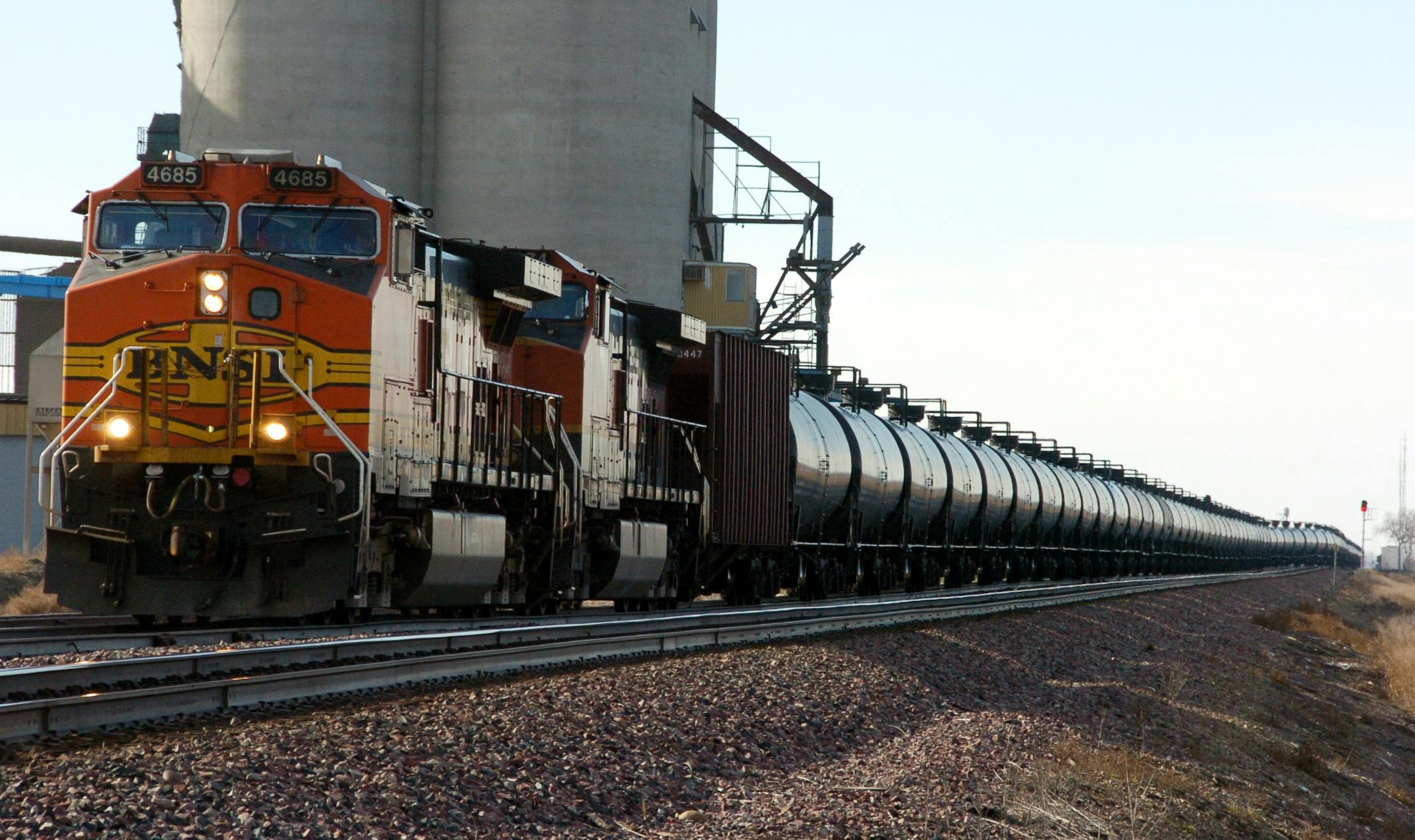
Nov. 6, 2013: A BNSF Railway train hauls crude oil near Wolf Point, Mont.
A BNSF Railway train hauls crude oil near Wolf Point, Mont. (Stan Schmidt — Associated Press/The Minnesota Star Tribune)

One of the largest U.S. railroads and one of the largest labor organizations representing railroad workers have reached a tentative agreement to allow one person to operate a train on routes protected by a new collision-avoidance system required by Congress in 2008.

A BNSF Railway spokeswoman confirmed the agreement with the International Association of Sheet Metal, Air, Rail and Transportation Workers. If ratified by union members, it would cover 60 percent of the BNSF system.

Under the agreement, a sole engineer would operate most trains with the support of a remotely based "master conductor" on routes equipped with Positive Train Control.

The agreement was first reported Thursday by Railway Age, a trade publication.

The union represents roughly 3,000 BNSF employees in far-flung locations from the Upper Midwest to the Gulf Coast to the Pacific Northwest. Some of the cities include Fort Worth, Texas; Kansas City and St. Louis, Mo.; and Tacoma, Seattle, Spokane and Pasco, Wash.

Roxanne Butler, a spokeswoman for BNSF, based in Fort Worth, said the agreement would not apply to trains carrying large volumes of hazardous materials, including crude oil and ethanol.

BNSF, which blankets the western two-thirds of the U.S., is the largest hauler of crude oil by rail in North America.

A Federal Railroad Administration emergency order last August required a minimum of two employees for such trains. Last July, an unattended crude oil train broke loose and rolled down a hill, derailing in the center of Lac-Megantic, Quebec, igniting massive fires and explosions that killed 47 people. A sole engineer was in charge of the train.

The Transporation Safety Board of Canada has yet to release its findings on the causes of the disaster.

Positive Train Control

Congress required the installation of Positive Train Control (PTC) following a head-on collision between a Metrolink commuter train and a Union Pacific freight train near Chatsworth, Calif., in August 2008.

The accident killed 25 people, including the train's engineer, who had been texting at the time of the crash and may have missed a stop signal, according to the accident report from the National Transportation Safety Board.

PTC could have stopped the commuter train before it crossed into the path of the freight train. It also could have avoided a December derailment of a Metro-North commuter train near Spuyten Duyvil, N.Y. Four people were killed and dozens injured when the train rounded a 30 mph curve at 82 mph and jumped the track.

However, PTC likely would not have stopped last year's deadly crash in Quebec.

Most freight trains in the U.S. currently operate with at least two crew members. The reduction in crew size has allowed railroads to dramatically reduce labor costs. As recently as the 1970s, many states required five or six employees to operate every train.

about the writer

about the writer

Curtis Tate, McClatchy News Service

More from Business

See More
The newly renovated Parkway Theater is next door to the new restaurant El Burrito Mercado.
Star Tribune/The Minnesota Star Tribune

The new rule, which goes into effect March 1, says only firms owned by citizens or U.S. nationals will qualify for Small Business Administration loans.

card image
card image