
Brown: Smart forestry saves birds — and people, too

What’s good for the woods is good for the birds, and what’s good for the birds helps keep the natural world — including us — alive and well.

Columnist Icon
The Minnesota Star Tribune
August 27, 2025 at 11:00AM
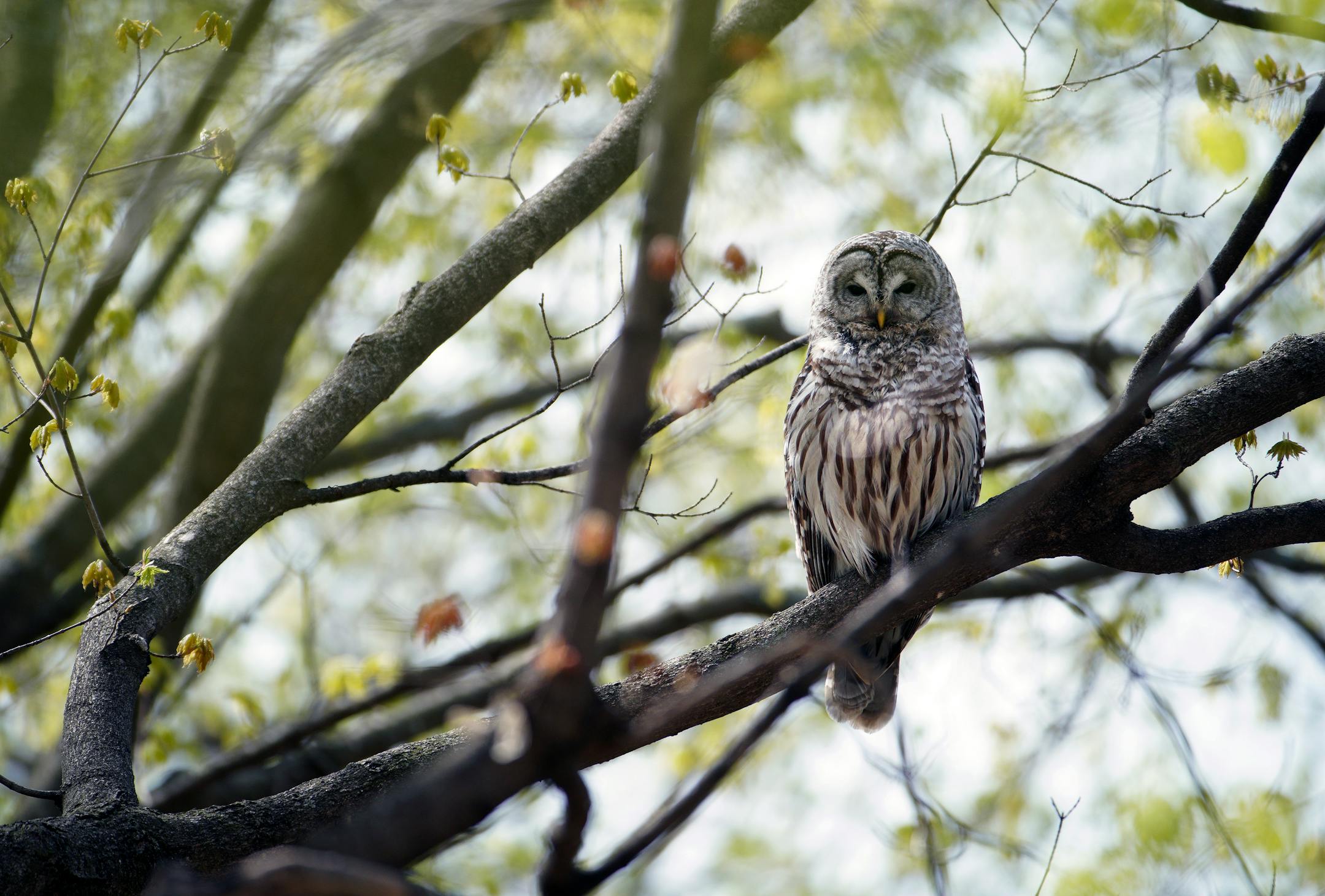
A barred owl watches the forest floor from a perch in a maple tree at the Minnesota Landscape Arboretum. (Brian Peterson/The Minnesota Star Tribune)

Opinion editor’s note: Strib Voices publishes a mix of commentary online and in print each day. To contribute, click here.

•••

I’ve lived in forests my whole life, but until a decade ago I could not have told you what was going on beyond my lawn mower’s reach.

I would have perhaps identified pokey woods, the kind where you scrape yourself all to heck when you lose control of said lawn mower. Deep in the swampy woods, you’re always wet and covered in somebody else’s blood from swatting mosquitoes. Tall and stately cathedral woods feel like church, cloaked in reverence and guilt over any noise your body makes accidentally.

Some trees are pointy and others poofy. Some you can climb up but can only fall down. If the branch is covered in a white substance, you probably shouldn’t stand underneath.

That brings me to birds. Until my son got his first bird feeder eight years ago, I would have told you there are only four types of birds in Minnesota: chickadees, crows, eagles and mystery.

But then, like a magic eye puzzle, staring at birds out the living room window revealed hidden images. That weird chickadee was, in fact, a white breasted nuthatch. Ravens are black, too, but their feathers shine like oily rainbows in early morning puddles. Ravens do not say “caw,” but rather issue stern warnings like my elementary school recess attendant. “Wall, wall, go stand by the wall.”

Even absent-minded bumblers like me can learn, and if you know better you can do better.

That’s the premise behind Forestry for Birds, a national movement that began in Vermont in 2015. After four years of collaboration, this year experts released a guide to promote forestry practices that create and maintain bird habitat here in Minnesota.

That’s not just a big deal for birds, but also for people.

“From an ecological standpoint, birds do a lot of things we don’t know about,” said project co-author Dr. Alexis Grinde. She leads the forest and lands division of the Natural Resources Research Institute at the University of Minnesota Duluth.

Birds help pollinate plants and spread seeds. They cycle nutrients throughout the ecosystem, which is a fancy way of saying that their much-maligned poop holds purpose. Birds kill forest pests like emerald ash borer and spruce budworms, which contributed to forest fires in northern Minnesota this past spring.

As climate change expands the range and population of pests, birds become even more important — but their population is in decline.

“A world without birds would look a lot different,” said Grinde.

North America has lost nearly 3 billion birds since 1970, a quarter of all birds. Destroyed habitat, forest segmentation, changing climate and environmental factors are all partially to blame.

The loss can be reversed, however. We know this because we’ve successfully nursed endangered species like bald eagles and trumpeter swans back to healthy populations. It just takes a little effort.

This work starts in the woods.

Forests cover almost 18 million acres of Minnesota, about one-third of the state’s land mass. Of 250 bird species that nest in Minnesota, 150 nest in those woods.

You can’t address the bird crisis without forestry. The problem is that foresters weren’t communicating as well with wildlife ecologists before both groups started contributing to Forestry for Birds. In one recent example, the U.S. Department of Interior released an internal audit on July 30 that raised some red flags. Fish and wildlife scientists for the Minnesota Department of Natural Resources said they felt pressure to meet timber harvest goals regardless of the impact on local wildlife.

This can happen when forestry and wildlife goals are placed in competition, but Grinde said it doesn’t have to be that way.

“Forestry was developed for economic reasons, but with little tweaks we can add bird diversity,” said Grinde.

Those tweaks might include planting different species in strategic pairings with existing trees, creating gaps in the forest canopy to promote new species in the understory or using logging to mimic the disruption of natural forest fires.

The state and federal government can do much upon their vast lands, but anyone can practice forestry for birds without congressional approval. If you own land, manage your forest with selective harvesting while leaving some habitat behind for birds. This might include some standing dead or fallen trees left in place, or “islands” of trees left within logged-off areas.

If you live near or visit public forests, protect the spaces where birds and other wildlife might dwell.

If you’re not sure how to do good in a world that seems so dark and foreboding, plant a tree and watch what lands on the branches.

“Birds give us clues about how to interact with our environment,” said Grinde. “Secret messages almost. When you unlock that ability you can see so much more. It’s like having a million friends come back to visit.”

about the writer

about the writer

Aaron Brown

Editorial Columnist

Aaron Brown is a columnist for the Minnesota Star Tribune Editorial Board. He’s based on the Iron Range but focuses on the affairs of the entire state.

See Moreicon