

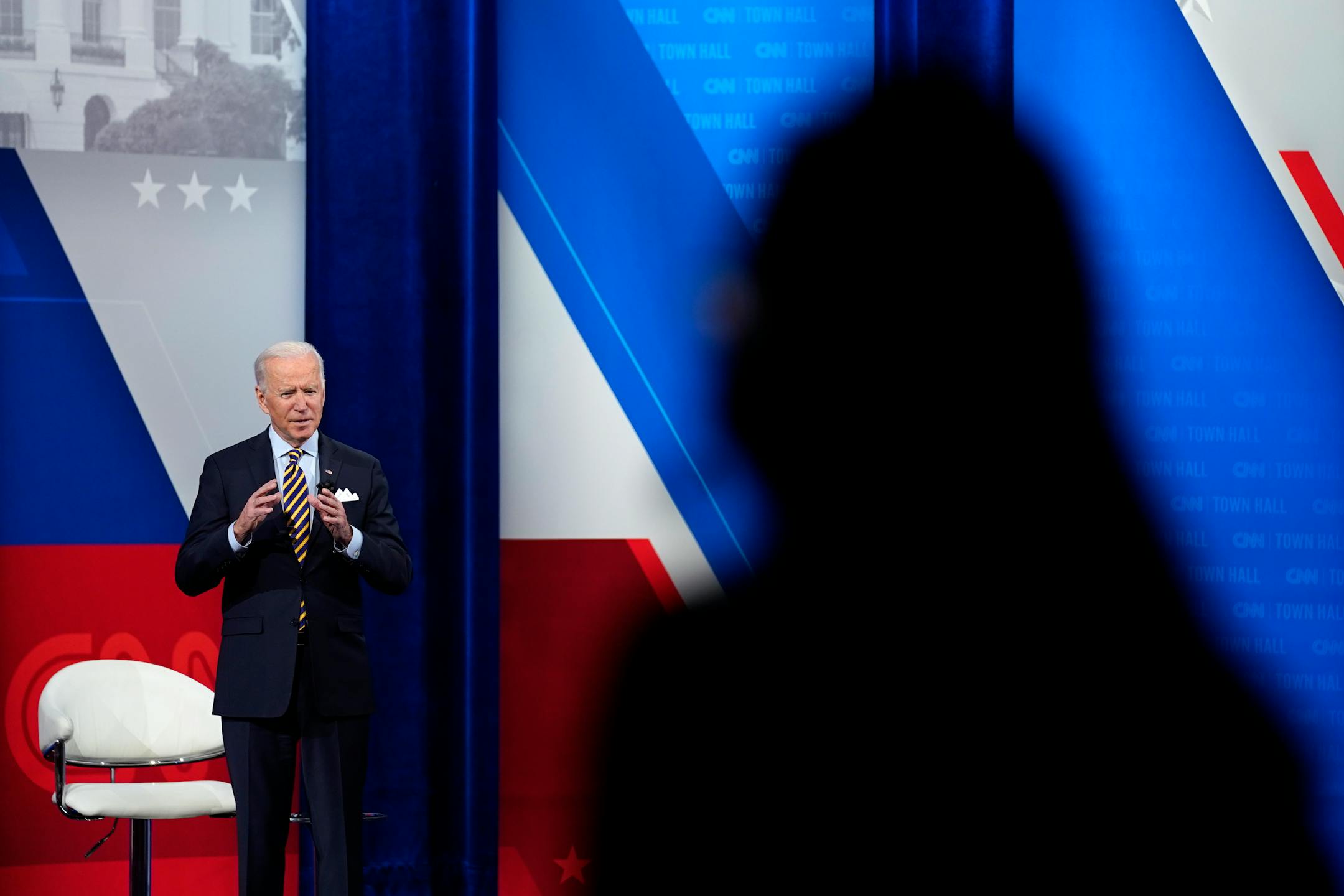
A generation ago, when Bill Clinton wanted to prove to Middle America that he wasn't a cartoon leftist, he publicly bashed a previously obscure Black woman hip-hop artist named Sister Souljah. Last week, President Joe Biden — ever eager to cling to his centrist bona fides while pushing a mostly progressive economic agenda — found his Sister Souljah moment in the hypothetical persona of a young and presumably woke Penn grad demanding taxpayers retroactively finance their elite education.
Indeed, America's new 46th president dropped the healer-in-chief schtick and seemed to get his back up when a young woman at his Milwaukee CNN town hall meeting last week told him that the U.S. $1.7 trillion college debt is crushing the American dream and urged at least $50,000 per student in government debt cancellation, asking, "What will you do to make that happen?"
"I will not make that happen," Biden responded sharply, and then the president — who reveled during the 2020 campaign in the fact that he'd be the first in the Oval Office without an Ivy League degree since Ronald Reagan — pivoted to a tortured explanation of why. He tried to frame the $50,000 debt cancellation, backed by other leading Democrats, as "the idea that I say to a community, 'I'm going to forgive the debt, the billions of dollars of debt, for people who have gone to Harvard and Yale and Penn.' " Then, he rapidly veered away to other laudable ideas like early childhood education and free community college, which — unlike federal action on debt — would require action from our divided Congress.
Biden's answer was chock full of the calculation that one sharpens in a 50-year career as an elected official, and the political logic is understandable. The anti-elitist tone from the University of Delaware grad has always served him well, and fans of Biden, or of realpolitik, would surely argue that rejecting a key item on the progressive checklist offers political cover for the important, left-leaning policy that's most critical for his presidency, the $1.9 trillion coronavirus relief package.
But factually, morally, and on the basics of an issue that's more important to the future of the American dream than our new POTUS seems to realize, Biden got it all wrong last week in Wisconsin — arguably, more wrong than he's been about anything in the first month of a presidency looking to undo the four-year stain of his warped predecessor. Whether Biden — whose capacity to learn, adapt and grow is largely the reason he became president at age 78 — figures out the nation's "college problem" may determine whether his ultimate legacy is mixed, or transformative.
Let's start by noting the huge irony buried beneath Biden's response, which reminded me of Upton Sinclair's famous line, "It is difficult to get a man to understand something, when his salary depends upon his not understanding it." Biden might not hold an Ivy League sheepskin, but during his brief stint between the vice presidency and the presidency he was paid more than $900,000 by Penn for ill-defined work that helped to pump up the Philadelphia university and its public image. Now, one has to wonder if the Ivy seduction of a future president didn't also foster a status quo view of higher ed in America that doesn't comport with the real-world aspirations and struggles of an increasingly desperate middle class.
Here's what people — but, first and foremost, the president of the United States — need to know and understand about a student loan crisis that came from nowhere to become one of our major crosses to bear in the 21st century. First and foremost, the crushing debt burden — which topped $30,000 for the average student in the late 2010s, up sharply since the turn of the millennium — has become the foundational problem for a large swath of young Americans. It cripples their ability to do things that came easily for someone like Biden after graduating from a super-low-tuition University of Delaware in the 1960s — like buy a new home or get married. The negative fallout on the U.S. economy affects everyone — not just the 37% who've been able to earn a four-year degree.
But on Feb. 16, Biden also offered Americans a grossly misleading picture of what the loan crunch is all about. In fact, experts say that just 0.3% of federal student borrowers attended Ivy League schools such as Harvard, Yale or Penn, the ones cited by Biden as motivating his thoughts against sweeping debt relief. Yes, their sticker cost is the highest, but there are just eight Ivies amid the vast sea of 6,000 U.S. colleges and universities. What's more, the much-criticized admissions policies at these elite schools favor the privileged classes that don't need to take out loans, and — aided by their large endowments — the Ivies also tend to offer scholarships instead of loans to the lower-income kids they do accept.


