
Advertisement

Bamboo building into a billion-dollar industry

A Washington state entrepreneur is mixing high-tech science and salesmanship to find new markets for bamboo in the paper industry.

July 7, 2012 at 2:32AM
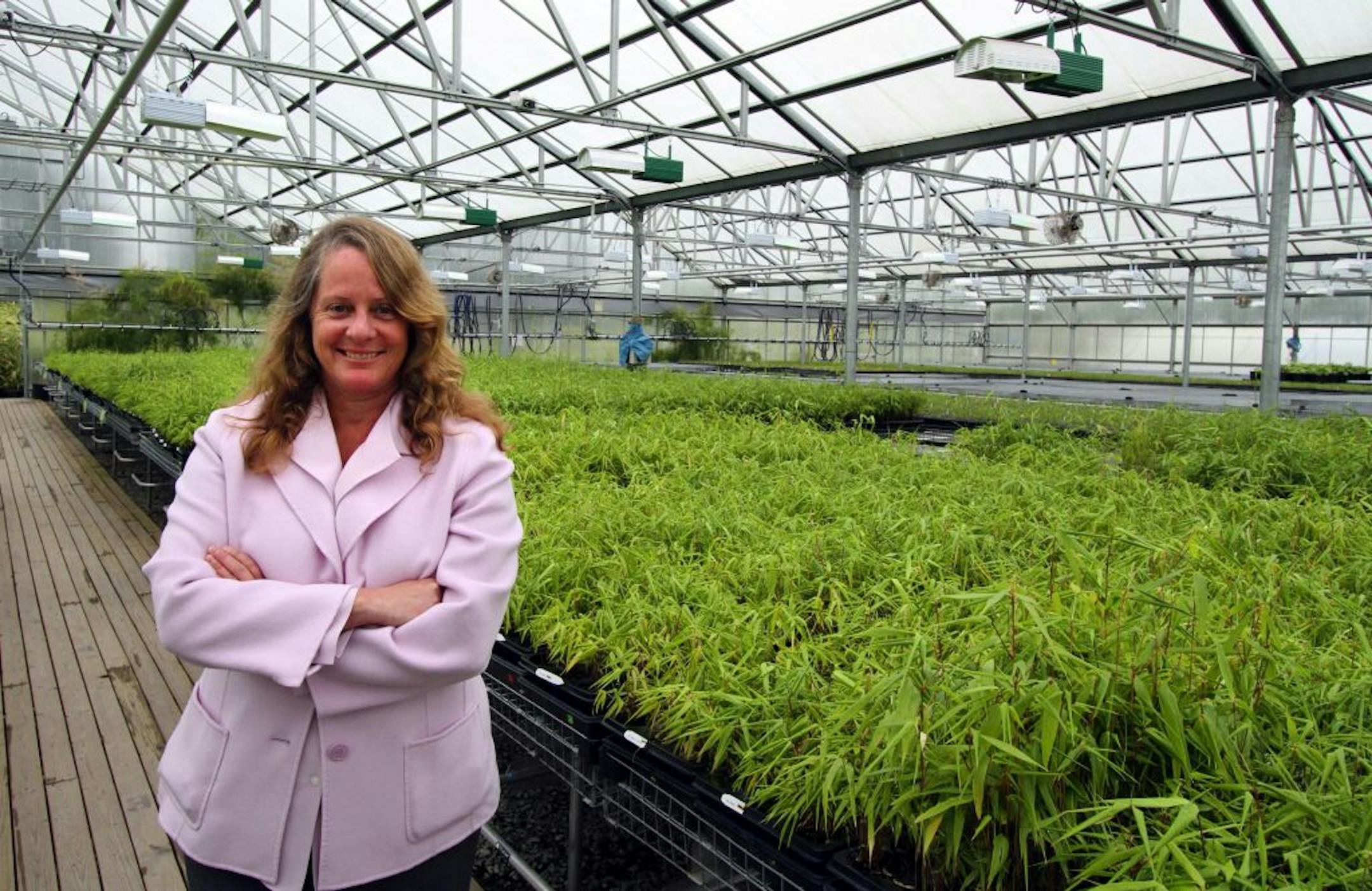
Jackie Heinricher, pictured June 22, 2012, is president and CEO of Booshoot in Mount Vernon, Washington. Here she stands in one of the greenhouses where bamboo plants are started.
Jackie Heinricher, pictured June 22, 2012, is president and CEO of Booshoot in Mount Vernon, Washington. Here she stands in one of the greenhouses where bamboo plants are started. (Mct/The Minnesota Star Tribune)
Advertisement

MOUNT VERNON, WASH. - Jackie Heinricher, Booshoot's founder and CEO, took a deep breath as she walked into a greenhouse full of hundreds of bamboo plants.

The fast-growing bamboo plants pump out more oxygen than trees do, and this concentrated atmosphere makes people smile, she said, so "when this is full, we bring clients in here."

Buttering up visitors with oxygen has helped Booshoot land clients such as Home Depot, Costco and, most recently, Kimberly-Clark, the world's largest tissue manufacturer.

Kimberly-Clark recently announced an agreement to work with Mount Vernon-based Booshoot to develop a mass-market toilet paper using 20 percent bamboo fiber.

Booshoot already produces about 10 million bamboo plants annually and earlier this year signed an exclusive three-year contract to sell ornamental bamboo in Home Depot stores across the nation.

After more than a decade of research, Heinricher and her team of scientists have created an advanced tissue culture system to produce genetically identical bamboo plants at a commercial scale. This new technology has positioned them to infiltrate the forestry market.

"Even if bamboo penetrates just a small fraction of that, it is a multibillion-dollar opportunity," said Pettus Randall, chief operating officer of Booshoot.

But breaking into the market for paper products will be challenging.

Advertisement

"As a whole, the industry is very resistant to taking the first, risky step," said William McKean, a longtime pulp and paper engineering professor at the University of Washington. If one company makes the initial investment, such as creating a bamboo plantation, and demonstrates the product's success, others might jump on board, he said.

"Once somebody is successful, then other parts of the industry tend to follow," McKean said. Executives at Booshoot certainly hope so.

"We see tons of opportunity with this discrete deal, but really this is accelerating a lot of conversations with big players and big markets," Randall said.

Kimberly-Clark already sells toilet paper with 10 percent bamboo fiber in the U.K. but wants Booshoot for the U.S. market.

"We've got to create a viable supply-chain model for bamboo in North America because the bamboo that they are using in the U.K. is the bamboo imported from China," said Suhas Apte, vice president of global sustainability for Kimberly-Clark. "That is not a long-term solution."

Heinricher spends a lot of time in the Southeast, where there are 30 million acres of industrial pine plantations that supply a large part of the U.S. pulp and paper industry.

Advertisement

The Southeast would also be the best place to grow bamboo in the U.S. because of its warmer temperatures and rainfall. She also visits "Paper Valley" in Wisconsin, where major paper companies have operations. Heinricher often finds she must educate paper companies about the benefits of using bamboo.

Upfront costs for bamboo plants are higher than for trees, she said. However, over a 10-year period, bamboo can produce up to 10 times more material per acre than slower-growing southern pine used by many paper mills. Bamboo can also be processed using the same paper-mill equipment as trees.

Bamboo does the planet a favor by removing four times more carbon dioxide than an equivalent amount of trees does, and it produces up to three times more oxygen, according to Booshoot.

Bamboo fibers also are long as opposed to short, which adds strength to products such as toilet paper.

For Kimberly-Clark, the Booshoot agreement is part of a larger sustainability initiative. Last year, the company used 750,000 metric tons of wood fiber from natural forests, but it's pledged to cut that in half by 2025.

"We pretty much lead the world in this technology," she said. "We took an old science and created a new science."

Advertisement

Although running bamboos can spread quickly through their roots, many species of bamboo are in short supply because they only flower and produce seeds every 60 to 120 years.

Now Heinricher can multiply bamboo in days. She takes a sliver of bamboo and puts it in a secret sauce of natural compounds, which causes it to grow so it can be redivided numerous times. She then introduces hormones that create roots. Next, the bamboo plants are put in soil and placed in the greenhouse.

about the writer

about the writer

JOHANNA SOMERS, Seattle Times

More from Business

See More
card image
Glen Stubbe/The Minnesota Star Tribune

Jeff Anderson & Associates paid a ransom to the hacker in turn for guarantees that the data would be destroyed.

card image
Advertisement
