Audit: Minneapolis didn’t violate policy in federal raid

City auditor says that while the response to the federal raid was overall coordinated, council members were left in a “void” of information.

The Minnesota Star Tribune
August 5, 2025 at 9:55PM
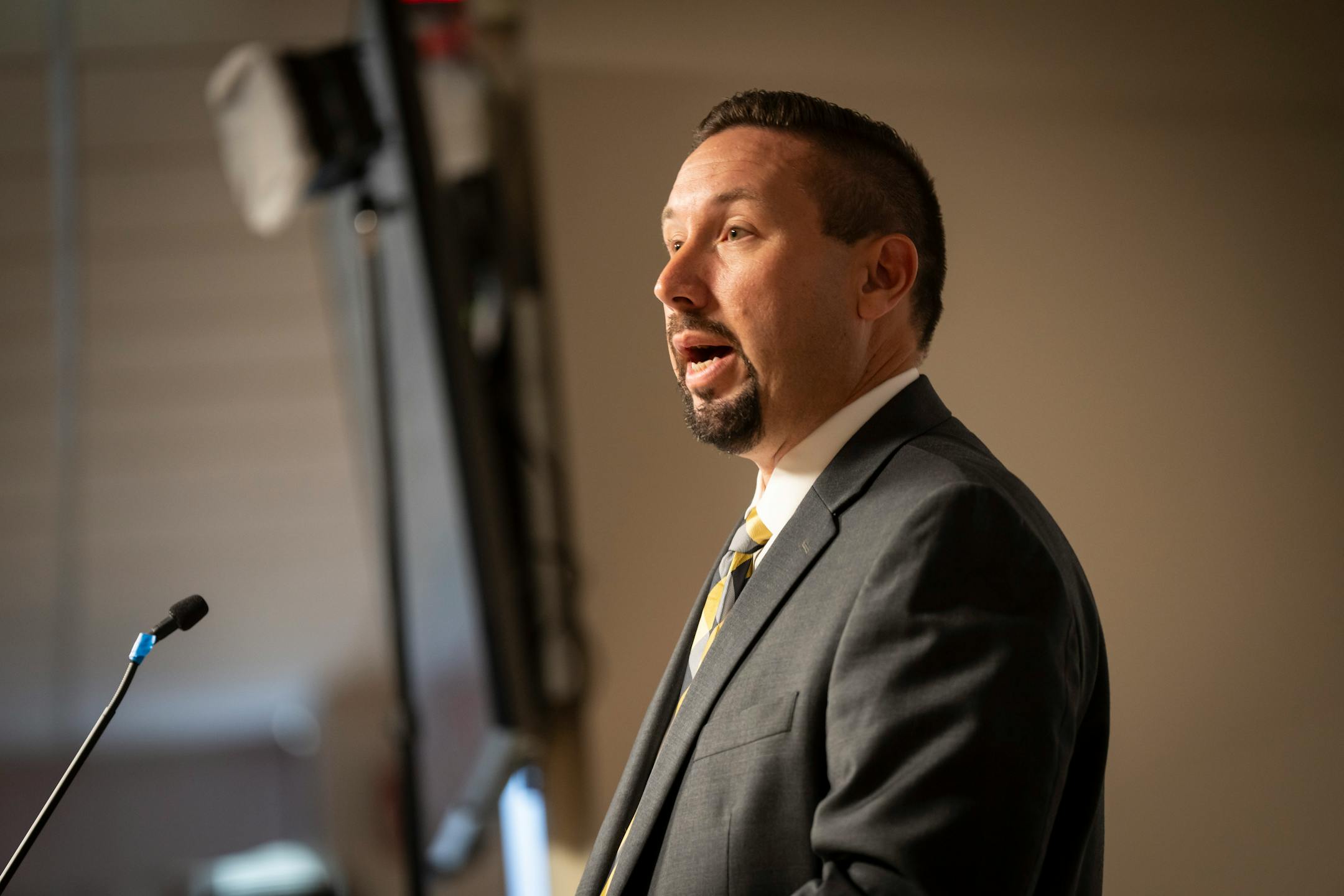
Minneapolis City Auditor Robert Timmerman speaks on the review of the Lake Street and Bloomington Avenue federal law enforcement raids in June at the Public Service Center on Tuesday in Minneapolis. (Renée Jones Schneider/The Minnesota Star Tribune)

The Minneapolis city auditor found the city did not violate its ordinance prohibiting assistance with immigration actions when police acted as crowd control during a June federal operation at a Lake Street Mexican restaurant.

However, his report also found shortcomings with how the city communicated the incident — initially misconstrued as an immigration raid — with council members, and a need to better prepare a response plan should such an operation occur.

The findings were reported Tuesday to the Minneapolis City Council regarding the June 3 operation. On that morning, military-gear-clad federal officers marched along Lake Street along with armored vehicles in order to serve a criminal search warrant at the Las Cuatros Milpas restaurant at the intersection of Bloomington Avenue. Officials have said the warrants were connected to a “transnational criminal organization” suspected of drug and human trafficking, and money laundering.

The raid included officers from the FBI, IRS and DEA, and Immigration and Customs Enforcement (ICE).

The inclusion of ICE alarmed many residents who protested in the street and believed the operation was focused on picking up undocumented immigrants for civil deportation. The city has a “separation ordinance” which prohibits police or city workers from assisting with civil immigration enforcement carried out by federal agents.

On the day of the Lake Street raid, federal officers serving a search warrant in a different part of the state arrested the owner of Las Cuatros Milpas, whose official name is Francisco Estrada-Deltaro but has used multiple aliases, according to prosecutors.

Estrada-Deltaro, who was born in Mexico, was placed in ICE custody for weeks before getting moved to Sherburne County jail on a criminal charge of illegal re-entry after being deported previously several times. He also has a criminal record that includes a 2022 conviction for making “threats of violence.”

Minneapolis Mayor Jacob Frey criticized council members the day after the raid, saying they spread misinformation implying it was an ICE raid in social media posts.

On the day of the raid, Council Member Jason Chavez and two other council members visited the site. According to the audit, he was told at 10:39 a.m. by Minneapolis police that it was not an immigration operation.

He then posted a few minutes later on social media that: “They tried [to] lie about an ICE presence,” and that Minneapolis police assisted with closing off the area.

The audit found that the statement, and others made that day by council members and the mayor’s office, were truthful.

“We verified statements to be factually accurate at the time they were said or otherwise communicated,” City Auditor Robert Timmerman said. “We do, however, hold space for differing viewpoints and interpretation of the events that were unfolding.”

People confront law enforcement as they try to remove someone they detained outside Las Cuatro Milpas restaurant. (Elizabeth Flores/The Minnesota Star Tribune)

Police Chief Brian O’Hara has said it was necessary police act as a barrier to ensure the safety of both the residents and the federal officers to escort them out of the city. Following the raid, police reiterated that police cannot assist with civil immigration enforcement but that officers will respond to 911 calls, “threats to life or property” or to “ensure public safety” at protests.

But some residents and immigrant-rights activists have remained skeptical and said at a Tuesday news conference the operation made them concerned the city would fail to uphold its separation ordinance should ICE carry out an immigration raid.

Frey wrote in a statement Tuesday that he appreciates the auditor’s report and that it reinforces transparency and accountability.

“Facts matter. In moments of crisis, our residents deserve clear, accurate information,” Frey said. “This audit confirms that the City did not violate its Separation Ordinance and acted with integrity, keeping public safety front and center.”

The report confirmed that Minneapolis police did not question anyone based on their immigration status, and that officers were not “directly” involved in the investigation.

Minneapolis police were sent to act as crowd control after the operation started, which included federal officers and protesters clashing in the street.

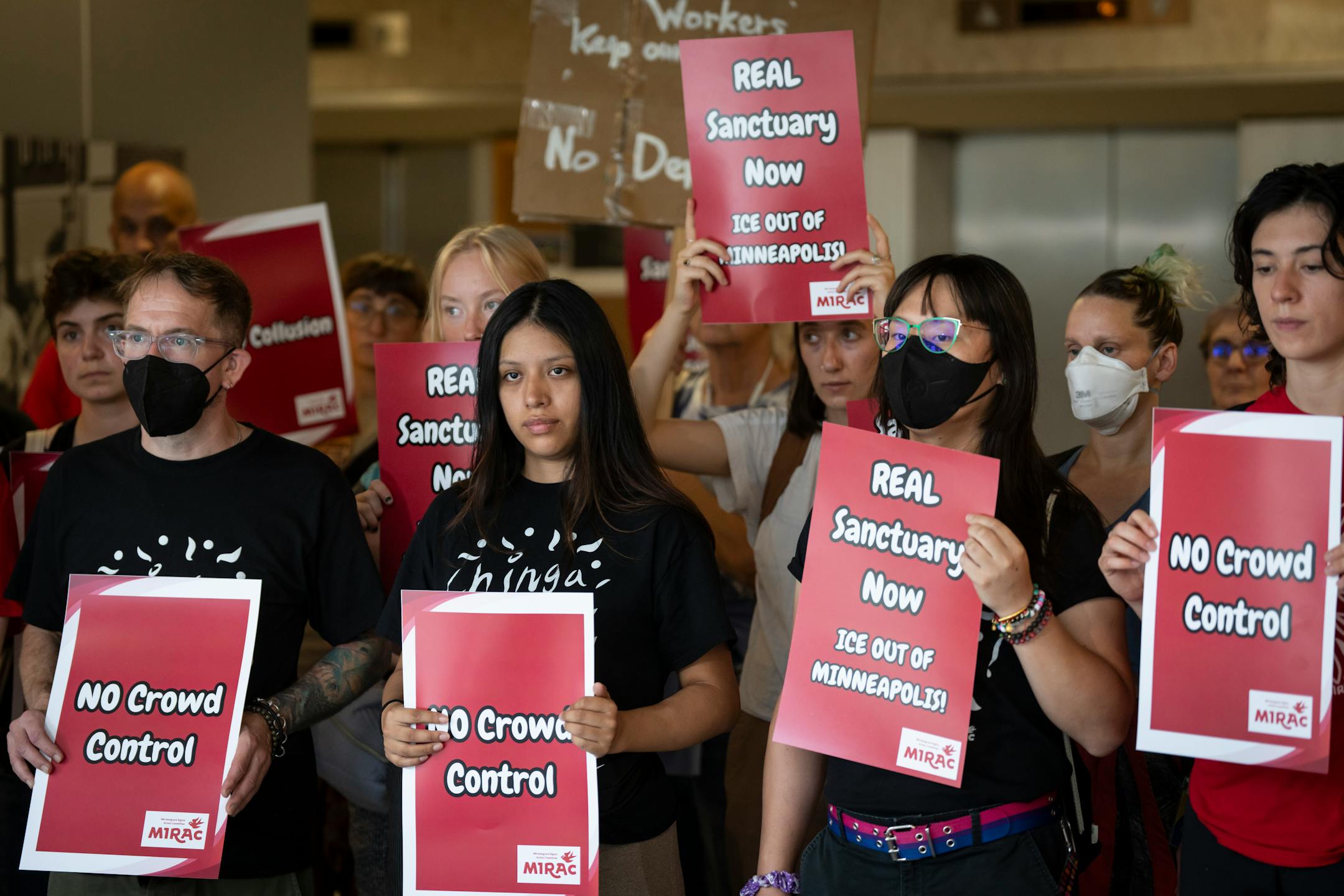
Protesters with Minnesota Immigrant Rights Action Committee hold signs during a news conference before the Minneapolis City Council meeting where City Auditor Robert Timmerman released a review of the federal law enforcement raid in June, at the Public Service Center on Tuesday in Minneapolis. (Renée Jones Schneider/The Minnesota Star Tribune)

On Tuesday, Timmerman laid out a timeline of the communications on June 3, including when officials learned of the raid and when they learned it was a criminal operation.

One of the takeaways was that — although police posted at 12:43 p.m. on the platform X that it was a criminal operation — city administration did not notify the City Council members of the operation until 1:50 p.m., nearly four hours after police were informed of it. Those council notifications were not sent until the federal agents had left the scene, Timmerman added.

“Federal agents concluded their enforcement actions and left the scene before the full council was even formally notified, council members were left with a void of information and an urgency to respond to constituent concerns,” Timmerman said at the meeting.

In response to the report findings, a city spokesperson said it was necessary for the administration to confirm the accuracy of their information of the federal enforcement before sending it out to the full City Council and the public.

“During quickly unfolding and escalating situations, it is prudent to confirm the accuracy of information before it is shared publicly, and sometimes that takes time,” the spokesperson said.

According to the timeline provided by the City Auditor’s Office:

  • Just before 10 a.m. - Minneapolis police made aware of operation.
    • 10 a.m. - O’Hara is made aware.
      • 10:45 a.m. - Frey is made aware.
        • 11 a.m. - Frey convened a “situation call” to learn it was not an immigration raid.
          • 11:14 a.m. - FBI requests Minneapolis police assist with crowd control.
            • 11:30 a.m. - Minneapolis officers arrive.
              • 12:39 p.m. - Report made of a civilian injured.
                • 12:43 p.m. - MPD posts on X that it’s a criminal federal operation.
                  Minneapolis Council Members Aisha Chughtai and Jamal Osman listen as Minneapolis City Auditor Robert Timmerman speaks on the review of the federal law enforcement raid in June at the Public Service Center on Tuesday in Minneapolis. (Renée Jones Schneider/The Minnesota Star Tribune)

                  Timmerman said his office recommends the council and Mayor’s Office develop “communication sequencing protocols” to notify the council during incidents of “great public interest” and “especially those that can lead to civil unrest.”

                  Chavez said at the meeting he thinks it’s “alarming” that it took as long as it did for the full council to be formally notified.

                  Three council members visited the Lake Street operation that day, along with their aides. In the report, it states those aides participated in the demonstration and “either made physical contact with federal law enforcement officers or were extremely close in proximity to them.”

                  The report says that “nuances exist” that lead to those interactions not being a clear violation of the city’s code of ethics or other policies.

                  Although the audit found areas to improve when the council is informed, Timmerman said the city’s response was overall “coordinated and executed within the parameters of current city policy importance.”

                  about the writer

                  about the writer

                  Louis Krauss

                  Reporter

                  Louis Krauss is a general assignment reporter for the Star Tribune.

                  See Moreicon

                  More from Minneapolis

                  See More
                  card image
                  Jeff Wheeler/The Minnesota Star Tribune

                  From Winona State University to Augsburg University and the U, professors are helping students wrestle with misinformation and disinformation.