Bitter divisions over power company sale

The parent company of Minnesota Power says its proposed sale to a private equity group would supply cash for the state’s carbon-free law. Critics say private control of a utility is bad for customers.

The Minnesota Star Tribune
August 26, 2025 at 11:00AM
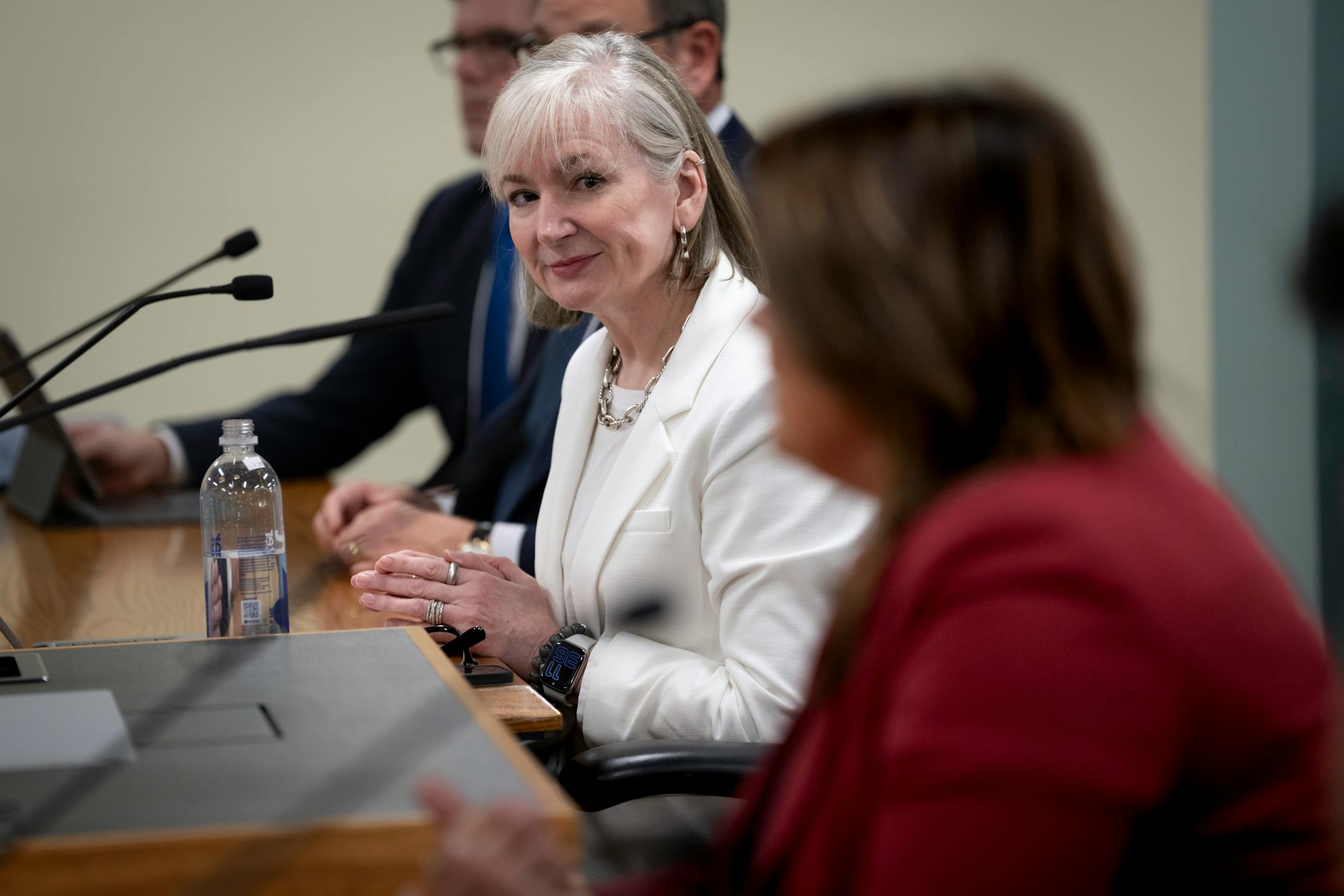
Allete CEO Bethany Owen listens during a Minnesota Public Utilities Commission meeting in St. Paul on May 9, 2024.
Allete CEO Bethany Owen during a state Public Utilities Commission meeting in 2024 about the company's pending sale. (Renée Jones Schneider/The Minnesota Star Tribune)

In the debate over the future of northern Minnesota’s largest power company, the rhetoric has turned nasty.

The Minnesota Public Utilities Commission (PUC) will decide in October whether to approve the $6.2 billion sale of Duluth-based Allete, parent company of Minnesota Power. The case, which has drawn growing national interest, is about what’s best for the 150,000 customers of Minnesota Power.

But the acrimony also reflects larger tensions among left-leaning advocacy organizations. Some hope to guarantee money for the infrastructure costs of a carbon-free grid. Others want to block private equity, for them a symbol of capitalism run amok, from taking control of a power company.

In comments to the commission, one clean energy advocacy group accused others of “not knowing anything” about the case. Allete criticized an administrative law judge as being “one-sided” and “completely ignoring or trivializing” arguments in favor of the deal.

The companies that operate northeast Minnesota’s taconite mines, paper mills and oil pipelines said Allete and its buyers were acting “insolently” and “demonstrating an utter lack of respect for the Minnesota regulatory process.”

The comments give a view into a struggle for an upper hand in a deal that would take the publicly traded company private under an ownership group led by a subsidiary of BlackRock, the world’s largest asset manager.

“Do we want regulated monopolies that provide an essential service like electricity that we all depend on to be owned by huge private equity firms?” said Brian Edstrom, an attorney for the Citizens Utility Board of Minnesota, which opposes the sale.

Sydnie Lieb, an assistant commissioner at the Minnesota Department of Commerce, said only a handful of U.S. utilities have been purchased by private equity, and none in Minnesota.

“This is a fairly novel thing,” she said. “I think there’s a lot of uncertainty for folks about how this is going to work.”

Allete’s hunger for clean-energy capital

Under the deal announced in May 2024, the New-York based infrastructure firm Global Infrastructure Partners (GIP) would own 60% of Allete, while the Canada Pension Plan Investment Board (CPP) would own the rest. GIP is a subsidiary of BlackRock.

From the start, Allete said the deal was necessary to clear the biggest hurdle for complying with Minnesota’s carbon-free law - cash.

Allete says it will spend more than $4 billion on its utility infrastructure over the next five years, primarily on transmission lines, solar, wind and large-scale batteries as the company seeks to shutter a large coal plant in Cohasset.

Coming up with that kind of money in public markets would be challenging, Allete argues, and could slow its progress on clean energy goals. For example, fluctuating interest rates can chill the appetite of investors.

Jonathan Bram of Global Infrastructure Partners and Palak Trivedi of Canadian Pension Plan chat with Allete CEO Bethany Owen after a Minnesota Public Utilities Commission meeting to discuss the sale of Minnesota Power, in St. Paul on May 9, 2024. (Renée Jones Schneider/The Minnesota Star Tribune)

Minnesota Power is also unique because most of its electricity is sold to those large industrial customers. The company said public investors might not want to offer vast sums to a utility weathering a downturn in natural resource extraction.

Earlier this year, Cleveland-Cliffs, the utility’s second-largest customer, idled two mines in the region. Minnesota Power’s largest customer, U.S. Steel, told the Minnesota Star Tribune it’s exploring other ways to get power after an electric supply contract ends in 2029.

Amid the turbulence, GIP is promising money but also patience, saying it’s willing to recoup the cost of infrastructure from Allete customers over time.

“In the public market, investors are making decisions quarter to quarter,” said Jennifer Cady, Allete’s vice president of regulatory and legislative affairs. “We have two sophisticated partners who are looking long term.”

Skeptics warn against private equity

Most opponents of the sale support Minnesota’s carbon-free law. That includes Attorney General Keith Ellison, the Citizens Utility Board and several environmental nonprofits.

Those groups contend BlackRock’s money is not the only way to ditch fossil fuels.

Edstrom said the buyers would pressure regulators to increase electric rates after paying a premium to buy Allete. If those aren’t granted, the buyers could cut costs, slow spending to focus on other investments or quickly sell, Edstrom said.

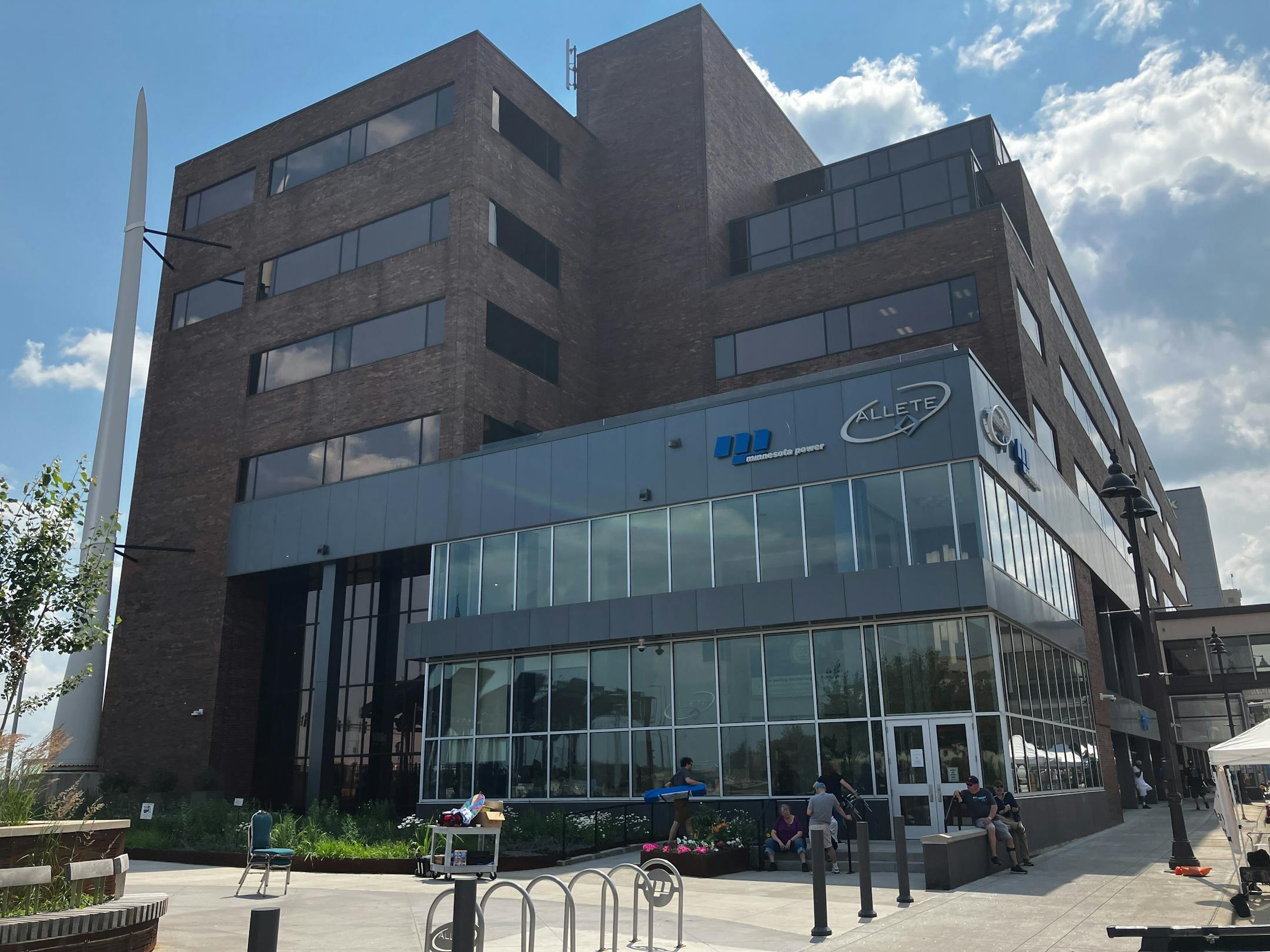
Allete and Minnesota Power headquarters in Duluth, pictured in 2024. (Brooks Johnson/The Minnesota Star Tribune)

In mid-July, opponents of the sale scored a win. A Minnesota administrative law judge issued a nonbinding opinion opposing the transaction.

Judge Megan McKenzie wrote that the buyers intend to “pursue profit in excess of public markets” and that there are cheaper routes to carbon-free energy.

McKenzie wrote that the transaction could result in higher electric bills, along with other potential risks, such as less transparency and the potential for self-dealing if the buyers steer contracts to favored companies in their investment portfolios.

“Ultimately, even if declining to approve the Acquisition eventually resulted in some complication or short delay in Minnesota Power meeting the Carbon Free Standard, this is not a reason to approve the transaction given its serious risk to Minnesota ratepayers,” McKenzie wrote.

Hard feelings and accusations

This judge’s ruling is part of what touched off the unusually heated conflict in Minnesota’s energy sector.

In a filing at the PUC, Allete and its buyers said the opinion was copied nearly word for word from opponents of the sale.

The groups said the judge showed a “lack of care” in summarizing the debate and was dismissive and insulting to many Allete supporters in northern Minnesota. Allete and the buyers argued McKenzie relied on stereotypes of private equity, and that most of the buyers’ money comes from pension funds.

“They are not the kind of investors that flip companies,” Cady said in an interview.

The Laborers’ International Union of North America (LIUNA), one of several construction unions who support the deal, told the PUC that nobody can describe McKenzie’s report as thorough “with a straight face.”

In response, Minnesota Power’s biggest customers told the PUC that Allete and the buyers were “insolently” taking issue with nearly every aspect of the judge’s opinion, in “petulant commentary that appears to be an attempt to browbeat the state into accepting the Proposed Acquisition.”

Gov. Tim Walz’s Department of Commerce, which represents consumers at the PUC, initially opposed the deal. But the agency changed its stance after striking a deal with Minnesota Power.

The utility agreed to a one-year freeze on electric rates and a slight change to a profit metric that will trim customer bills. Allete’s buyers guaranteed capital for new infrastructure, as well as governance rules aimed at protecting the company’s long-term value. Separately, the buyers agreed to forgive many past-due bills. That’s one reason why some affordability advocates back the deal.

The Citizens Utility Board and Ellison’s office are among the opponents who view the settlement as having only small wins, or provisions that may not be enforceable. But the agreement drew support from some environmental groups and trade organizations for companies that build clean energy infrastructure.

“We very much see the clean energy goals directly tied to having the ability to have financing and the capital to build those projects,” said Allen Gleckner, chief policy officer for Fresh Energy, a St. Paul-based nonprofit that supports carbon-free power. “Especially with federal headwinds and changes” like Congress cutting clean energy tax credits, he said.

There is considerable pressure for utility companies and regulators to meet Minnesota’s carbon-free law, which is one of Walz’s signature legislative achievements.

Supporters also argue that while ownership will change, the PUC will still have control over rates and other crucial aspects of Minnesota Power’s finances — regardless of whether a utility is publicly or privately traded.

The support for Allete led to hard feelings between clean energy supporters that aligned to pass Minnesota’s carbon-free standard at the Legislature but are now at odds.

The Citizens Utility Board accused LIUNA of condescension and lambasted Fresh Energy and others as late-comers with “minimally substantive” opinions.

Said Cady: “The intensity you’re seeing reflects the gravity of what’s before us.”

Correction: A previous version of this story incorrectly said Allete is Duluth's only publicly traded company.
about the writer

about the writer

Walker Orenstein

Reporter

Walker Orenstein covers energy, natural resources and sustainability for the Star Tribune. Before that, he was a reporter at MinnPost and at news outlets in Washington state.

See Moreicon

More from Environment

See More
Rising above the treeline (Top of this photo), on the shore of Birch Lake, the Twin Metals Copper Nickel Mine Plant site and Tailings Management site is part of the proposed plan. ] In theory, the copper-nickel mine Twin Metals wants to build in the headwaters of the Boundary Waters Canoe Area Wilderness is a zero-discharge mine — a closed loop that will endlessly recycle millions of gallons of water, including rainwater and the polluted process water it uses to extract ore and
Brian Peterson/The Minnesota Star Tribune

The copper-nickel mine is controversial for its proximity to the Boundary Waters Canoe Area Wilderness, and the Biden Administration had canceled its leases.

card image
card image