Anderson: Doomed to a cold, watery death, three hunters were awash in the Mississippi River until being rescued

Caught in a maelstrom, their boat swamped and they bobbed amid whitecaps.

Columnist Icon
The Minnesota Star Tribune
January 23, 2026 at 7:36PM
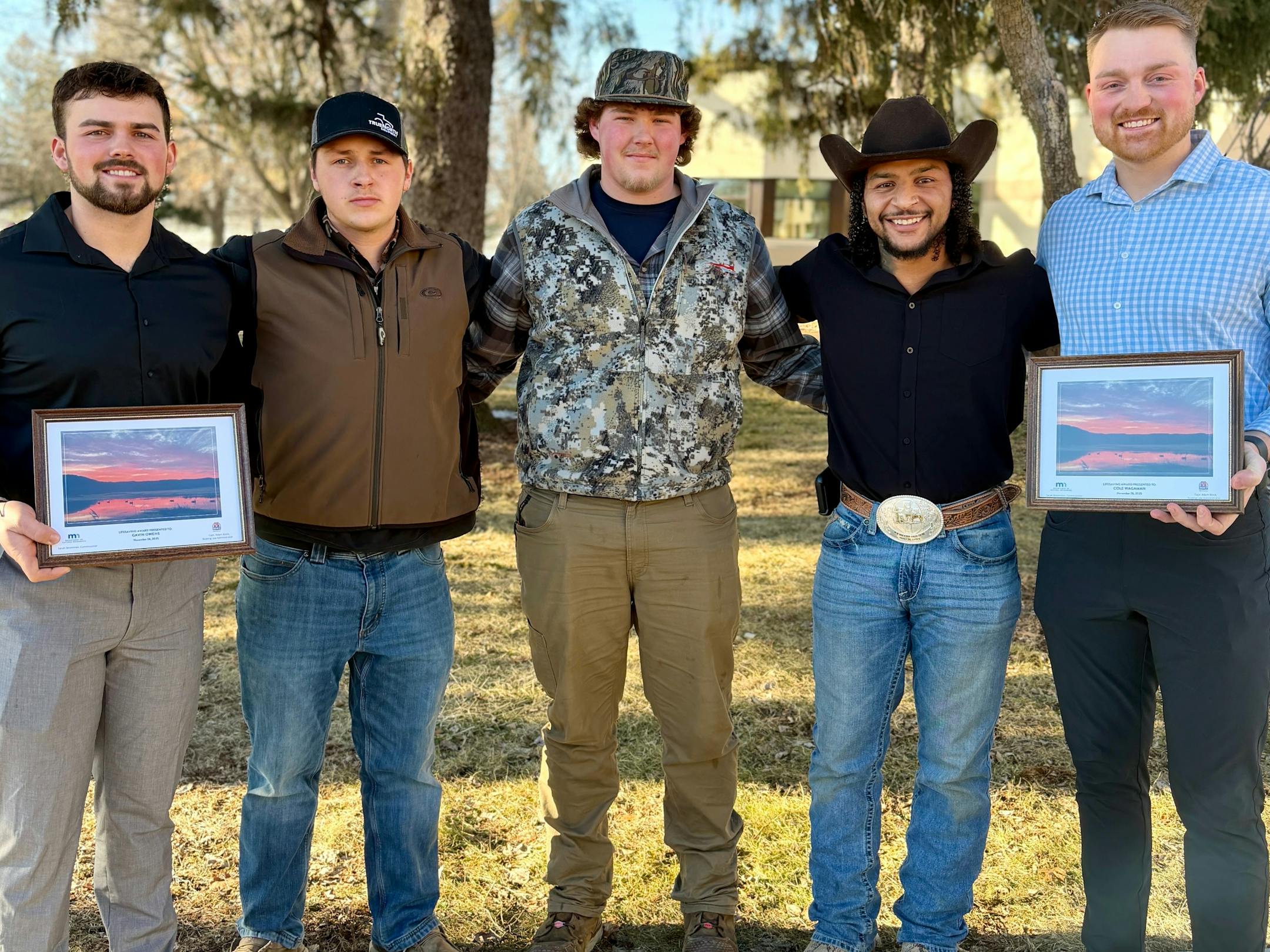
On a better day, Gavin Owens, left, of St. Charles, Minn., and Cole Wagaman, far right, of Kasson, Minn., are shown with three waterfowlers they rescued from the MIssissippi River on a tempestuous November morning. Second from left is Parker Dunn of Red Wing, then Jackson Melrose of Lake City and Noah Ijomah of Cottage Grove. Owens and Wagaman are holding DNR Lifesaving Awards. (Department of Natural Resources)

On the day before Thanksgiving, Cole Wagaman awoke uncertain whether he would hunt ducks. He lives in Kasson, in southern Minnesota, and the wind was whipping snow out of the northwest at 30 miles an hour, with a temperature in the mid-20s.

If he did hunt, he wouldn’t take along his golden retriever, Nellie, he knew that.

Too risky, he thought.

“I called my buddy Gavin and told him I’d try to make it to Rochester,” Wagaman, 28, said. “If I could get there, I figured I could make it to the river.”

Wagaman had hunted the Mississippi River out of the Weaver Bottoms for 15 years, and his friend Gavin Owens, 25, had also chased ducks there for some time.

So the two had experience. They also had Wagaman’s 18-foot boat with a 50-horsepower surface drive motor swinging from the transom — a craft safe enough for anything the Big River could dish out.

Or so Wagaman thought.

Arriving at the public landing near the small town of Weaver, Minn., a couple hours before dawn, Wagaman joined Owens and a third friend, Hunter Brown, 34, both of St. Charles, Minn.
Owens reported that three other hunters had launched their boat, also an 18-footer, about 15 minutes earlier, and their quick disappearance into the white caps and the pitch black early morning signaled how nasty conditions were.

“But we figured the ducks would be flying, so we launched and headed downriver,” Wagaman said. “Waves were 3 to 5 feet, with water spraying over the bow. I had the boat’s lights on, and in the dark, with the blowing snow being illuminated, it looked like something out of Star Trek — stars seemed to be everywhere."

Then, toward the west, they saw a light.

Faint and flickering, the tiny beacon peaked through the darkness from an area closed to hunting.

“We thought: Those guys must be lost‚" Wagaman said. ”They can’t hunt there."

Five minutes later, Wagaman killed his boat engine at a spot where he, Owens and Brown would set their decoys.

Just then, about two hours before dawn, Boom! Boom! Boom!

Three shots rang out, perhaps from a mile away.

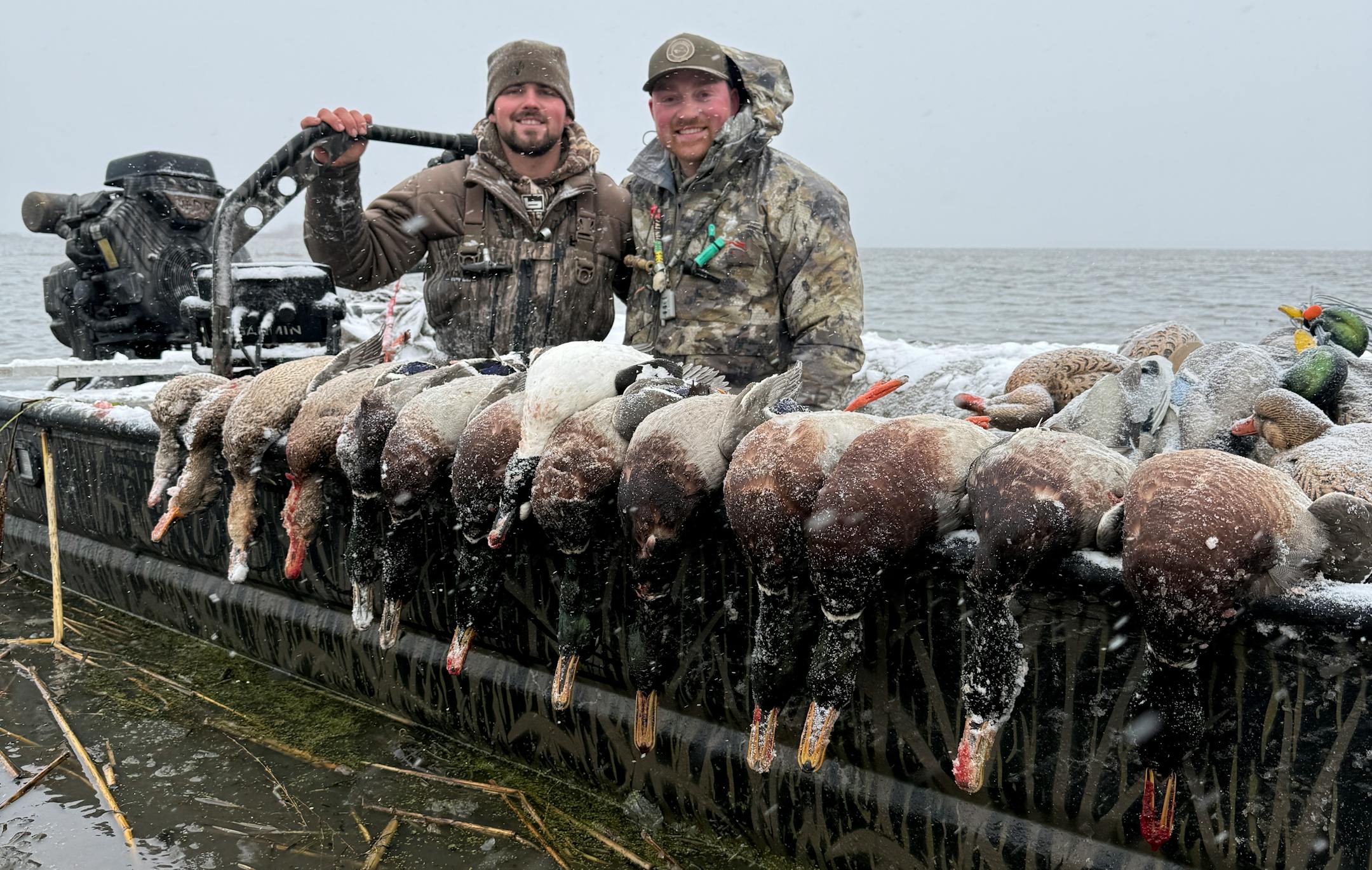
On a cold Mississippi River duck hunting day during which no rescues of other hunters was required, Gavin Owens, left, and Cole Wagaman and their bounty, and that of fellow waterfowler Hunter Brown, are shown in Wagaman's Prodigy duck hunting boat. The specially built craft, with its high sides, withstood Mississippi River whitecaps during a rescue of three hunters in late November. (Hunter Brown)

At the time, Wagaman, Owens and Brown didn’t know — couldn’t know — that the shots were fired by one of the three hunters who had left the boat launch before they did.

Noah Ijomah, 26, of Cottage Grove, Parker Dunn, 19, of Red Wing, and Jackson Melrose, 16, of Lake City, had swamped their boat and the three had been in the river for about a half-hour, their waders filled with water.

“The river was too rough, Ijomah said. “So we decided to head back to the landing. As I turned my boat around, a wave came over the bow, then another came over our stern and sunk us, just like that. Stern first, that’s how we went down.”

Yelling as loudly as they could, while holding a cell phone flashlight aloft, Ijomah, Dunn and Melrose had tried to flag down Wagaman’s group as they passed in the night.

But Wagaman’s roaring motor stifled their shouts, and they watched helplessly as their chance to be rescued disappeared downriver.

Taller than Ijomah, Dunn and Jackson bounced their feet on the river bottom to keep their heads mostly above water.

At 5-7, Ijomah had no chance to do that, and his waders ballooned with water, pulling him down.

“I keep a knife in my pocket and I used it to slice off my wader’s shoulder straps,” he said. “Underneath, all I had on were sweat pants and socks.”

With his phone held above the waves, Dunn dialed 911 and reached a dispatcher who said he would send a rescue team as soon as he could.

“But there was no hope,” Ijomah said. “They would never get to us in time. We were going to die. Already, I had lost feeling in my legs and feet.”

Serendipitously, one of the men’s guns drifted by, kept atop the waves by its floating case. Grabbing the 12 gauge and uncasing it, Melrose jacked a shell in the chamber and two in the magazine, and fired off three quick rounds.

“We heard the shots and knew right away someone needed help,” Wagaman said. “Immediately, we took our gear out of my boat, and Hunter agreed to stay with it on shore while Gavin and I checkout out what was happening.’’

The scene Wagaman and Owens came upon was surreal.

Two faintly lit headlamps bobbed above the water, perhaps 100 yards from a third guy who was adrift in the river.

“Those two guys had their heads above water,” Wagaman said. “But the third guy kept going under, even though they all had lifejackets on. We went for him first.”

Pitching and yawing, the boat heaved in the waves as Wagaman and Owens pulled Ijomah from the water. The next guy, Melrose, was heavier, and with his waders full of water, he struggled to climb over the high freeboard of Wagaman’s Prodigy, a specially built waterfowl-hunting boat. Then the third hunter was rescued.

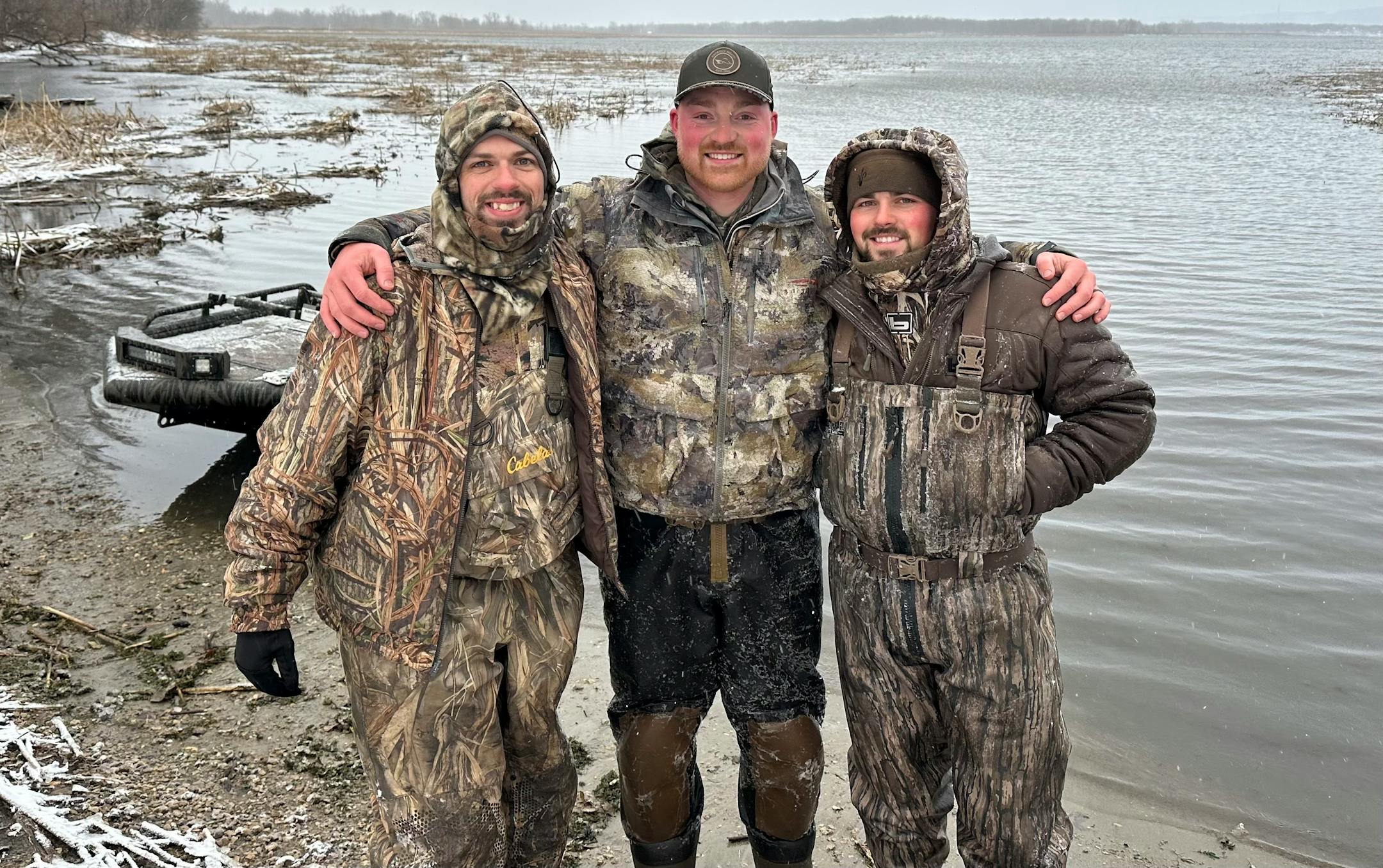
Hunter Brown, left, Cole Wagaman and Gavin Owens after the rescue of three other hunters they performed on the Mississippi River near Weaver, Minn., in late November. (Cole Wagaman)

But there were problems.

The motor’s kill switch had been damaged when one of the men clambered into the boat. So the engine wouldn’t start.

Plus, the boat was awash in water and now carried the weight of five men.

“Finally, I had Gavin hold the kill switch and I got the motor started,” Wagaman said. ”We started upriver. But we were in the refuge. It’s shallow in there, and I ran onto a sandbar. With all the weight and water we were carrying, I couldn’t power it off."

Wagaman and Owen got out of the boat to push, and Ijomah helped.

“I couldn’t feel my legs or knees, I was so cold. But I knew we had to get the boat moving or we would all die,” Ijomah said.

When the boat was freed, Wagaman started the motor and the journey upriver continued.

By then, flashing red lights could be seen on the Minnesota side of the river, racing toward the landing.

“Parker had called ahead and said we needed three ambulances,” Wagaman said.

Ijomah, Dunn and Parker’s body temperatures ranged from 82 to 85 degrees en route in the ambulances to a nearby hospital. But they lost no fingers, toes or limbs, and they’ve since recovered.

“The circumstances that caused my boat to swamp weren’t good,” Ijomah said. “Fortunately, we had all of our safety gear, and that’s what I would tell everyone to keep handy. Life jackets, floating gun cases, shells, a knife and a phone. Those things, and Cole and Gavin — and a lot of luck — saved us."

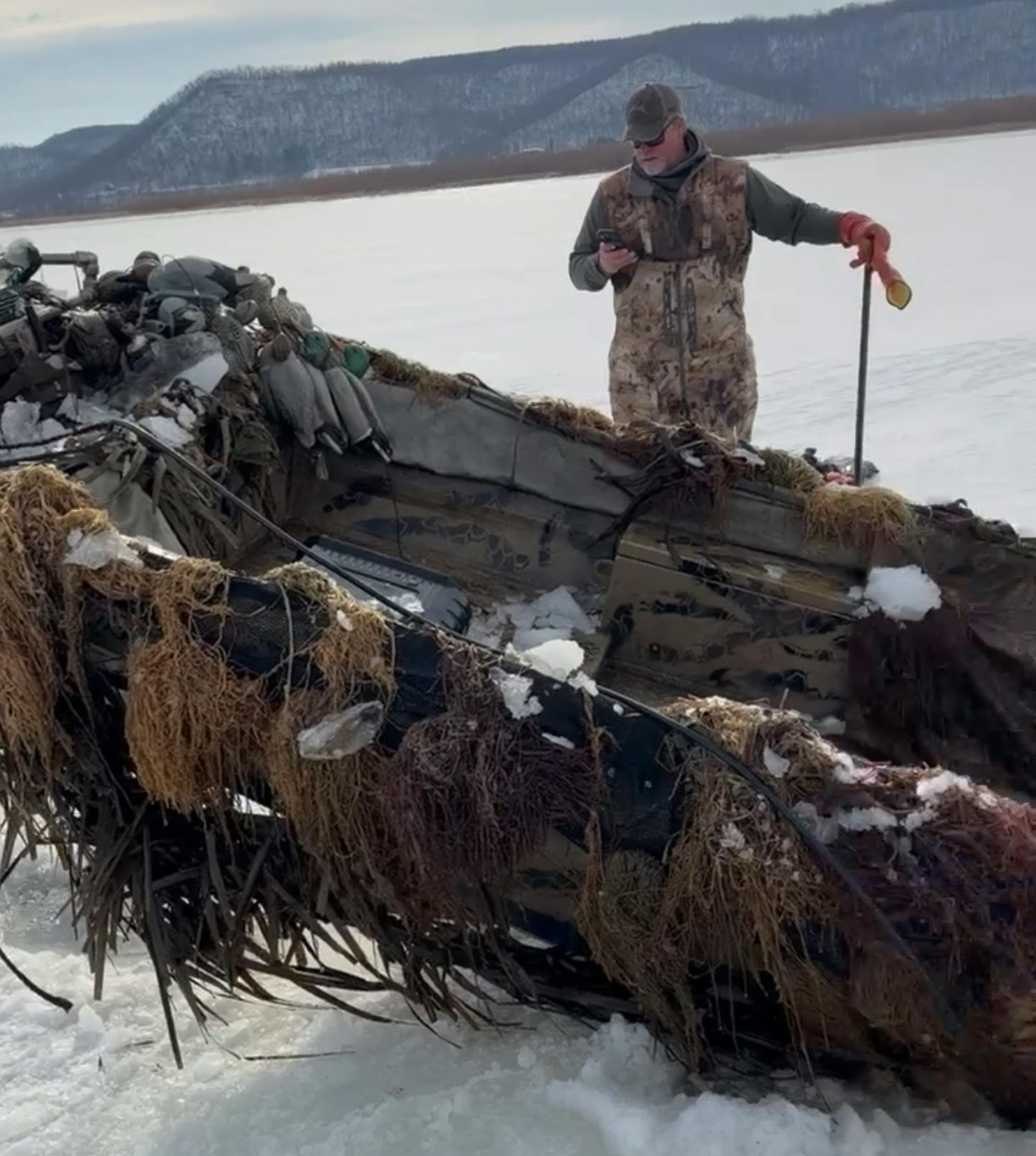
Noah Ijomah's 18-foot duck hunting boat swamped in high winds on the Mississippi River in late November. Here the boat is being raised through ice from the river bottom on Dec. 15. Ijomah is from Cottage Grove. (Noah Ijomah)

On Dec. 15, Ijomah’s boat was recovered from beneath the Mississippi River ice. Taking the boat home, Ijomah dried it out, and the engine started.

For their efforts, Wagaman and Owens were given Department of Natural Resources Lifesaving Awards on Jan. 12.

“Hunter did as much as anyone, staying on shore by himself for two hours‚" Wagaman said. ”In fact, in all the excitement after we got to the landing, we almost forgot to go get him.

“And I’m glad I didn’t bring Nellie.”

about the writer

about the writer

Dennis Anderson

Columnist

Outdoors columnist Dennis Anderson joined the Star Tribune in 1993 after serving in the same position at the St. Paul Pioneer Press for 13 years. His column topics vary widely, and include canoeing, fishing, hunting, adventure travel and conservation of the environment.

See Moreicon