A Willmar family fights a father’s deportation as a daughter’s quinceañera nears

A 37-year-old man has been in immigration custody since February. He and his family fear violence in Honduras.

The Minnesota Star Tribune
September 13, 2025 at 12:00PM
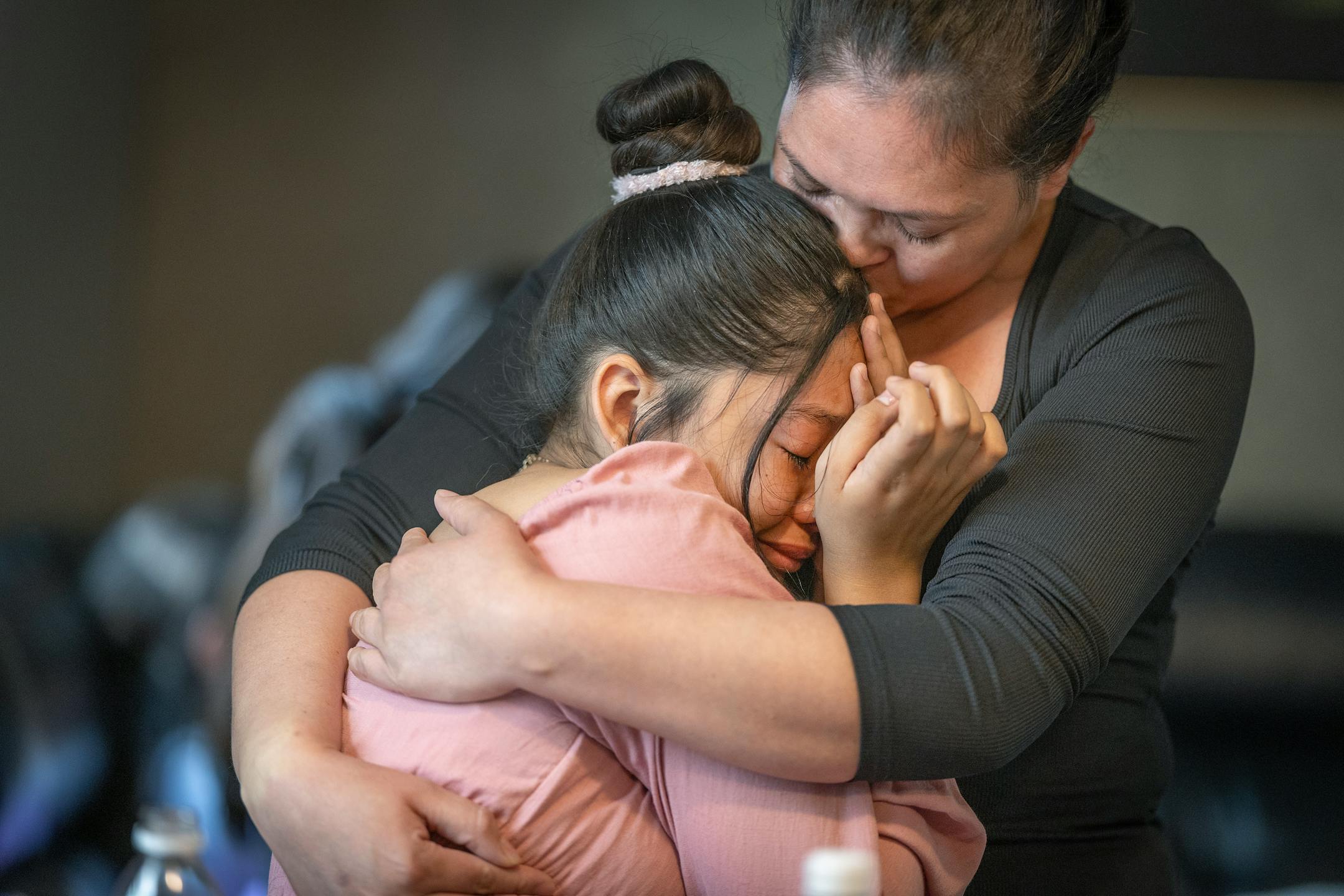
Greysi is comforted by her aunt Erika Salinas during a makeshift quinceañera celebration in Willmar on Aug. 24. Greysi's father’s, Noe Salinas Ramirez, is in ICE custody at Kandiyohi County Jail. (Elizabeth Flores/The Minnesota Star Tribune)

WILLMAR, MINN. – Isabel Dubón began cooking lunch before noon. From there, her responsibilities would continue until nearly dawn the next day.

Before going to work overnight at rural turkey farms, Dubón, 36, would have to wrangle her daughters for a trip to church and host a small, surprise birthday party for her eldest, Greysi.

The birthday is a monumental one – Greysi’s 15th, what should be celebrated with a quinceañera.

But extravagant parties are not possible right now. The family’s father, Noe Salinas Ramirez, 37, has been in immigration detention since February.

He is facing deportation to Honduras for the third time since 2007. He has no previous criminal history other than a misdemeanor conviction following an attempted illegal border crossing in 2016, according to court records.

President Donald Trump’s administration has said its crackdown on illegal immigration mainly focuses on those “who threaten the safety or security of the American people.” Salinas Ramirez’s case illustrates how some people with no violent criminal history have still been swept up.

Family members said they have not been the same since Salinas Ramirez’s detention. They used to go out for dinner, take trips to the Mall of America. Now they lay low. Dubón and the extended family have had to pool resources to fight Salinas Ramirez’s deportation, leaving little for his daughter’s quinceañera.

“I can’t do it,” Dubón said in Spanish, as she looked down at the tamales cooking in front of her on a Sunday in late August.

Isabel Dubón teaches her daughter Ivanna, 8, how to make tortillas as her eldest, Greysi, 14, cleans rice at their home in Willmar on Aug. 7. (Elizabeth Flores/The Minnesota Star Tribune)

A traffic stop and an arrest

It was Feb. 26 in Grand Forks, N.D.

Salinas Ramirez, who split his time between there and Willmar because he made good money working construction as a welder, was a passenger in a car that police pulled over for a broken taillight.

Salinas Ramirez was allowed to leave. The driver, who had a warrant through Immigrations and Customs Enforcement, was not.

When Salinas Ramirez arrived at the home where he was staying that night, he thought he was safe. But police went back to find him there.

Noe Salinas Ramirez has no criminal history other than a misdemeanor conviction following an attempted illegal border crossing in 2016, according to court records. (Provided by family)

According to police and court records, the U.S. Border Patrol wanted Salinas Ramirez arrested for a deportation order because of past immigration violations. Grand Forks police visited the home and an officer coaxed Salinas Ramirez into opening a backyard gate by telling him the arrested driver was there and needed to be let inside.

“As soon as they saw the door open, that’s when they grabbed me,” Salinas Ramirez said in an interview from the Kandiyohi County jail. He is one of more than 600 people in immigration detention there, a short drive away from his family in Willmar.

The Kandiyohi County Law Enforcement Center in Willmar. (Elizabeth Flores/The Minnesota Star Tribune)

He has been in custody since. Having been deported before – in 2007 and 2016 – he now faces a felony charge in federal court on the grounds that he entered the United States again without permission.

Salinas Ramirez said only violence awaits him in Honduras, where longstanding conflicts and no help from police have driven his extended family to flee to the U.S. over the years.

“I’m afraid that if I get deported, my kids will be left as orphans,” he said. “And I’m at risk of arriving to a situation where I could be executed.”

Salinas Ramirez faces long odds of staying here. He is only eligible for a status called “withholding of removal,” where he must demonstrate a 51% likelihood of persecution in his home country. Asylum seekers must meet a 10% threshold.

His application was rejected this summer. He filed an appeal in late August and an answer won’t come for at least four months.

Salinas Ramirez said hope is slipping from him. His family visits weekly, but glass separates them. No hugs, no kisses — his face flinched and reddened at the thought.

“We went out together, we would go to parks, we would play soccer,” he said. “It hurts that I have all these memories … and now I can’t do that anymore.”

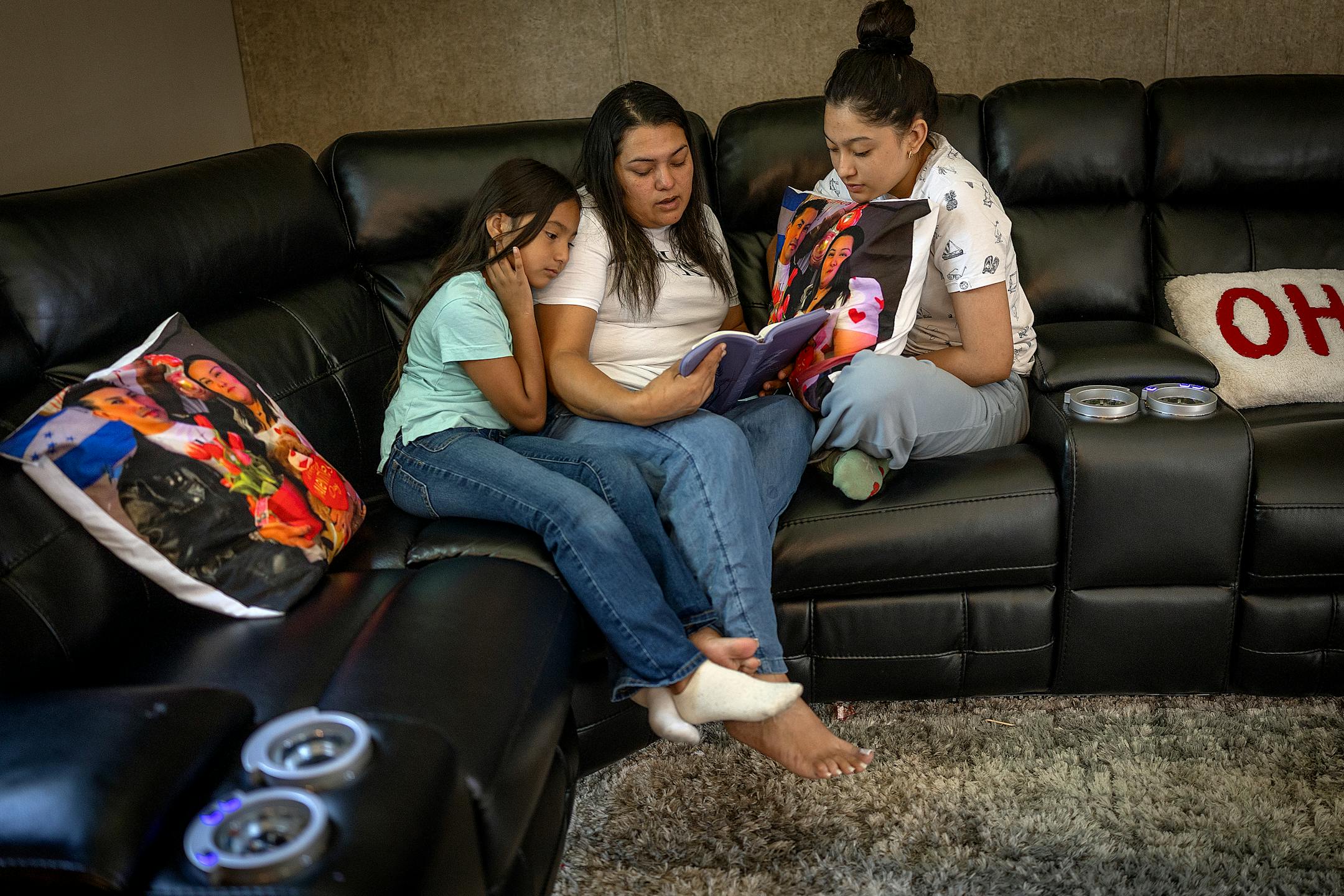
Isabel Dubón studies the Bible with her daughters Ivanna and Greysi. They hold pillows with their father’s picture. (Elizabeth Flores/The Minnesota Star Tribune)

Life continues at home with camp, church

Back at the family home, Dubón finished lunch and turned to help her youngest daughter, Ivanna, get ready for church.

Greysi was expected to return home any minute from a four-night Bible camp. Lately, she had hardly left her bedroom, was not eating and talked of returning to Honduras, her mother said.

Dubón had heard about new friends, campfires and ziplining from Greysi. But she also said she didn’t want to come home.

Ivanna, an 8-year-old who never misses a chance to tease her sister, didn’t hesitate to chirp in.

“Sometimes, I miss her when she’s not at home and then when she comes back, I want her to go back,” she said with a cheeky smile, as her mother brushed her hair.

Moments later, the front door opened. Greysi burst in, smiling wide, followed by her cousin and aunt. After hugs and hollers of “¡Hola!” the girls rushed into their rooms to change for church.

Isabel Dubón is greeted with a hug from her daughter Greysi after she returned from a Bible camp. (Elizabeth Flores/The Minnesota Star Tribune)

At Casa de Misericordia, a Pentecostal church serving Willmar’s Latino community, Dubón filed into a row of seats with her daughters and four extended family members.

The service, 2½ hours long, was scored with lively music that only slowed for sermons. On this Sunday, the pastor preached about the strength of faith.

Greysi, dressed in a red and gold gown, danced with two dozen girls at the start of the service. Ivanna stood up to give an offering.

Later, Dubón joined other women invited to the front. She stood and swayed to the music, her eyes closed as tears fell. When she retook her seat, Greysi rested her head on her mother’s shoulder.

Isabel Dubón prays with her daughter Ivanna during a service at Casa de Misericordia (House of Mercy) church in Willmar on Aug. 24. (Elizabeth Flores/The Minnesota Star Tribune)

Looking for refuge and a better life

In summer 2021, Dubón and her daughters spent about a month journeying to the United States by foot and bus.

Although separated from Salinas Ramirez at the time, Dubón brought their daughters to Minnesota to join relatives of their father. They started coming here about 12 years ago, fleeing the poverty, corruption and unchecked violence of Honduras.

Salinas Ramirez arrived in Minnesota in March 2022, and reconciled with Dubón afterward. She and her daughters, who do not have legal status as residents, are now seeking asylum.

In Honduras, Dubón’s family struggled for years with a dispute over land with a neighboring family. Police were no help, and the disagreement escalated to the deaths of her grandfather and two uncles, she said.

The final straw came when a man fired a gun outside her home, with her daughters present.

“We were specifically looking for refuge, to be away from where we felt unsafe and for a better life for our daughters,” Dubón said.

Dubón and her in-laws work in Kandiyohi County’s turkey production industry. She works up to 14 hours at a time, five days a week, as a “chaser.” In dirty, smelly conditions, she herds turkeys into trucks. The turkeys that are too fat to walk – weighing around 70 pounds – must be carried.

No white people work these jobs, said Maria Salinas, Dubón’s sister-in-law.

Isabel Dubón moves turkeys through a tunnel and into a semi during a shift near Willmar on Aug. 7, a job known as a "chaser." She works eight to 14 hours a night for $14 an hour. (Elizabeth Flores/The Minnesota Star Tribune)

“I have 24 people working under me, so that means I’m supporting the economy,” said Salinas, whose job is to find day laborers to chase turkeys. “They’re all Latinos. We pay a lot of taxes. We do everything by law.”

Without a father or his income, Dubón’s family has been off balance since his incarceration. Dubón doesn’t have time to sleep for long. Greysi pitches in by looking after Ivanna and babysitting other kids. The extended family pools money to help pay for Salinas Ramirez’s food, phone calls and attorney fees.

The price of fighting deportation has skyrocketed under the Trump administration. Earlier this year, it would have cost $110 to file Salinas Ramirez’s appeal for withholding of removal status.

The cost jumped to $1,010 in July.

Greysi prays before blowing out her quinceañera candles in Willmar on Aug. 24. (Elizabeth Flores/The Minnesota Star Tribune)

An emotional birthday

After church, Dubón returned right away to her kitchen. Greysi and Ivanna curled up on the couch to watch cartoons as the stovetop hummed.

Behind them on the wall hung a Honduran flag. Four soccer medals won by their father are draped in front of it.

The door opened. It was Maria Salinas and her family, bearing birthday balloons, tres leches cake, fried chicken and other treats.

Greysi sat up, her eyes wide. The room soon filled to six adults, seven kids and one infant.

Everyone entered party mode. Greysi changed into a pink dress for photos outside. Her cousins played with a grasshopper and goofed around. The adults blew up balloons and ate.

It seems Dubón is always on her feet. She ate while standing, was the first to start cleaning the kitchen and helped hang birthday decorations. Another long shift chasing turkeys was just hours away.

Greysi wore a smile through it all. But she was honest: It was not her ideal 15th birthday party.

“Maybe I’m just tired,” she said.

Her father wanted to throw a big celebration for her. He pictured a father-daughter dance to a song called “No Crezcas Más (Don’t Grow Anymore)” by Tercer Cielo. It’s about a father watching his daughter turn 15, when a girl transitions to womanhood in Latin American cultures.

At one point, a family member played the music video and everyone stopped. Tears flowed in the room. Finally, an uncle grabbed Greysi for a dance.

They parted as the song finished, and Greysi’s mother wrapped her in a hug.

about the writer

about the writer

Elliot Hughes

Reporter

Elliot Hughes is a general assignment reporter for the Star Tribune.

See Moreicon

More from Greater Minnesota

See More
card image
Leila Navidi/The Minnesota Star Tribune

Friday’s morning commute and weekend travel could be impacted by the snow.

card image
card image