

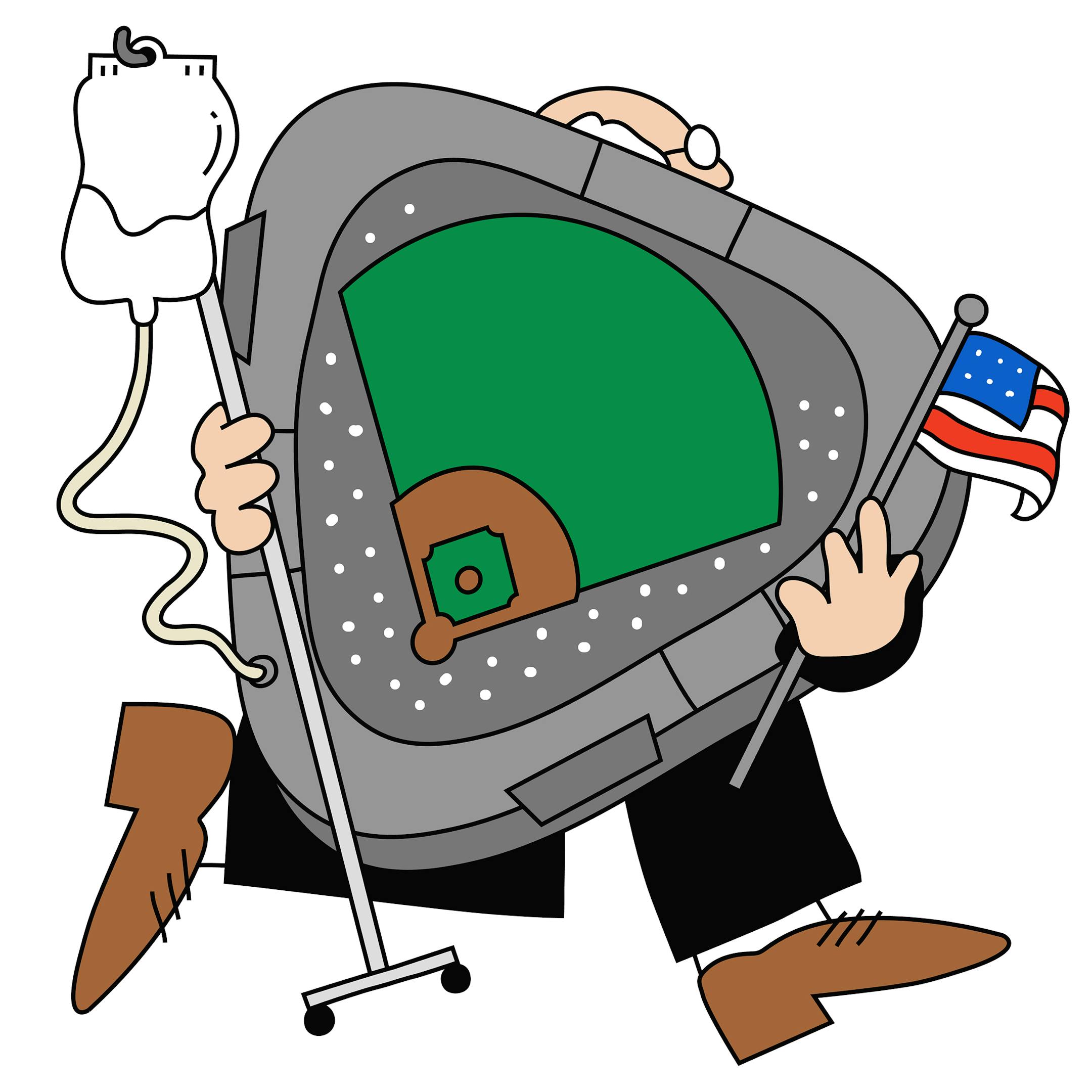
Opening Day of the Major League Baseball season, which fell on Thursday after being delayed for a week by a labor dispute, is as good an occasion as any for fans of the game to come to terms with certain hard facts. I am talking, of course, about the inevitable future in which professional baseball is nationalized and put under the authority of some large federal entity — the Library of Congress, perhaps, or more romantically, the National Park Service.
Like the Delta blues or Yellowstone National Park, baseball is as indelibly American as it is painfully uncommercial. Left to fend for itself, the game will eventually disappear.
Attendance at games has declined steadily since 2008, and viewership figures are almost hilariously bleak. An ordinary national prime-time MLB broadcast, such as ESPN's "Sunday Night Baseball," attracts some 1.5 million pairs of eyes each week, which is to say roughly the number that are likely to be watching a heavily censored version of "Goodfellas" on a basic cable movie channel in the same time slot.
Even the World Series attracts smaller audiences than the average "Thursday Night Football" broadcast, the dregs of the National Football League's weekly schedule. In 1975, the World Series had an average of 36 million viewers per game; in 2021, it barely attracted 12 million per game.
Casual observers may assume that despite this lack of popularity, baseball is still somehow insanely valuable. This is an illusion. Major League Baseball generated around $11 billion in revenue in 2019, but this figure does not accurately reflect the demand for its product. The astronomical salaries that continue to be enjoyed by the sport's stars (if that is the mot juste) are a result not of the game's nonexistent popularity but of the economics of cable television providers, who bundle regional sports networks alongside dozens of other channels so that anyone with cable TV is buying baseball whether they like it or not.
Mike Trout's $426 million contract is effectively being paid by millions of grandparents who just want to tune in to Anderson Cooper or "Antiques Roadshow." As that audience dies off and younger generations of "cord cutters" take their place, baseball's revenue will plummet.
Culturally, too, the game is increasingly irrelevant. The average age of a person watching a baseball game on television is 57, and one shudders to think what the comparable figure is for radio broadcasts. Typical American 10-year-olds are as likely to recognize Jorge Soler, who was named the most valuable player of last year's World Series, as they are their local congressional representative. College athletes drafted by MLB and NFL teams choose the latter without hesitation.
In some parts of the country, participation in Little League has decreased by nearly 50% in the past decade and a half. When my wife and I signed up our 5- and 6-year-old daughters for T-ball a few weeks ago, we did so partly out of a grim sense of obligation. We might have been Irish parents enrolling our children in step dancing classes: This is your heritage and you are going to learn to appreciate it!


