40 years ago, Hormel workers walked off the job. Austin would never be the same.

December 29, 2025
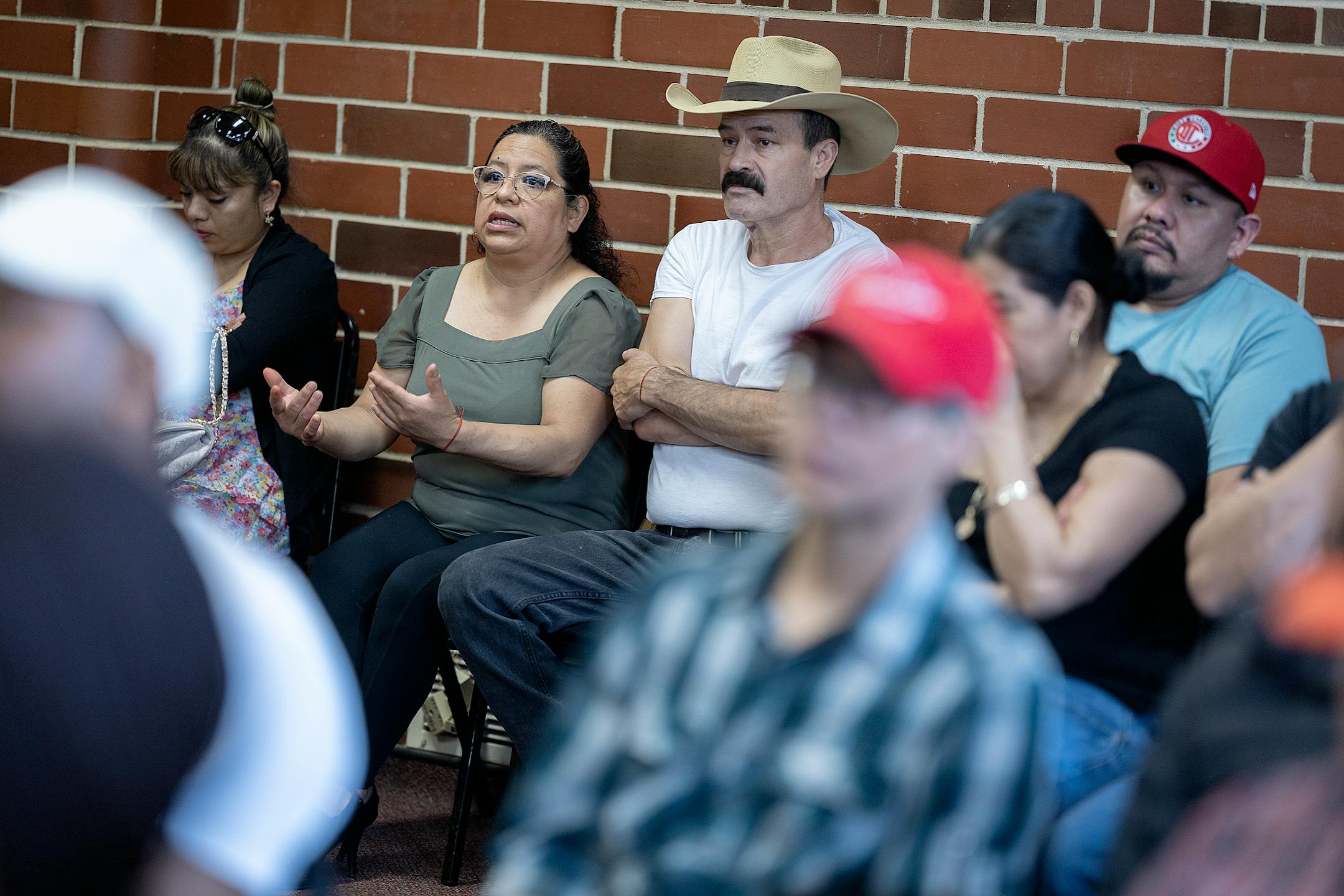
QPP workers participate in an informational meeting for the UFCW Local 663 at the Austin Labor Center. (Elizabeth Flores/The Minnesota Star Tribune)

Austin’s slaughterhouse workers nearly went on strike again this summer, four decades after the Hormel strike that divided a city.

AUSTIN, MINN. — On a Sunday this summer, slaughterhouse workers from Mexico, Sudan and Southeast Asia sat at tables with water bottles and paperwork, listening to a speech in English and Spanish.

For perhaps the first time since 1985, they were prepping for a strike.

Forty years ago, about 1,500 blue-collar workers walked off the job at Hormel, splitting this town near the Iowa border and catapulting the plight of middle-class hog butchers into the national conversation.

The 1985 strike turned out to be a brutal defeat for Hormel’s workers, one of several pivotal labor clashes in a decade marked by the declining economic and political clout of organized labor in the United States. In Austin, more than 1,000 workers lost their jobs, and remaining workers were forced to accept a contract that paid them less than what they were making before the strike.

Hormel is still the economic center of Austin, though its slaughterhouse operations are now run by a company called Quality Pork Processors. Today, about 2,700 people work at the two plants — 80% more than in 1985.

Many are immigrants and first generation Americans, doing the same arduous labor for a fraction of the inflation-adjusted 1984 wage. They are also members of Local 663 of the United Food and Commercial Workers union, and they were feeling emboldened. After years of persistent inflation and sped up production lines, they were seeking higher wages and more safety measures.

“That’s why we’re trying to get [employees] involved more in the union,” said Mario Garcia Lopez, a native of Michoacan, Mexico, who drives a forklift at QPP. “So they can trust that things can be different than before.”

At left, QPP employees learn how to unionize during a meeting at the Austin Labor Center in May. At right, QPP forklift driver Mario Garcia Lopez and his wife Susana listen at the meeting. “I hope people keep attending the union meetings because people didn’t attend before and now ... we understand there’s a lot of information out there regarding workers' rights in Minnesota,” Garcia Lopez said.

The missing middle class

For over a century, the good life in Austin — a city of 26,000 people on the southern Minnesota prairie — has come through the Hormel slaughterhouse.


Meatpacking has always been considered tough, undesirable work. But, in the 1980s, at least it paid well.

Federal data shows the meatpacking job, as an expression of real wages, declined between 1979 and 1990. This spring, workers at the QPP plant made just $19.80 an hour, while workers at the adjacent Hormel plant made a base rate of $24.35. The plants are separated by a wall.

According to retired Hormel workers, it wasn’t uncommon by the early 1980s to make $32,000 a year, equivalent to more than $95,000 in 2025 wages, according to the CPI Inflation Calculator from the Bureau of Labor Statistics.

Today’s wage, in many cases, does not lift people out of the working class. President Donald Trump and his supporters believe bringing more manufacturing to the U.S. — and fewer immigrants — will raise wages closer to what they were in the ’80s. Between 1979 and 2023, Austin’s median income, when adjusted for inflation, fell 3% as statewide incomes grew more than 17%, according to state demographer Susan Brower.

Meanwhile, the town’s racial makeup has moved from 99% white in 1980 to 65% white in 2020 — with large populations of Latino, Asian and African immigrants. The student body of today’s school system speaks more than 50 languages.

A float displaying the American and Guatemalan flags makes its way down Main Street during the Fourth of July parade in Austin, Minn. (Elizabeth Flores)

Laura Helle, an Austin City Council member, said more than faulting immigrants, what’s changed in Austin is that the middle class disappeared. Meatpacking has long lured first-generation Americans.

“I think we went from having a sort of bell-curve income distribution where most people were in the middle,” Helle said, ”to having a barbell where there’s a lot in the low end, a lot in the high end and not a lot in the middle.”

Researchers in rural Minnesota have investigated the region’s changing farm economy and sentiments toward immigrants since the farm crisis of the 1980s and the anti-union efforts at meatpacking plants.

Other meatpacking towns like Worthington, Willmar and Long Prairie experienced dramatic spikes in immigrant populations in the 1990s and early 21st century. This followed declining wages during the 1980s.

Austin is a microcosm of what happened to U.S. manufacturing labor in the 1980s with open global competition, free trade agreements, automation and the weakening of unions.

There’s a persistent belief that workers in immigrant-heavy counties rely on public assistance.

But Kelly Asche, senior researcher at the Center for Rural Policy and Development in Mankato, says the link between public assistance and immigrants living in packing towns is vastly overstated.

“There is this idea that immigrants are taking advantage of our fabulous welfare state,” Asche said. “But a lot of immigrants are coming back here to make money to send it back home.”

Hormel, the $12 billion global food company with household name products such as Spam, Planter’s Peanuts and Jennie-O turkeys, offered a statement but declined an interview request about the strike.

“The events of 40 years ago were a difficult moment in our company’s history, but they are long behind us,” the statement said. “Over the decades, both Hormel Foods and the Austin community have grown and evolved, building a strong, diverse and vibrant community together.”

QPP did not offer a comment.

Life after the strike

Hormel still very much dominates Austin culture. The Spam Museum is downtown. At Kenny’s Oak Grill, Hormel memorabilia hangs on the wall. A Spam patty melt is on the menu.

Al Wesley, a former member of the Local P-9 union who grew up in Austin and got a job at Hormel after a stint in the military, thought he’d work at the plant for his entire career and make enough for a boat and a cabin.

Like others, he voted to strike after Hormel’s offer effectively cut wages from $31.93 to $26.64 in 2025 buying power, according to the CPI Calculator.

Wesley did not go back to the plant after the strike ended. He operated a tour bus service. After bouncing between jobs, he worked as a janitor at Riverland Community College.

In the early 2000s, Wesley even went on strike at the community college.

“It’s funny because they thought they had beat us,” Wesley recalled. “They made us into activists.”

Today, his daughter works for Hormel in the office. A son-in-law works in the plant. It’s still a good job, he says, just not with the same buying power as in the 1980s.

“Austin never knew it was a packing town [before the strike],“ Wesley said, ”But now it does."

From left, Ken Gorman, Lynn Houston, Al Wesley and Judy Himley look at photos from the Hormel strike of 1985. (Elizabeth Flores)

Raising a new Austin

Within this economic shift, however, has been opportunity for newcomers.

Garcia Lopez, the QPP forklift driver, came to the U.S. in 1985 on an amnesty offer from President Ronald Reagan. He worked on fruit farms in the Pacific Northwest for 15 years until a friend heard about a factory in Minnesota “where they make ham.”

They arrived in February.

“I’d never seen such snow,” Garcia Lopez remembered. “These little houses covered.”

Over the years, Garcia Lopez and his wife raised three children. He became a fixture at the plant, started coaching in an adult soccer league. Soon, the pitch was filled with 22 teams.

In 2011, QPP ran identity checks and found 900 out of the 1,300 employees at its plant were undocumented. The company fired staff who failed the documentation check, shedding about 40 to 50 employees each week for months. Hundreds of Latino families left Austin during that time, afraid a federal immigration raid might take place.

The soccer league broke down. Teams just “disappeared,” Garcia Lopez said.

“That hurt,” he said. “We still haven’t got all the teams back yet.”

When Mario Garcia Lopez isn’t working at QPP he volunteers as a referee for weekly soccer tournaments in Austin, Minn. (Elizabeth Flores)

Still, the layoffs led to another transformation, coming often from Southeast Asia and Africa, filling the jobs that Latinos previously held at QPP. Since then, Garcia Lopez said, folks from Haiti to Thailand have found work in Austin.

But wages have remained low. Unlike the golden days in Austin’s packing plant, Garcia Lopez didn’t want his kids to follow him into the factory.

“No, no, no,” Garcia Lopez said. “I sent them to college not to work the same job I did.”

QPP workers decide to fight

For years, the union lived in the infamous strike’s shadow.

But as the old guard faded, the newer workers grew tighter. They also saw household budgets tighten and working conditions worsen with faster line speeds in the plant.

So the UFCW 663 union decided it was time to again teach its members how to organize. For years, building unity amid myriad languages and cultures was tough.

Union officials said they’d witnessed companies try to pit workers against each other, often weaponizing diversity. But UFCW 663 mirrored a strategy they used to negotiate with Hormel in 2023: assembling a diverse cast of workers on the team, each representing a different cohort.

In June, Rena Wong, UFCW 663 president, revved up those gathered at the Labor Center in Austin.

“We do not actually want to have to take you out on strike,“ Wong said. “But we also need the workers in the company to be prepared.”

By the end of the summer, they had secured $3.10 per hour wage increases over a three-year contract, plus new safety language and better reimbursements for clothing and boots.

“That’s the way we support ourselves and our families so we love our employer to do something better for us,” said Simon Mayem, 43, a Sudanese worker.

QPP workers celebrate a three-year union contract deal with ice cream at the Austin Labor Center on Aug. 4. (Elizabeth Flores)

The new contract means at least $22 per hour for workers. It’s less, when adjusted for inflation, than what workers in the 1980s settled on, but workers felt they made their point: Austin’s success now depended on them.

“Hopefully, we get better more and more with every issue,” said Hser Wah, a 32-year-old Karen worker and translator who has worked at QPP for nine years.

Garcia Lopez, who owns his own home and has eight grandchildren in town, credited the strategy of the union to bring the diverse workers together.

“All the committee was new,” Garcia Lopez said. “It was a mixture of cultures, and that helped a lot. The strategy was good.”

Across town, cheering them on was Wesley. He could never fault the workers who came from far-flung lands to find opportunity in Austin.

“They earn every nickel in that plant,” Wesley said. “We did, and they still do.”

QPP workers cheer for their new contract at the Austin Labor Center on Aug. 4. (Elizabeth Flores)
about the writers

about the writers

Christopher Vondracek

Washington Correspondent

Christopher Vondracek covers Washington D.C. for the Minnesota Star Tribune.

See Moreicon

Trey Mewes

Rochester reporter

Trey Mewes is a reporter based in Rochester for the Star Tribune. Sign up to receive the Rochester Now newsletter.

See Moreicon

More from Agriculture

See More
card image
Elizabeth Flores/The Minnesota Star Tribune

Austin’s slaughterhouse workers nearly went on strike again this summer, four decades after the Hormel strike that divided a city.

card image