
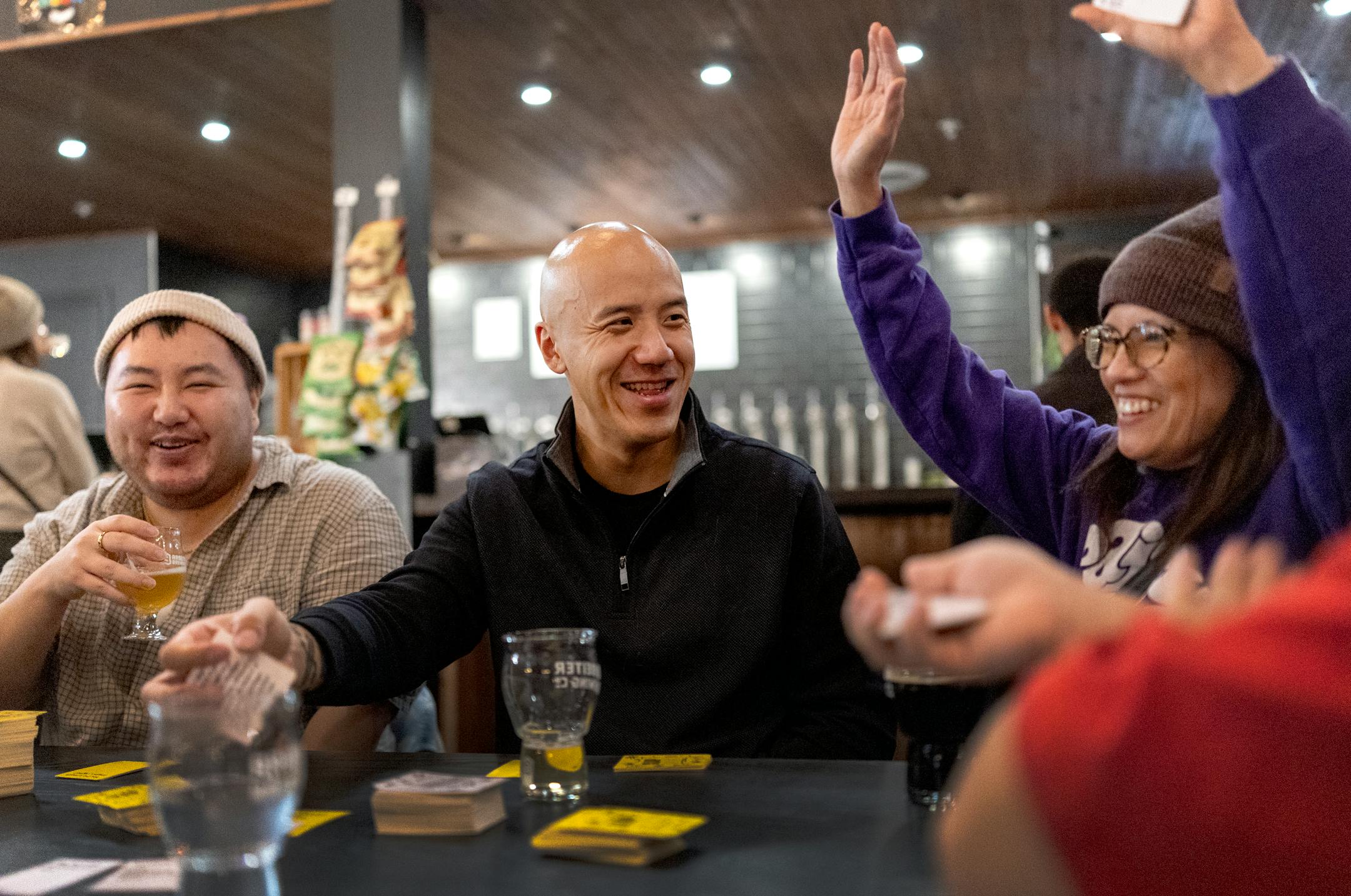
Yuen: Do you think of the perfect comeback way too late?

Asian Americans and friends can exercise their quick-wit muscles in a Minnesota-made card game addressing microaggressions.

Columnist Icon
The Minnesota Star Tribune
December 27, 2025 at 11:30AM
Damon Lee, Harrison Thao and Fran De Leon react while playing "Clapback: The Asian American Edition," at Arbeiter Brewing Co. in Minneapolis. (Carlos Gonzalez/The Minnesota Star Tribune)

Everyone knows that the most fruitful time to come up with a witty response to another person’s insult is several hours, if not days, later, when ruminating in the shower, dripping with regret.

“I’m terrible at clap backs,” admitted Talee Yang, 29, of Brooklyn Park. “I usually laugh it off, and then later on when I’m by myself, I think, ‘I could have said this.’ I’m just so bad at thinking on the spot.”

For Asian Americans like Yang, an ability to instantly spin up a powerful comeback to a hurtful or misinformed comment would prove useful. We are accustomed to hearing microaggressions about how well we speak English, where we’re really from, and that we look just like Jackie Chan.

A new game, “Clapback: The Asian American Edition,” is rooted in the idea that would make our parents proud: We can get better at clapping back — with practice.
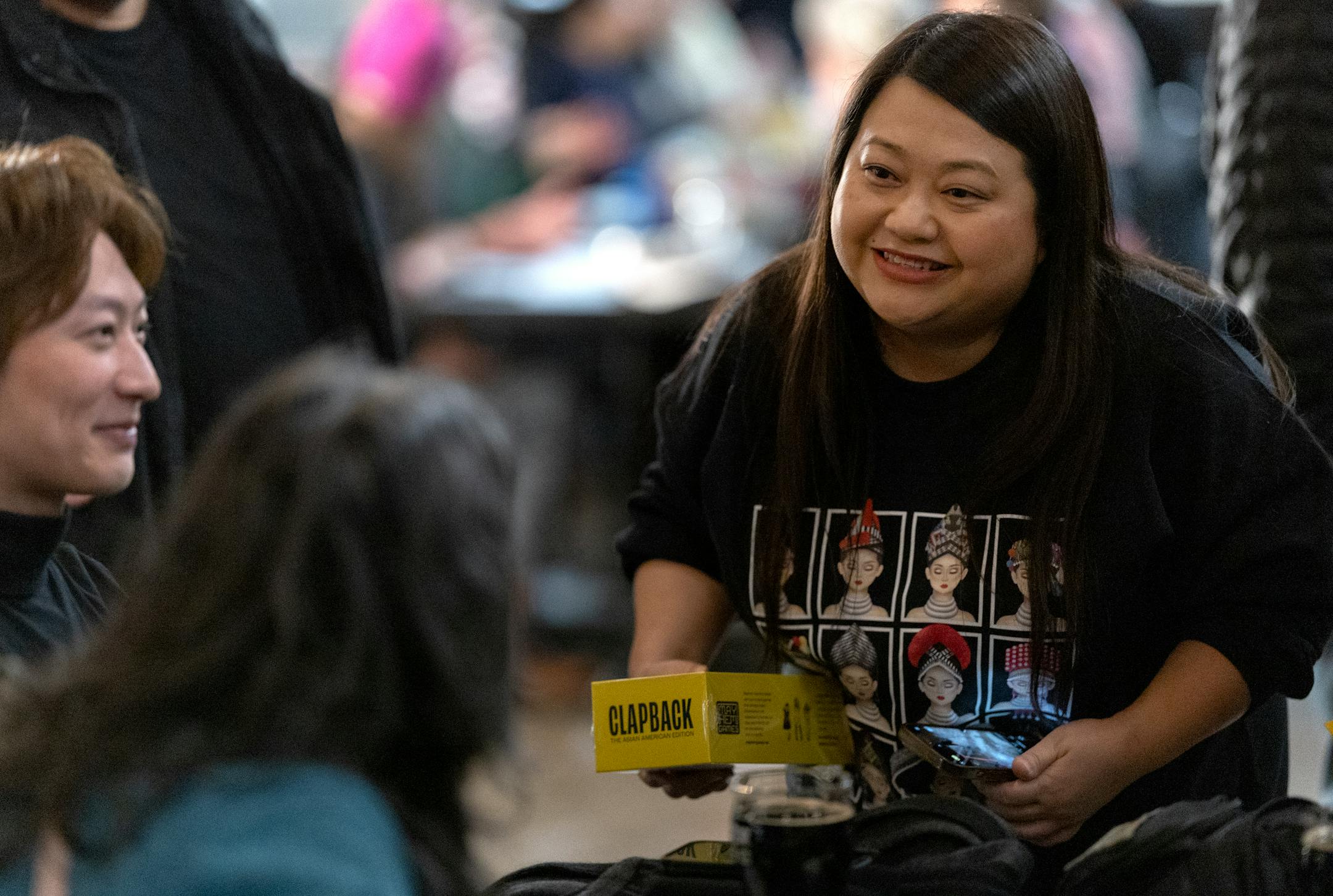
May Lee-Yang, a writer and comedian from St. Paul, hosts a game night of her card game Clapback at Arbeiter Brewing Co. in Minneapolis. (Carlos Gonzalez/The Minnesota Star Tribune)

The idea for the game came to its creator, Hmong American writer and comedian May Lee-Yang, after hosting workshops as a founding member of the comedy group Funny Asian Women Kollective. Organizations and colleges hired the troupe to teach how to use humor and quickness to respond to everyday rudeness.

At these workshops, Lee-Yang and her co-facilitators would ask participants to use Post-its to scribble down some of the microaggressions they’ve encountered. The sticky notes would then fill up a wall, which they called the Wall of Oppression.

In her new game, the microaggressions now appear on playing cards contained in what’s known as the Deck of Oppression. Each player flips a card and reads the microaggression aloud. Then the other players take turns reading one of several Clapback cards in their hand that could work in that context.

Say someone tells you: “I thought Asian women were supposed to be hot.”
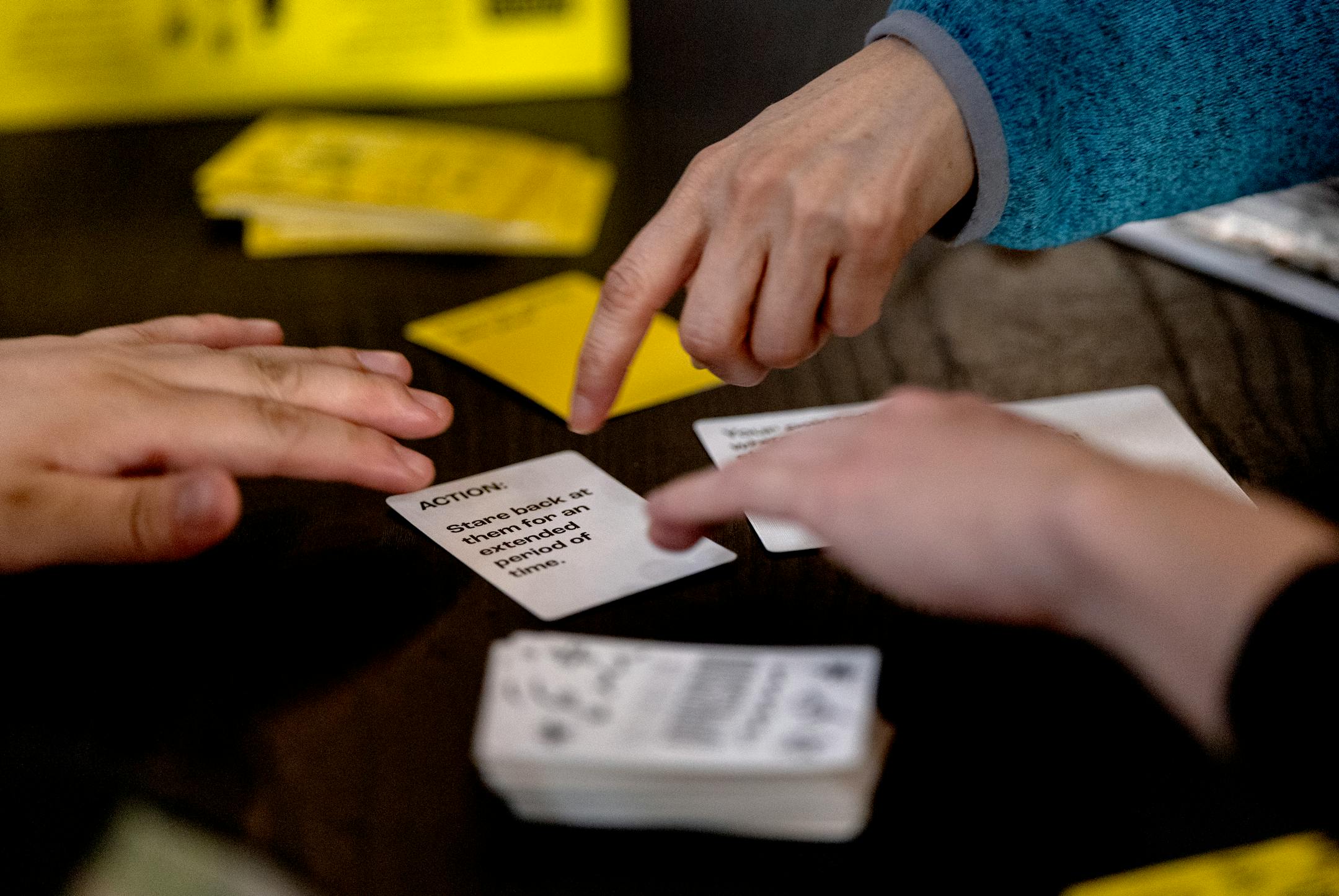
You could clap back with, “Go back to the suburbs,” “Who hurt you?” or “Have you met my mom?”

Lee-Yang, of St. Paul, said humor has always been a useful weapon to defuse confrontations. Rather than being the object of the punchline, she says, why not deliver it?

“In comedy, you can stand up for yourself, hold people accountable and hopefully not get fired for it,” she said. “Comedy breaks down a lot of barriers people have. It also builds community. Some white folks, when they play the game, say they didn’t realize that Asian folks went through this.”

The game, intended for adults, offers opportunities to clap back to bigotry and ignorance, but also to unwanted remarks from one’s own family members. “Microaggressions can come from anywhere,” Lee-Yang said. For example, she constantly fields the question — when are you going to have children? — from parents and random community members alike.

Lee-Yang developed her company, Mayhem Games, while she was a fellow with the Finnovation Lab, which supports entrepreneurs with dreams to deliver social impact.

Players reach for a card while playing Clapback, a party game intended to put "haters in their place." (Carlos Gonzalez/The Minnesota Star Tribune)

On a recent night at Arbeiter Brewing Co., strangers gathered to play Clapback for the first time or buy a set for themselves. (The game can be purchased at mayhemgames.net for $30.)

The night gave some a chance to reflect on their own reluctance to speak up for themselves when they were younger. Some pointed to cultural values, such as deference to one’s elders, while others said they lacked the strength in numbers to fight back.

Mea Hurley, a 59-year-old from Blaine, grew up in the 1970s in a small Minnesota town. A Korean child adopted by white parents, she faced lingering hatred over the Korean War that spilled into hostilities directed at her.

When kids taunted her with racist words, “I didn’t do anything,” she said. “It just made me not want to be Korean.”

Lee-Yang said she would love for Asian Americans to feel empowered by playing the game, but her ultimate goal is for people of all backgrounds to just have fun.

“We market it as a party game to put haters in their place,” she said. “I know some people will never clap back in a public space. But the fact that they’re feeling seen and laughing in these crazy times is really beautiful.”

Sign up here to follow Laura’s columns by email.

about the writer

about the writer

Laura Yuen

Columnist

Laura Yuen writes opinion and reported pieces exploring culture, communities, who we are, and how we live.

See Moreicon

More from Culture

See More
card image
Opus 3 Artists

Minnesota Orchestra’s “Turandot,” Dmitry Sinkovsky with the SPCO and Joshua Bell at the Minnesota Beethoven Festival were among the best.

card image
card image