

Like so many other Americans, I cheered in awe and happy disbelief last year as a band of driven, brainy scientists worked at breakneck speed to develop a vaccine to stop a pandemic's deadly rampage across the globe.
Sacrificing sleep, foregoing family, fueled by adrenaline and hope, a small group of immunologists and virologists collaborated across borders to achieve the impossible: create a new type of vaccine from scratch in a fraction of the time previously required to create the inoculations that had conquered past pandemics.
They didn't have the four decades it took before British physician Edward Jenner unveiled the smallpox vaccine in 1796, the first in world history. They didn't have the 12 years needed to unveil the flu vaccine in 1945, which to this day is only about 50% effective. They didn't even have the five years it took Dr. Jonas Salk to develop the polio vaccine, considered a medical miracle when he announced it in 1953.
In a few short weeks from its origin in China, the coronavirus had reached virtually every country around the world. It was soon killing thousands of people a week globally and sending many more to hospitals, where they were encased in tomblike ventilators. As bad as the health devastation, the virus had shut down national economies and sent frightened survivors into lockdown.
In a scenario far beyond Alfred Hitchcock's imagination, life on earth was stalked by an invisible enemy that binds its spikes to human cells, invades them, and then wages all-out war on the body.
Leading experts on TV issued gloomy predictions that it would take two years or longer to create a COVID-19 vaccine, one they added might — like the flu vaccine — leave half its recipients still in peril.
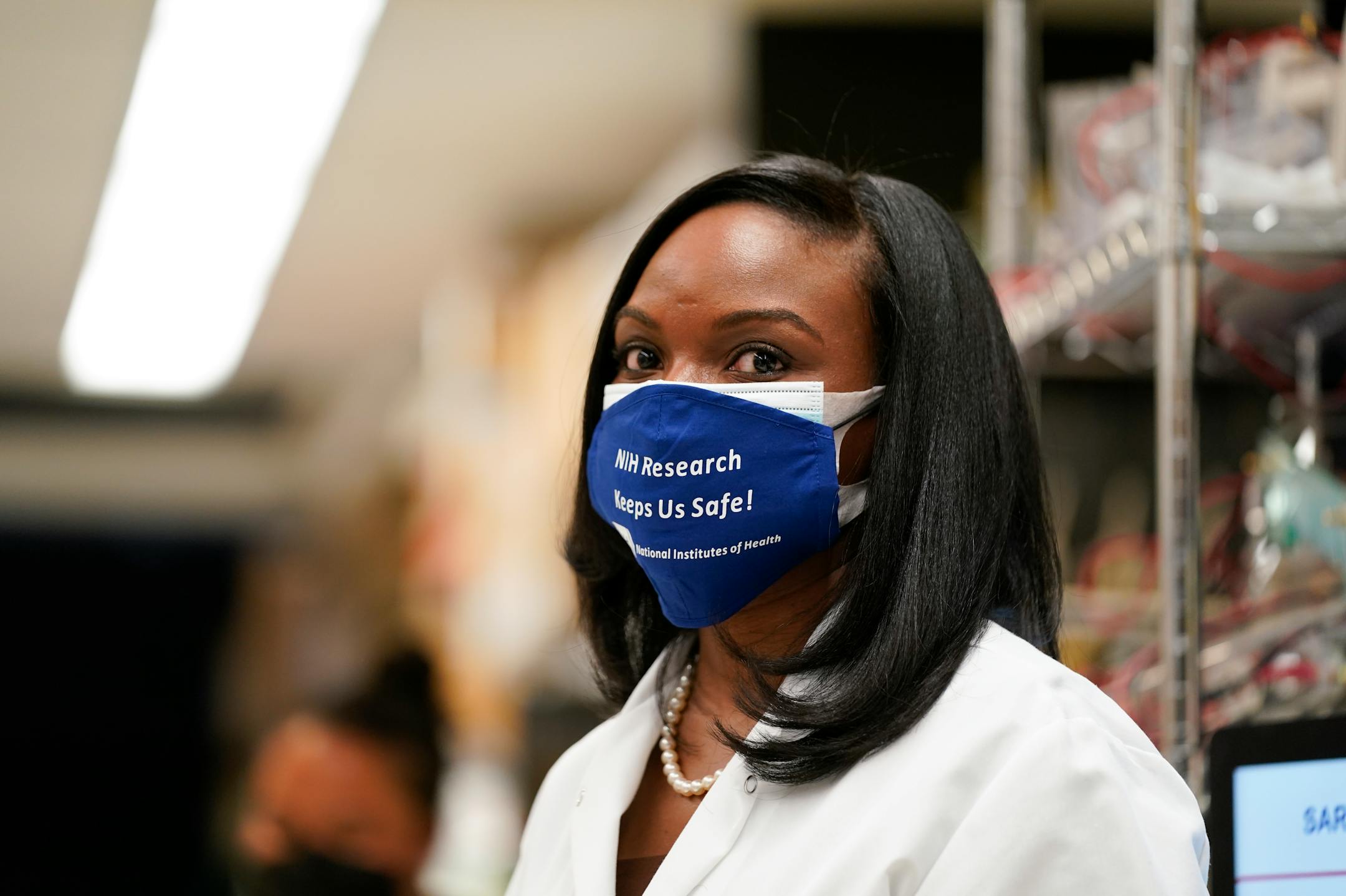
At a lab deep inside the National Institutes of Health, the world's preeminent medical research center just seven miles north of Washington, D.C., Dr. Kizzmekia Corbett was too busy to heed the doomsayers.
Working under Dr. Anthony Fauci, director of NIH's Institute for Allergy and Infectious Disease, Corbett was a lead immunologist on the vast health agency's hastily assembled Coronavirus Vaccines and Immunopathogenesis Team.


