

Electric cars are clean, quiet and, it seems, the future.
But not all forms of transport are so easy to electrify. One of the hardest is aviation, where battery power runs up against a serious problem: weight.
By weight, fossil fuels contain roughly 100 times as much energy as a lithium-ion battery. On the road, that is a problem which can be designed around. For a machine that must lift itself into the sky, it is much harder to solve.
But it is not impossible. Dozens of firms are working on electrically powered planes. Some resemble flying cars, such as those which Larry Page, one of Google's founders, is backing. Others are hovering, drone-like machines that could operate as autonomous aerial taxis. Pipistrel, a Slovenian company, already makes a two-seater electric training plane. Another two-seater, the E-fan, has been flown by Airbus, a European aviation giant, although it recently abandoned the project.
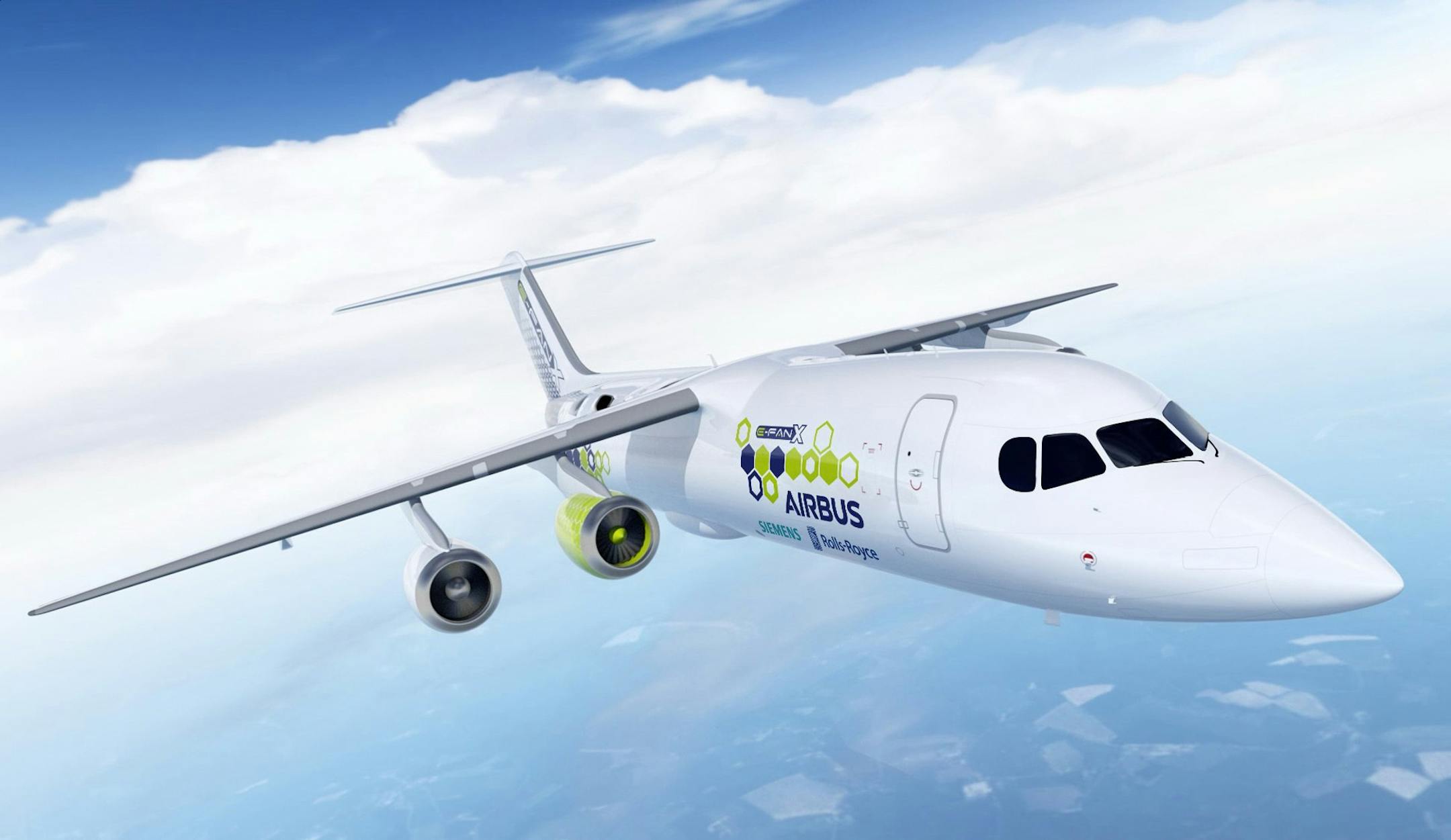
The reason for that became clear Nov. 28, when Airbus announced it has teamed up with Rolls-Royce, a British jet-engine producer, and Siemens, a German electricals group, to convert a small airliner into a "flying test bed" to prove the feasibility of hybrid-electric propulsion.
"We are entering a new world of aviation," said Frank Anton, head of Siemens eAircraft. Electric power, he predicted, would prove to be as significant to commercial aviation as the jet engine.
The general industry view is that battery technology is not yet up to building fully electric airliners. But just as hybrids help to extend the range of some electric cars, so hybrid systems will bring electric aircraft closer to takeoff.
The Airbus team plans to modify a BAE 146, which is a 100-seat regional airliner powered by four conventional jet engines. The first step will be to replace one of those engines with a 2MW electric unit, consisting of a fan contained in a shroud. As with a hybrid car, the fan will be powered by a combination of a battery and a range-extender, in the form of a small jet engine mounted in the rear of the fuselage and hooked up to a generator. This range extender can be switched on during parts of the flight to power the fans or to top up the battery. Because it can be run at its most efficient speed all the time, unlike a jet directly propelling a plane, it would be highly fuel-efficient.


