

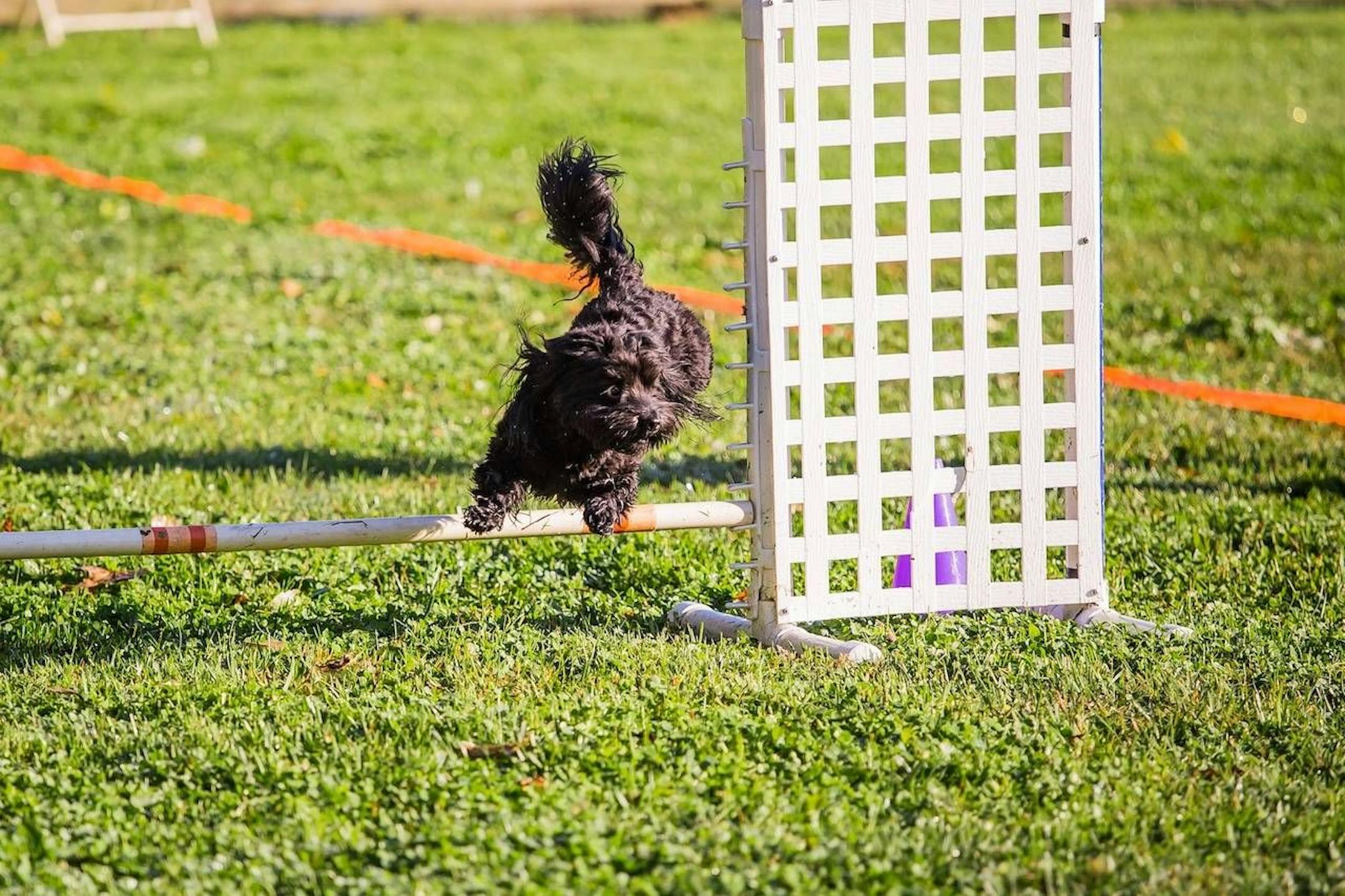
Anyone who’s seen agility on television knows the adorable canines steal the show, barking with bliss as they summit A-frames and tip seesaws, their handlers perhaps fading into the background.
So, who are these human competitors? A term like dog sports might suggest strapping young guys with Jeeps and border collies, but in fact, most participants are more like me, a 56-year-old woman with a Ford Focus and a Yorkiepoo.
Every Thursday evening, on my signal, Clarence bolts from the start line. I shout, “Tunnel!” and his 12-pound body darts into it. I meet him at the other side, yelling, “Walk it!” He climbs an elevated balance beam called a dog walk, and I run alongside, saying “Feet! Feet!” a reminder not to take a flying leap off the equipment – which is not only unsafe, but results in deductions for missing the yellow contact at the bottom. Clarence slows, his body vibrating, the whites of his eyes visible as he studies my face like Come on, Lady! Let’s gooooo! This pause is a Herculean task, requiring as much self-control as any athletic feat. I say “OK!” and he bounds to the next obstacle.
A sport for all dogs
In agility, handlers are given a few minutes to walk a course we’ve never seen before, studying numbered obstacles and calculating how to navigate them, asking questions like, “Should I run along the left or the right side as my dog goes through the weave poles?” The aim is to communicate to our dogs where to go while also staying out of their way. The winner at a trial could be the fastest team, but it could also be the one with the fewest mistakes.
While it’s true that border collies are very well-represented in agility, Clarence and I are proof that all manner of dogs and people can participate. He’s a scruffy rescue that’s had surgery on both back legs for a congenital condition, and I’m someone who grew up with more passion for books than for gym class.
I started agility to give my energetic puppy something to do — he was whip-smart and a master of the dramatic sigh. I never anticipated the activity would enrich my own life, too, but taking classes with Clarence always melts away the stresses of my workday, of child-rearing, of the national news. And the chance to watch other handlers and their dogs is more therapeutic than cute animal videos.
My classmates share similar origin stories. Cindy Hill, age 70, started when her daughter went away to college and left her beloved dog behind. The little poodle became so restless that Hill thought, “This dog needs something to do.” Hill tried agility and got hooked, and although that first dog has since died, she now has three miniature poodles at home that participate. “We all get exercise of the mind and body, as well as socialization. I love the bond with the dogs and the friends I’ve made.”
Many participants in agility are women over 50, and some of my classmates are doing it into their 80s. When they return from knee replacements and cancer treatments, others often pinch-run their dogs, though few competitors seem to need that kind of help for long. Our instructor, Nancy Woodside, 70, says one reason for the endurance in the sport is that agility helps people maintain fitness. “Plus, as you age, you also learn to train dogs to work away from you, so you don’t have to run as much — distance training.”


