

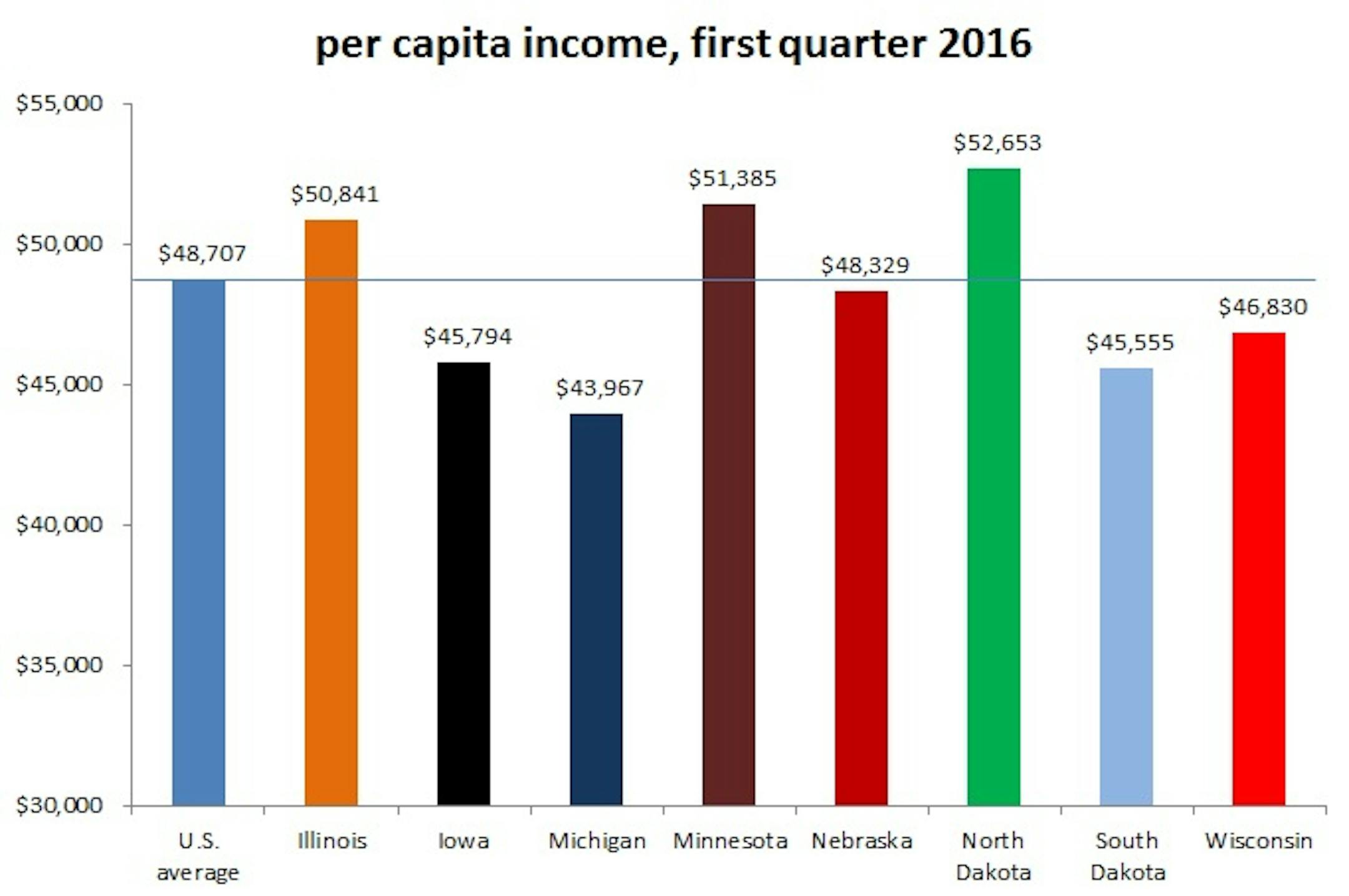
Income in Minnesota is growing more slowly than the U.S. average because of declines in farm income that are a drag on the entire Midwest, but the typical Minnesotan still makes a lot more money than the average American.
Per capita income rose 2.2 percent in Minnesota in the first quarter of the year to $51,385, according to personal income data released this week by the U.S. Department of Commerce.
The tepid income growth — per capita income nationally grew 3.8 percent over the same period — reflects the sagging farm economy and slower job growth in a state where unemployment is 3.8 percent and employers are struggling to find workers. U.S. unemployment is 4.7 percent.
The growth was roughly in line with Iowa, Nebraska and South Dakota, well better than North Dakota and well behind Wisconsin, Illinois and Michigan.
Per capita income is not the same as median household income, which is available by state only through the end of 2014 from the U.S. Census Bureau.
Here are five lessons from the new data on personal income from the first three months of 2016:
1. Minnesota is catching up to North Dakota on per capita income, mostly because income is falling in North Dakota.
At $51,385, Minnesota's per capita income is higher than that of all its neighbors except North Dakota, at $52,653. But in North Dakota, personal income declined year over year in the first quarter by 2.8 percent, and it has fallen for six straight quarters.
Income is falling in most industries in North Dakota because of low oil prices and the cooling off of the Oil Patch, with the largest drops in mining and oil and gas extraction, farming, construction and transportation and warehousing.


