

Most people "would give anything to trade places with you," Dwight MacAuley, the province of Manitoba's chief of protocol, tells his audience. No one disagrees.
In a packed hall in Winnipeg's century-old train station, 86 immigrants from 31 countries are becoming citizens of what MacAuley characterizes as one of the "greatest, freest, richest nations that has ever existed."
Some crowned with turbans, others with hijabs, they sing "O Canada" and take the oath of citizenship in English and French. A local member of parliament, Robert-Falcon Ouellette of the Red Pheasant First Nation, drums an honor song. A Mountie in red serge stands at attention; afterward he poses for pictures with the new Canadians.
Scale of openness
Some 2,000 such events take place across the country every year. Fresh recruits keep coming. Canada admitted 321,000 immigrants in the year to June 2016, nearly 1 percent of its population; typically 80 percent of them will become citizens. It is contemplating an increase to 450,000 by 2021. A fifth of Canada's population is foreign-born, nearly twice the share in the United States.
The warmth of the welcome is as striking as the scale of the intake. Immigrants are encouraged to keep their cultures. Winnipeg's public schools have classes taught in Spanish and Ukrainian as well as French and Cree. Its Central Mosque is a few blocks down Ellice Avenue from the Hindu Society of Manitoba. The Juliana Pizza & Restaurant serves its "Greek/Jamaican food" just a bit farther on.
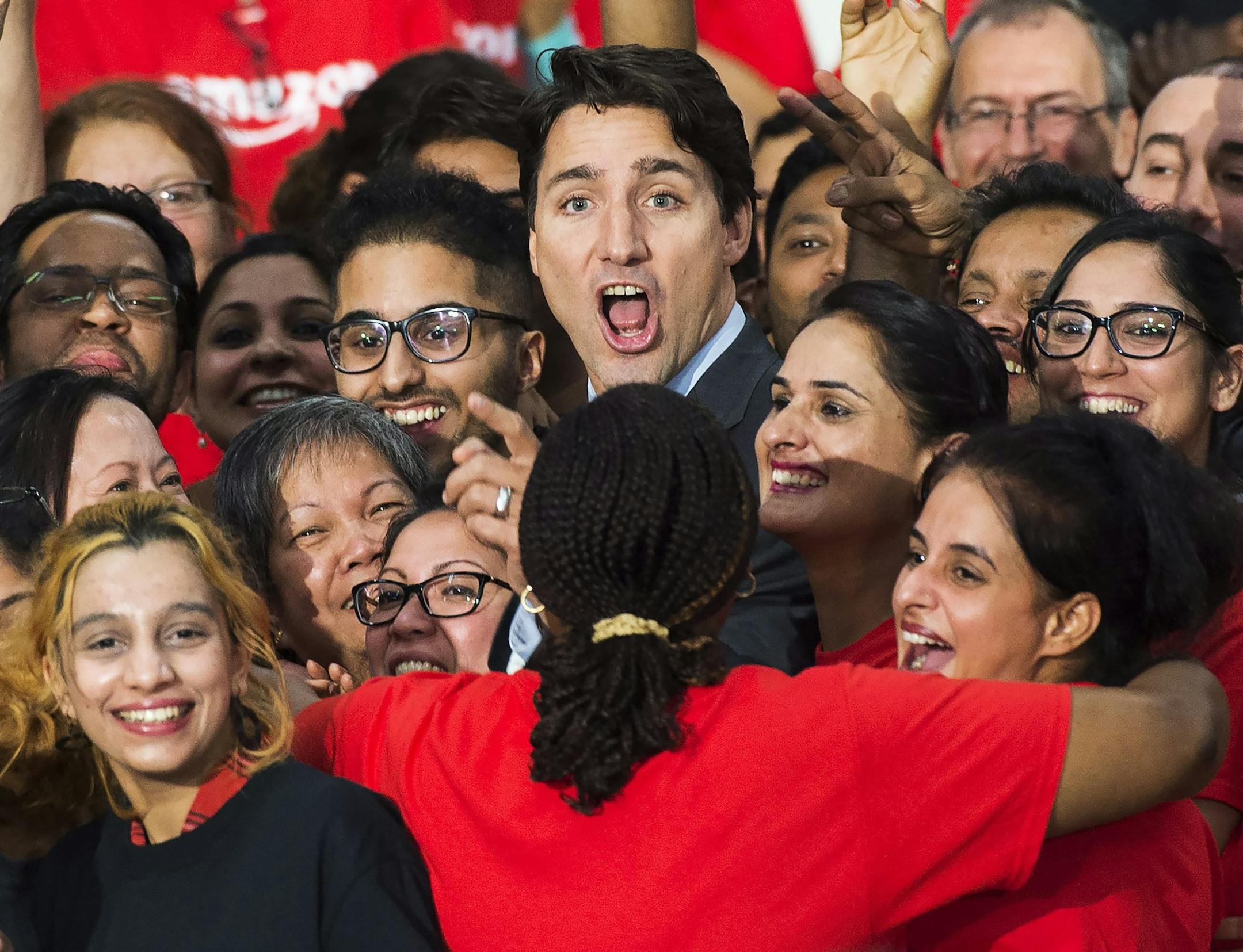
Canada's openness is not new, but it is suddenly getting global attention. It is a happy contrast to what is happening in other rich countries, where anger about immigration helped bring about Britain's vote for Brexit, Donald Trump's nomination and the rise of populist parties across Europe. And it has an appealing new face: Justin Trudeau celebrates his first anniversary as prime minister on Friday.
Trudeau comes from Canada's establishment — he is the son of a former prime minister — but is not despised for it. A former high-school teacher and snowboarding instructor, his cheeriness played a large part in the Liberal Party's victory over Stephen Harper, a dour conservative who had governed Canada for almost 10 years.
Where Harper was liberal, for example on trade, Trudeau carries on his policies. Where the conservative clenched, the Liberal loosens. Trudeau is seizing the opportunity offered by low interest rates to ramp up investment in infrastructure. He will end a visa requirement for Mexicans that Harper imposed and plans to legalize recreational cannabis. Harper was close to being a climate-change denier; Trudeau announced in October that he would set a price on carbon emissions. A month into the job he went to Toronto Pearson International Airport to welcome some of the 32,737 Syrian refugees admitted since he took office.


