

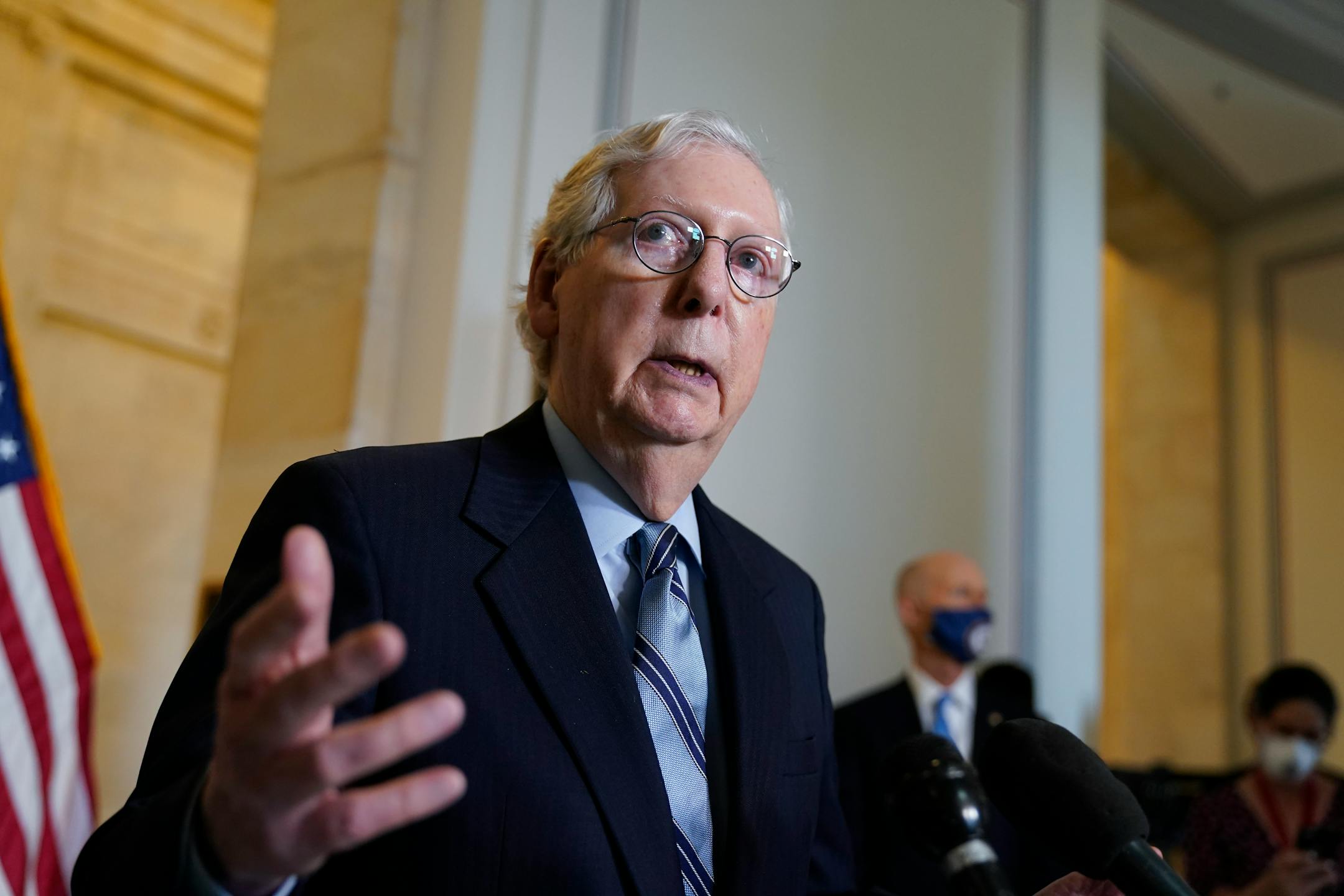
Mitch McConnell has a long history of playing hardball — even changing the rules of American politics — to benefit the Republican Party.
He has opposed limits on campaign finance, knowing that corporations and the wealthy donate to Republicans. As the Republican Senate leader, he has helped turn the filibuster into a normal tactic. He has boasted about his desire to damage the presidencies of both Barack Obama and Joe Biden. And McConnell in 2016 refused to consider any Supreme Court nominee by Obama, effectively flipping the seat back to a Republican nominee.
In each of the cases, McConnell, of Kentucky, has been willing to break with precedent in ways that many historians and legal scholars consider dangerous. He often seems to put a higher priority on partisan advantage than on American political traditions or even the national interest, these scholars say.
So how is the country supposed to make sense of McConnell's actions this week?
On Tuesday, he criticized the Republican National Committee for its response to the Jan. 6, 2021, attack on the Capitol. The committee — the party's official organization — had described the events of Jan. 6 as "legitimate political discourse" and censured Reps. Liz Cheney and Adam Kinzinger, two House members who are helping investigate the riot.
McConnell repudiated his own party. "We saw what happened," he told reporters. "It was a violent insurrection for the purpose of trying to prevent the peaceful transfer of power after a legitimately certified election, from one administration to the next. That's what it was."
The remarks were striking because McConnell's position on Jan. 6 — and on Donald Trump's false claims of election fraud that inspired the attack — has been inconsistent. At first, McConnell harshly criticized Trump for inciting it, only to back off. He voted to acquit Trump of impeachment charges, effectively keeping Trump as the party's dominant figure.
"To this day McConnell has been unwilling to impose any political consequences on Trump," Amanda Carpenter of the Bulwark, a conservative publication, has written. McConnell also waited more than a month to acknowledge that Biden had won the 2020 election.


