

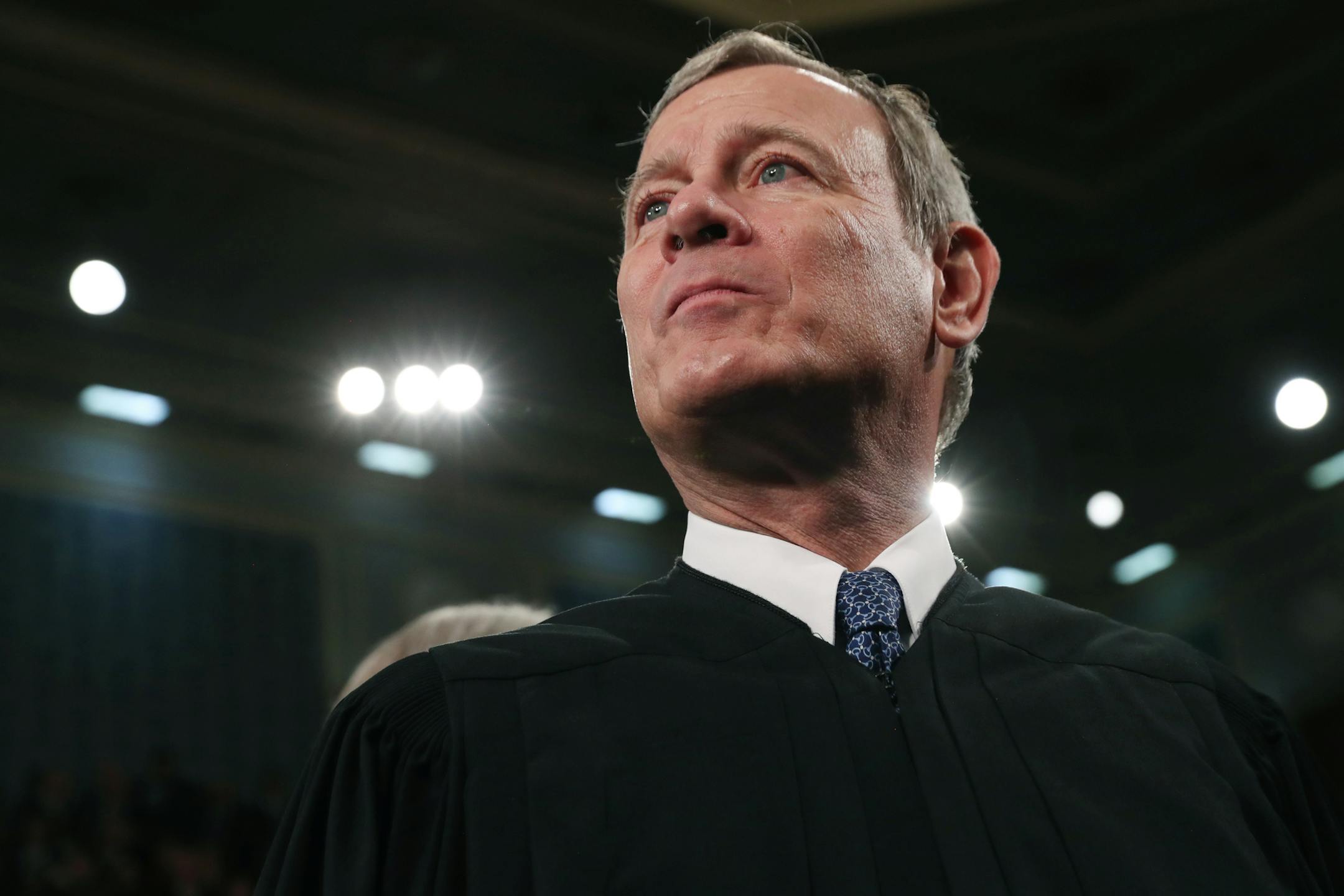
Chief Justice John Roberts has drawn his line in the sand. In what may well come to be his most famous opinion ever, a solo concurrence in Monday's Louisiana abortion case, Roberts voted to uphold Casey v. Planned Parenthood, the 1992 decision in which Justices Anthony Kennedy, Sandra Day O'Connor, and David Souter declined to overturn Roe v. Wade. The basis was stare decisis — the doctrine of precedent which, he said, instructs us "to treat like cases alike" rather than changing the rules and reversing course.
Roberts made it clear that he reads the Casey decision very narrowly, to allow restrictions on abortion that don't impose an "undue burden" on reproductive freedom. He signaled that he is still open to upholding laws that chip away at the existing abortion rights framework, which has been his approach in the past. Roberts hasn't had some transformative epiphany that made him into a staunch defender of abortion rights.
But crucially, Roberts also made it as clear as he could that, so long as he is the swing vote on the court, he isn't open to overturning Roe or Casey. He doesn't want the Roberts Court to be remembered as a reactionary body that reversed nearly 50 years of settled law on abortion rights.
This is a massive setback for legal conservatives. It means that to overturn Roe and Casey, they need President Donald Trump to be re-elected and to get at least one more conservative on the court to replace a liberal justice.
If Trump is not re-elected, then Roberts has single-handedly pulled off what the troika of Kennedy, O'Connor and Souter did almost thirty years ago: saving abortion rights for another generation.
Roberts's decision in today's case, June Medical Services v. Russo, began with his acknowledgment that the Louisiana law in question was basically identical to the Texas law that the Supreme Court struck down in 2016 in a case called Whole Woman's Health v. Hellerstedt. In that case, Kennedy provided the fifth vote for a strikingly liberal decision by Justice Stephen Breyer, who wrote the plurality opinion for the court in today's case.
The Louisiana law, like the Texas law, imposes a set of restrictions on abortion providers that include requiring doctors have admitting privileges at a hospital no more than 30 miles away from the abortion clinic. In the Hellerstedt case, Breyer took the "no undue burden on abortion rule" laid down in the Casey decision and turned it into a cost-benefit analysis. (Breyer made his academic career as a scholar of regulation, and cost-benefit analysis is in his blood.)
Roberts joined the dissenters in the 2016 Hellerstedt case. You read that right. Four years ago, Roberts thought the Texas restrictions were consistent with Casey. His vote at the time was based on the strategy that he had long embraced of not overturning Roe but instead subjecting abortion rights to death by a thousand small cuts.


