
Why videos of ICE in Minnesota are a ‘breakthrough moment’ online

Most news events don’t widely register in the public consciousness. Experts say it’s different with the killing of Renee Good and the ICE surge in Minnesota.

The Minnesota Star Tribune
January 17, 2026 at 12:00PM
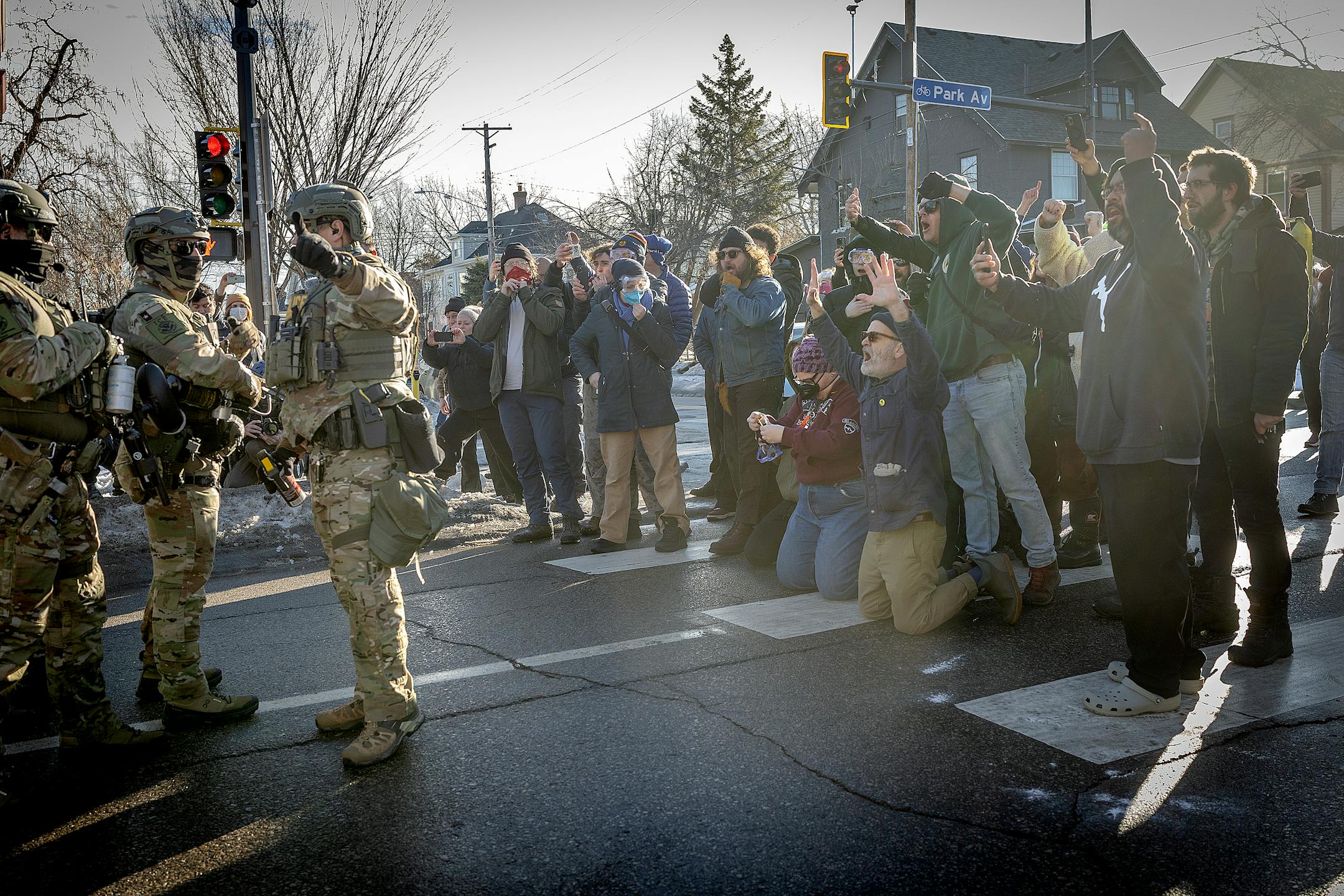
Protestors, some filming with their phones, yell at federal agents on Jan. 13 near the area where Renee Good was killed in Minneapolis. (Elizabeth Flores/The Minnesota Star Tribune)

The deluge of videos of ICE in Minnesota began with several showing a federal agent fatally shooting Renee Good in Minneapolis.

And now the internet and social media feeds are flooded with clips of what’s happened since: Federal agents smash a car window, pull a man out and detain him at a St. Paul gas station. Agents carry a U.S. citizen out of her car by her arms and legs as she yells she was on her way to the doctor. Protestors blow whistles, honk horns and yell at ICE agents in an effort to disrupt their work.

There’s always a stream of news online. But this is different. Videos from people documenting ICE’s presence in Minnesota are breaking through to an almost-unavoidable degree — giving people an unprecedented view of what’s happening on the ground. And while people’s interpretation of ICE’s presence differs with their politics, some polls suggest support for the agency is eroding.

“It is sort of wild how many people report seeing this,” said Shannon McGregor, an associate professor at the University of North Carolina Chapel Hill’s Hussman School of Journalism and Media.

McGregor, who studies the role of social media in politics, said she sees this as a rare “breakthrough” moment, when it’s not just people who are politically engaged watching and sharing videos. That could, she said, be because first-person videos are a visceral way to experience news.

“It doesn’t necessarily mean it changes their opinion,” McGregor said, but video “can be so much more impactful in how it makes people feel as compared to reading something or hearing something.”

‘Like a tidal wave’

Within days of Good’s shooting, the majority of Americans had watched the videos bystanders took of the shooting on Portland Avenue, according to polls from Quinnipiac University and YouGov.

“Just about the whole darn country has seen video of this,” said Tim Malloy, a Quinnipiac polling analyst.

He said that’s not entirely surprising because the story unfolded with multiple camera angles becoming available over time: “The story built momentum like a tidal wave and it’s still spilling over.”

In a poll conduct Jan. 8 through Jan 12, Quinnipiac found 82% of Americans saw the video — by now likely more, Malloy said.

“Evenly divided, 83% of Republicans, 81% of Democrats, 84% of Independents — that is a sweep,” Malloy said, adding that in 16 years at Quinnipiac, he’s not sure they’ve polled another event that’s penetrated the public consciousness so quickly.

It’s not just the videos, but the debate about them across a variety of media, that further cemented Minnesota in the national psyche. Podcasts from of all political stripes, from Pod Save America to the Joe Rogan Experience to the Ben Shapiro Show, have discussed the shooting or subsequent videos.

Both Quinnipiac and YouGov found the share of respondents who said the shooting was unjustified greatly outnumbered those saying it was justified. YouGov found the margin was nearly 2-1, while Quinnipiac found a 53%-35% split.

Both polls found a stark difference by party affiliation, with Republicans far more likely to say the shooting was justified and Democrats more likely to say it was not.

Their feelings on whether the shooting was justified were more likely to align with their partisan leaning than whether or not they saw the video, YouGov found.

“People are seeing the video and they’re seeing different things in it,” said David Montgomery, senior YouGov data journalist. “Democrats are seeing the video and becoming even more convinced that the shooting was not justified, and Republicans are having the exact opposite reaction.”

Quinnipiac found 40% of voters approve of ICE’s s enforcement of immigration laws, virtually unchanged since July.

But YouGov found more than half of Americans have unfavorable views of ICE and see its tactics as too forceful. YouGov found growing support for eliminating the agency and majority support for stricter ICE recruiting requirements and barring agents from concealing their faces with masks while making arrests.

Different interpretations

The ongoing nature of the ICE surge in Minnesota and the cadence of videos makes this event different from a one-off news event, too, McGregor said.

“It’s more salient because it’s ongoing,” she said. Even for people outside Minnesota, the experiences captured on videos of being at a gas station or at a Target store may be relatable to viewers.

She said it’s also striking that the same videos of Good’s shooting are being shared by people with differing views, arguing the images support their case.

The video apparently taken by ICE agent Jonathan Ross was first shared to a right-leaning news outlet, McGregor said, likely “you must imagine because they thought it would be exonerating.”

McGregor said people tend to think videos show a definitive account of what happened.

“But we know that’s not true,” she said because people may interpret the same video differently, finding different sets of facts in what it shows.

However it’s interpreted, McGregor said, it’s clear Good’s killing and the ICE surge in Minnesota have broken through the national consciousness, even more than ICE actions in other cities.

She said she sees people who don’t normally express political opinions sharing videos of ICE in Minnesota.

“These breakthrough moments matter a lot because of that,” she said. “Because it’s reaching this group of people that’s otherwise quite hard for politicians to reach.”

about the writer

about the writer

Greta Kaul

Reporter

Greta Kaul is the Star Tribune’s built environment reporter.

See Moreicon

More from News & Politics

See More
card image
Alex Brandon/The Associated Press

Before threatening the Insurrection Act, Trump officials privately strategized about using the Alien Enemies Act to detain people in Chicago, according to Signal messages reviewed by the Star Tribune.

card image