

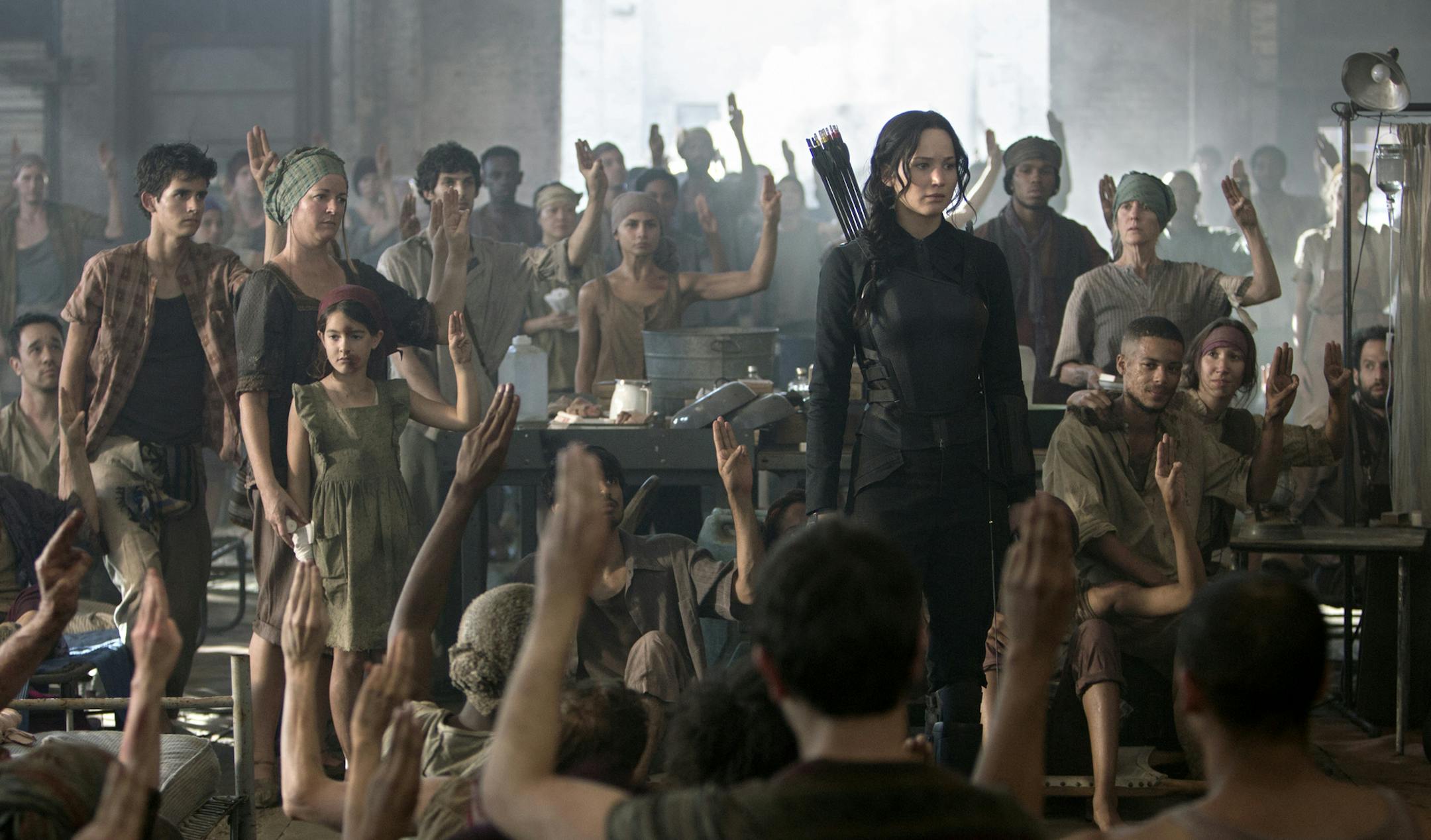
The latest Hunger Games film, "Mockingjay — Part 1," is topping the international box office. Although it's a Hollywood blockbuster aimed at young adults, it presents potentially quite subversive ideas of mass revolution, economic sabotage and the populist fight against oligarchy.
These themes of popular uprising are particularly relevant in light of the current civil unrest happening across the world, from the streets of Hong Kong to those of the United States — the latest "Hunger Games" has tapped into a certain zeitgeist of global rebellion. Thailand's prodemocracy protesters have even directly borrowed the movie's three-fingered symbol of resistance in their own struggles against a repressive regime. Adding fuel to this fire, one of its main stars, Donald Sutherland, recently declared: "I want 'Hunger Games' to stir up a revolution."
Despite these heady sentiments, the film's depiction of revolution is astonishingly simple: an adolescent vision of toppling an "evil" authority figure. Sure, this isn't surprising (as it's meant for young adults), but in the context of political spillover, this anti-authoritarian vision becomes more troubling. It reinforces prevailing Western ideas of social change — fastening on the idea that all one needs to do is eradicate the enemy. And, worryingly, it appears that this sort of adolescent rebellion isn't just consigned to teenage entertainment; it also increasingly forms our real adult fantasies.
The third "Hunger Games" movie takes place in the midst of a full-scale popular rebellion. Unlike the previous films, which fix their attention mainly on the games themselves, this one focuses exclusively on the attempts of the resistance to inspire mass revolt among the oppressed districts against the wealthy capital and its nefarious President Snow.
Within its melodrama of teenage romance lies a potentially fundamental critique of a status quo that bears much resemblance to our own times. The idea of a rich capital and its citizens exploiting workers in peripheral territories resonates with existing global divides between richer and poorer countries. Additionally, it speaks to growing economic insecurities associated with the increasing powers of the market and exacerbated by the 2008 financial crisis.
These films tap into the real anger of many, on both the left and right, who see a world emerging that is composed of the "haves" and "have nots" ruled by a privileged elite and their police forces.
The film's fixation on overcoming the rule of a malevolent leader reflects an image of popular struggles as primarily defined by fighting those in authority. Ignored is the perhaps less dramatic but more important process of collectively transforming social conventions, power structures and identities.
"The Hunger Games" undoubtedly portrays adult themes — yet ultimately it does so in a way that would appeal to its predominantly young audience. The main character Katniss' valiant struggle against Snow and latent distrust of those authority figures supposedly on her side all speak to teenage desires to heroically rebel against those who wield power over them.


