

When I run into former students, I feel pride and affection, seeing them suited up and taking on the larger world with the competence and confidence we tried to instill in them when they were in high school. As they dip their toes into the stream of networking that will carry them into their futures, I feel as if I'm watching from the shore, waving my syllabus and shouting: Don't forget to use your imaginations! Because, although we taught them to be confident and competent, we also hoped they would be compassionate — a trait that begins with imagination and fully flowers with empathy.
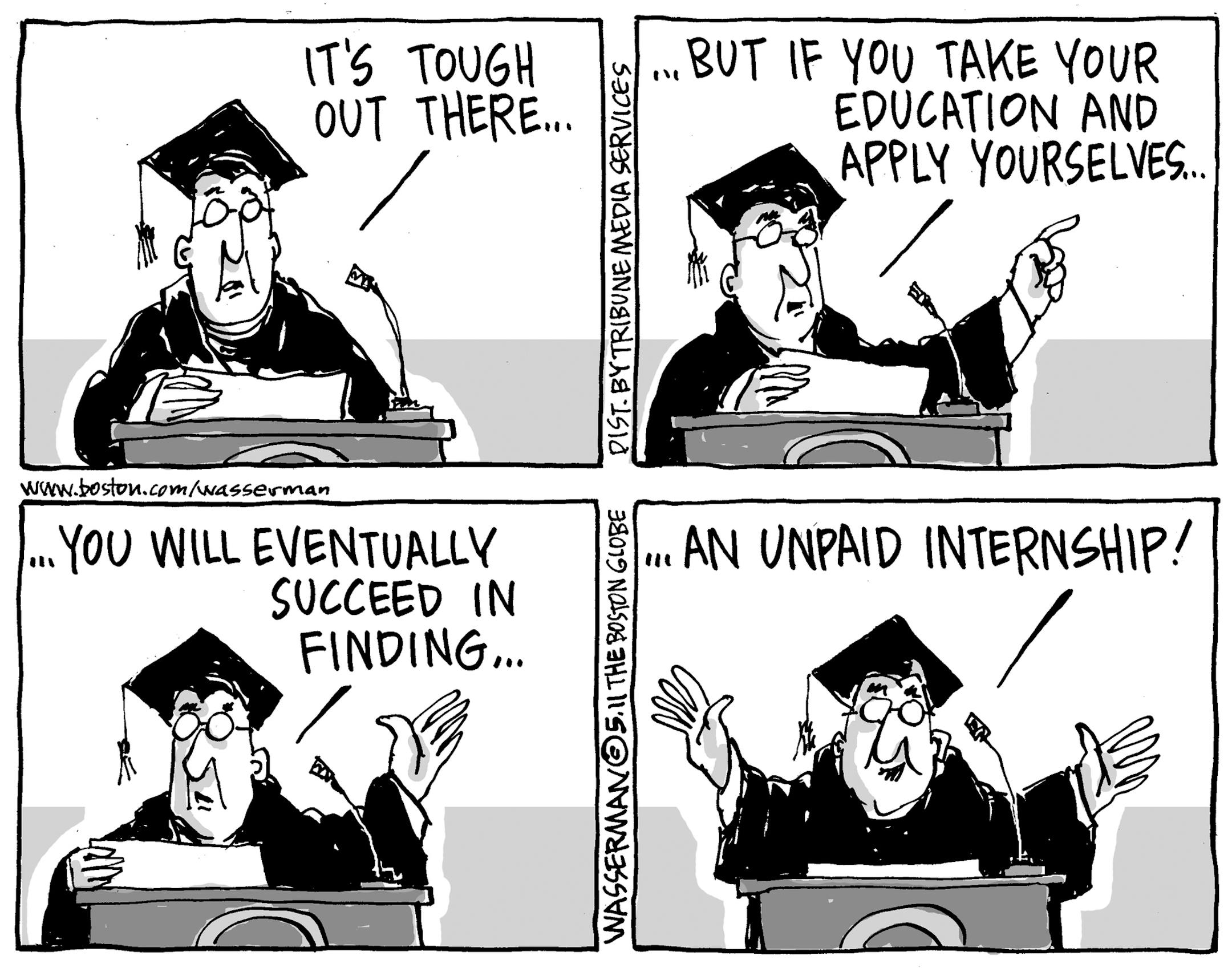
Which brings me to the current debate about unpaid internships. The unpaid internship may be a thing of the past after a federal judge ruled in June that Fox Searchlight violated the Fair Labor Standards Act. The decision has started a kerfuffle among the beneficiaries of unpaid internships. Their argument? If interns gain skills beyond what they learn in the classroom and if they are willing to work for networking opportunities and other "career capital" in lieu of a paycheck, what's the problem?
Here's the problem: suspiciously lacking from this debate is the truth that unpaid internships give a leg up to the well-off. As a teacher hoping to send students into the larger world with sympathetic imaginations — and if not yet a kinship for people of lesser means then at least an awareness of their plight — I find this omission disappointing.
I am not against unpaid internships. My point is that I would like to see a healthy acknowledgment, by those fortunate enough to avail themselves of them, that unpaid internships give people of means an advantage. I'd like to see that because humility and gratitude are much better for our democracy than lack of awareness and a sense of entitlement.
I know that working a productive job is important to keeping our economy clicking, and I applaud every young person who finesses his connections to get a good job. But I also agree with Alexis de Tocqueville when in "Democracy in America" he suggests a downside. Individualism, he wrote, is "a calm and considered feeling which disposes each citizen to isolate himself from the mass of his fellows and withdraw into his circle of family and friends; with this little society formed to his taste, he gladly leaves the greater society to look after itself."
This is not the attitude students should take with them into the world.
There is no lack of insular thinking in our society; failing to acknowledge our advantages only makes it worse. And it's not just unpaid internships that favor the well off. Unpaid service work (recently disdained in a Wall Street Journal commentary as mere "résumé fodder") is also an opportunity more available to the wealthy. The difference, however, is that service work — for résumé fodder or more altruistic purposes — more likely prevents insular thinking because it brings people together who might otherwise remain divided by circumstance.
For 40-some years, my father worked as a social worker. Every day he would suit up and head downtown and do his best to find homes for children orphaned by drugs or crime. He saw sad things and often felt powerless. He never said much, but he did say these words (which I took to be wisdom from years in the trenches): "These people do not want to be on welfare."


