
University of Minnesota professor enters Hennepin County attorney race as ‘innovator’ candidate

Francis Shen has focused his career on researching the intersection of neuroscience and the law and wants to bring “21st century” prosecution to Hennepin County.

The Minnesota Star Tribune
November 27, 2025 at 12:00PM
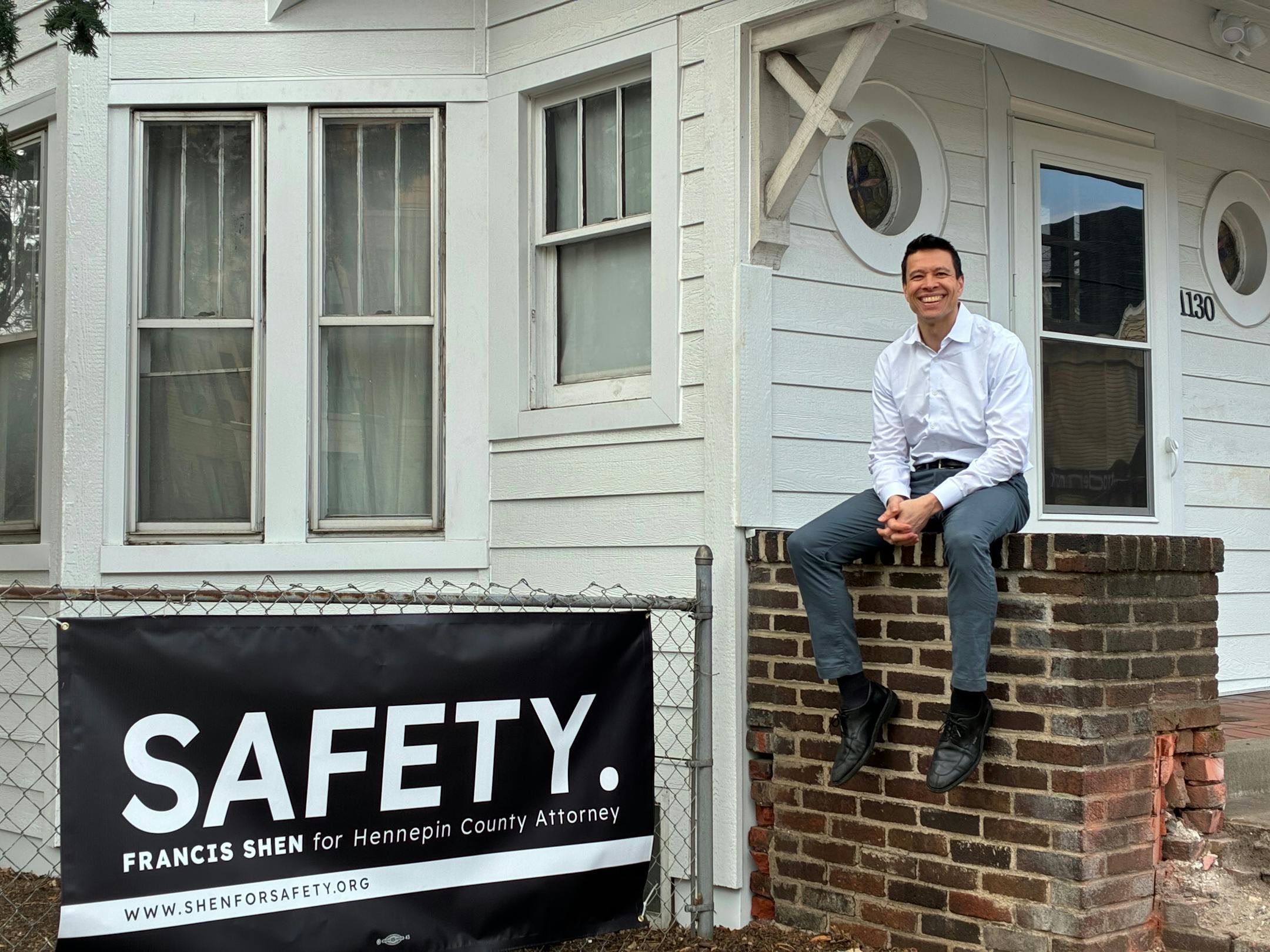
University of Minnesota professor Francis Shen sits on the porch of his campaign headquarters in Dinkytown. (Jeff Day)

University of Minnesota law professor Francis Shen knows he can’t win the race for Hennepin County attorney competing on his record as a prosecutor, which is exactly why he’s running for the office.

“The question for the public would be: ‘Do you want a litigator or an innovator?’” Shen asked. “If you want a litigator, that’s really clear, there’s some great litigators running. There’s only one innovator.”

Shen, 47, is one of the foremost experts on the emerging understanding of the intersection between law and neuroscience. He earned his law degree and Ph.D. in government and social policy at Harvard before joining the MacArthur Foundation Law and Neuroscience Project. He joined the faculty at the U law school in 2012 and now directs the Shen Neurolaw Lab and is the chief innovation officer of the Center for Law, Brain & Behavior at Massachusetts General Hospital.

In an interview with the Star Tribune this week, Shen said we are entering the “dawn of the 21st century prosecutor,” while adding that rapid technological advancements in artificial intelligence have already created massive changes in criminal justice. He’s been studying that world for more than a decade. Shen said he’s running because he has the unique expertise to understand and leverage that technology to focus on his one word campaign motto: safety.

He wants to use AI and more thoughtful data gathering to target criminal behavior using what he called “sequential interventions.” He brought up smarter DWI enforcement that tries to identify alcoholics who are likely to reoffend and trying to slow the endless cycle of repeat violent offenders.

“Most of what we call serious crime, there is a path leading up to it,” Shen said. “There were opportunities for the system to intervene earlier on.”

He said those interventions have to be layered with fair, consistent punishment.

“It’s the balance of the carrot and the stick. Carrots are things like, here’s the off-ramp for violence: mental health treatment, working with community partners, housing, jobs, all of those things,” Shen said. “If you don’t take the off-ramp, you have to have the stick.”

When it comes to community partners, Shen said the County Attorney’s Office and law enforcement have to not only be collaborative but work together to leverage technology. He pointed to current Minneapolis police department clearance rates of 20% for rape, less than 20% for robbery and 1% for auto theft.

“If people have a sense of lawlessness, they’re right,” Shen said, noting that AI can help ease the workload for police and prosecutors alike.

Shen has argued that less than 1% of the population is responsible for a disproportionate amount of gun violence and we do not need to “blanket the entire city” with police, but use technology to target the areas that need it.

He has focused his entire career on wondering how neuroscience could and should intersect with the law, from futuristic concepts like the viability of brain-wave lie detectors to more deeply rooted research into how neurological development impacts addiction and mental health — especially in young people.

“We’re ready to do it in the real world,” Shen said. “With real world constraints where there aren’t enough mental health beds and there aren’t enough resources and there’s crisis after crisis.”

Shen is a St. Louis native who had one grandfather who was a legendary union leader and another who fled China before the communist revolution and became a pro-life advocate who helped bring Mother Teresa to Missouri. He has co-authored four books and has won 10 individual championships in USA Track & Field competitions.

His campaign headquarters is a house in the heart of Dinkytown at the corner of 4th Street and 12th Avenue. He has already started to staff it with college volunteers who will get free housing in the spring. He plans to run a ground campaign built on door knocking.

He lives in the Bryn Mawr neighborhood of Minneapolis with his wife, Sophia Beal, a Portuguese professor at the U who is also associate dean for graduate fellowships and awards. They have two children: Simone, 12, who is a club volleyball acolyte of the legendary Annie Adamczak-Glavan, and Gabriel, 13, who wrote, directed and scored a raucous musical about death that premiered at the Minnesota Fringe Festival this summer.

“If somebody else was doing what I thought they should do, I’d just watch my daughter’s volleyball games and hang out while our oldest, Gabriel, makes theater,” Shen said. “But I feel so strongly and so compelled. This is the moment to do this thing.”

Moriarty’s term ends Jan. 4, 2027. The nonpartisan primary for county attorney will take place in August 2026 with the top two finishers moving onto the general election in November.

about the writer

about the writer

Jeff Day

Reporter

Jeff Day is a Hennepin County courts reporter. He previously worked as a sports reporter and editor.

See Moreicon

More from News & Politics

See More
card image
Shari L. Gross/The Minnesota Star Tribune

The nonprofit grocery store opened in 2017 to serve a neighborhood deemed a food desert.

card image
card image