

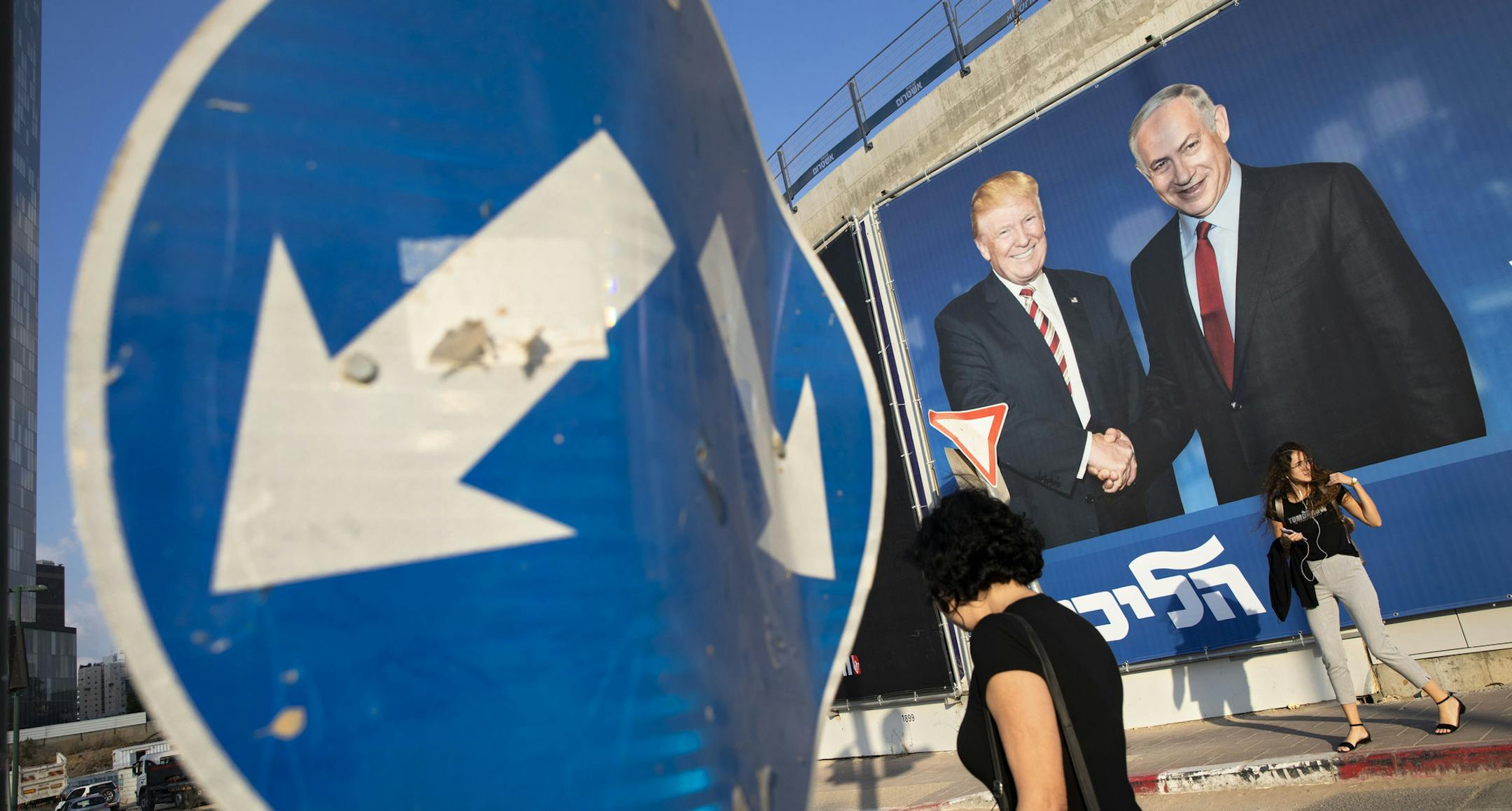
A campaign poster for the 2019 Israeli election — one of four in just two years — showed a smiling Prime Minister Benjamin Netanyahu shaking hands. But not with a coalition partner, or even reaching out to a rival in a magnanimous gesture. Rather, the man looking equally enthused to grip and grin was then-President Donald Trump, looking like a running mate in a U.S.-style campaign.
In metaphorical ways, the president and prime minister were running mates. More broadly, Netanyahu's closer association with Republicans was a sharp departure from the traditionally bipartisan foundation of the U.S.-Israel relationship.
That condition, which is good for both countries, may return — if the inchoate coalition formed to oust Netanyahu can hang together and pass an impending confidence vote in the Knesset.
That's not a sure thing, said David Makovsky, director of the Koret Project on Arab-Israel Relations at the Washington Institute of Near East Policy. Most coalition governments, Makovsky said, are ideologically in between the 30-yard lines. This one, an eight-party political octopus spanning the far right to far left — with the support of an Arab Islamist party — "is from end zone to end zone," which may allow Netanyahu to "pick off a backbencher" to scuttle the one-vote majority.
Speaking from Israel around 1 a.m. on Thursday, just an hour past Wednesday's midnight deadline to form a government, Makovsky reflected on the parallels between both nations' recent elections and how American-Israeli relations affected, and may be affected by, the outcomes.
Makovsky, who served for two years of the Obama administration as a senior adviser to the special envoy for Israeli-Palestinian negotiations, said that Netanyahu and Trump "both rely on populist themes for their support, and both have kind of stoked the idea of elite opinion against them as a way to rally their base" — especially as Netanyahu faces legal peril from charges of bribery, fraud, and breach of trust (which he denies).
The two leaders are "not identical, but there have been some troubling similarities recently. And in each case, there was a belief that four more years could politicize institutions that historically have prided themselves on their independence, their vitality, their resilience," Makovsky said.
Daniel C. Kurtzer, a former U.S. ambassador to Israel during the George W. Bush administration and to Egypt during the Clinton administration, sees similarities, too. Now a Princeton professor of Middle East policy studies, Kurtzer said that "since 2009 one can measure an increasing degree in which Prime Minister Netanyahu not only distanced himself from Democrats [but] adopted Republicans as their [coalition's] natural allies for his political movement." When Trump won the presidency, Kurtzer continued, Netanyahu "quite specifically adopted Trump's views and his behaviors to the point where much of the language became the same."


