

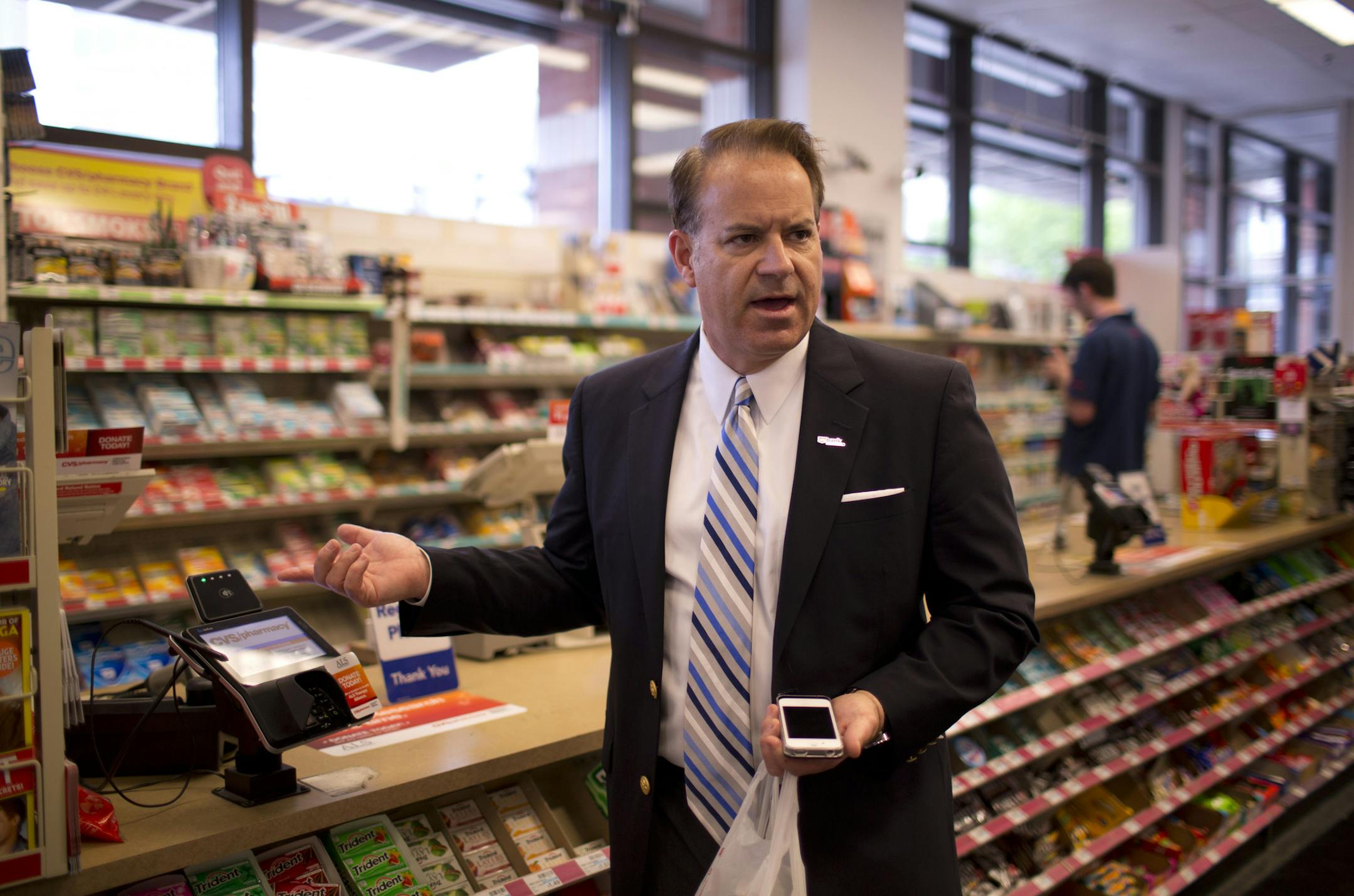
U.S. Bank wants you to substitute a wave of the cellphone for a swipe of the credit card when making retail purchases.
The service, which is aimed at technology early adopters and business travelers, is based on a wireless technology widely used in Europe and Asia in place of magnetic stripe credit cards, which are considered more vulnerable to fraud, U.S. Bank officials said. The cell transactions are protectively coded, or encrypted, while credit card purchases are not.
The bank's Go Mobile Payment Service requires an iPhone 4 or 4S that is equipped with a special app and a custom iPhone protective case that contains a computer chip. The chip uses a technology called Near Field Communication to interact with a wireless checkout terminal at a retail store. When software on the phone is activated, waving the phone within less than inch of the terminal completes a purchase. Wireless purchases are charged to a U.S. Bank credit card account.
"The technology hasn't gone mainstream in the U.S.," said Todder Moning, U.S. Bank's senior vice president of payments innovation in Minneapolis. "When I use it, people always say they've never seen someone use a phone that way."
But to use the service, the customer must sign up for a U.S. Bank FlexPerks Travel Rewards Visa Signature card, which contains a computer chip to store personal information. U.S. Bank will then send the customer a free iPhone case. Customers must also download the free U.S. Bank Go Mobile app from the Apple iTunes store to use the case's features.
But the bank is swimming upstream with the advanced service. The New York Times reported in February that U.S. consumers are hesitant because they don't think it offers an advantage over familiar credit cards and there are several competing technologies that leave them confused.
Other similar companies include Square, which makes a tiny mobile credit card reader for smartphones and tablet computers, and which has a partnership with Starbucks; a planned mobile payment network called Merchant Customer Exchange supported by Best Buy, Target, Wal-Mart and other retailers; Isis, a mobile payments network collaboration by AT&T, Verizon Wireless and T-Mobile USA; and Sprint, which has its own system.
Google Wallet, another wireless payment initiative that works on smartphones with the Near Field Communication feature, has gained little traction, and the vice president in charge of it recently resigned from Google.



