

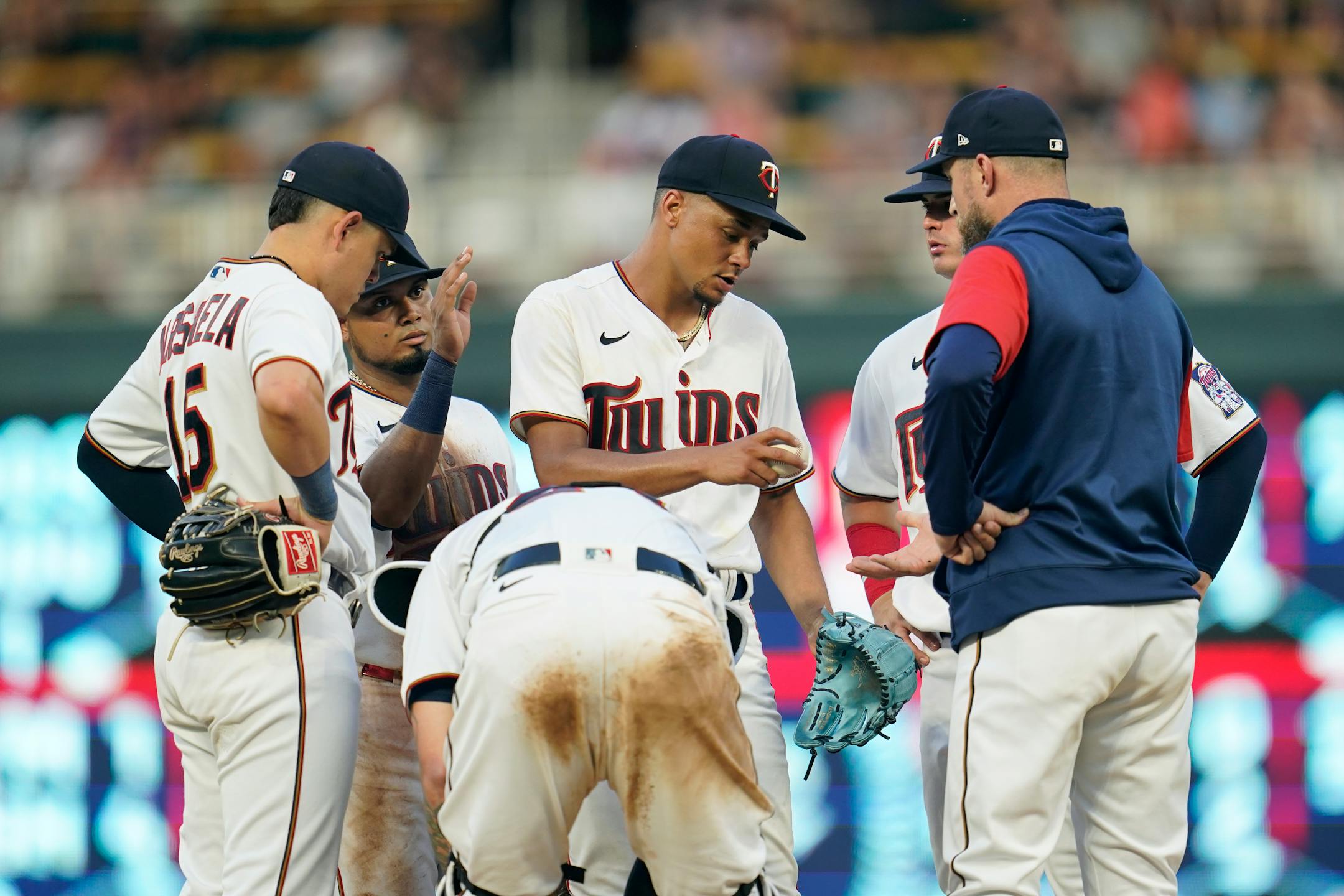
It hadn't been a good inning for Dylan Bundy on Saturday night, having given up Bo Bichette's two-run homer to tie the score 2-2. But after inducing a Danny Jansen fly out to end the fourth, Bundy reached the Twins dugout and began thinking about the fifth.
Then he saw Rocco Baldelli walking toward him.
"There's never a discussion. I know as soon as he comes over, it's game over," Bundy said, shrugging. "Shake his hand, look him in the eye, and evaluate from there."
Bundy's initial self-evaluation was disappointment, he said, at such an early, abrupt end to his evening against the Blue Jays.
"Obviously, I want to go deep in the game. Five innings is like the minimum as a starting pitcher. Didn't quite make it there tonight," the 29-year-old righthander said. "Wasn't too efficient, so it led to to the top of [Toronto's] order coming up in the fifth. [Avoiding them] is kind of how we're running things, and I understand that."
Most baseball observers, and surely most Twins fans, understand it by now, too. Baldelli insists it's not a blanket policy; it's more of a nightly choice that has tended to come down one way lately. Regardless of the process, though, the result has been clear: No team tries to avoid the so-called "third-time-through penalty" more than the Twins.
"We make all of our decisions on a game-by-game and really, at-bat-by-at-bat basis. We're just trying to win the game that we're playing," Baldelli said. "Sometimes it's letting your guy go out there and throw 98 pitches and do it that way. Sometimes, it's having your starters go four innings."
The Twins have leaned heavily toward the latter scenario, particularly this season — and it's an understandable choice. No team has paid a higher third-time-through penalty — the statistical fact that hitters tend to be more productive the more times they face a pitcher in a game — than the Twins.


