

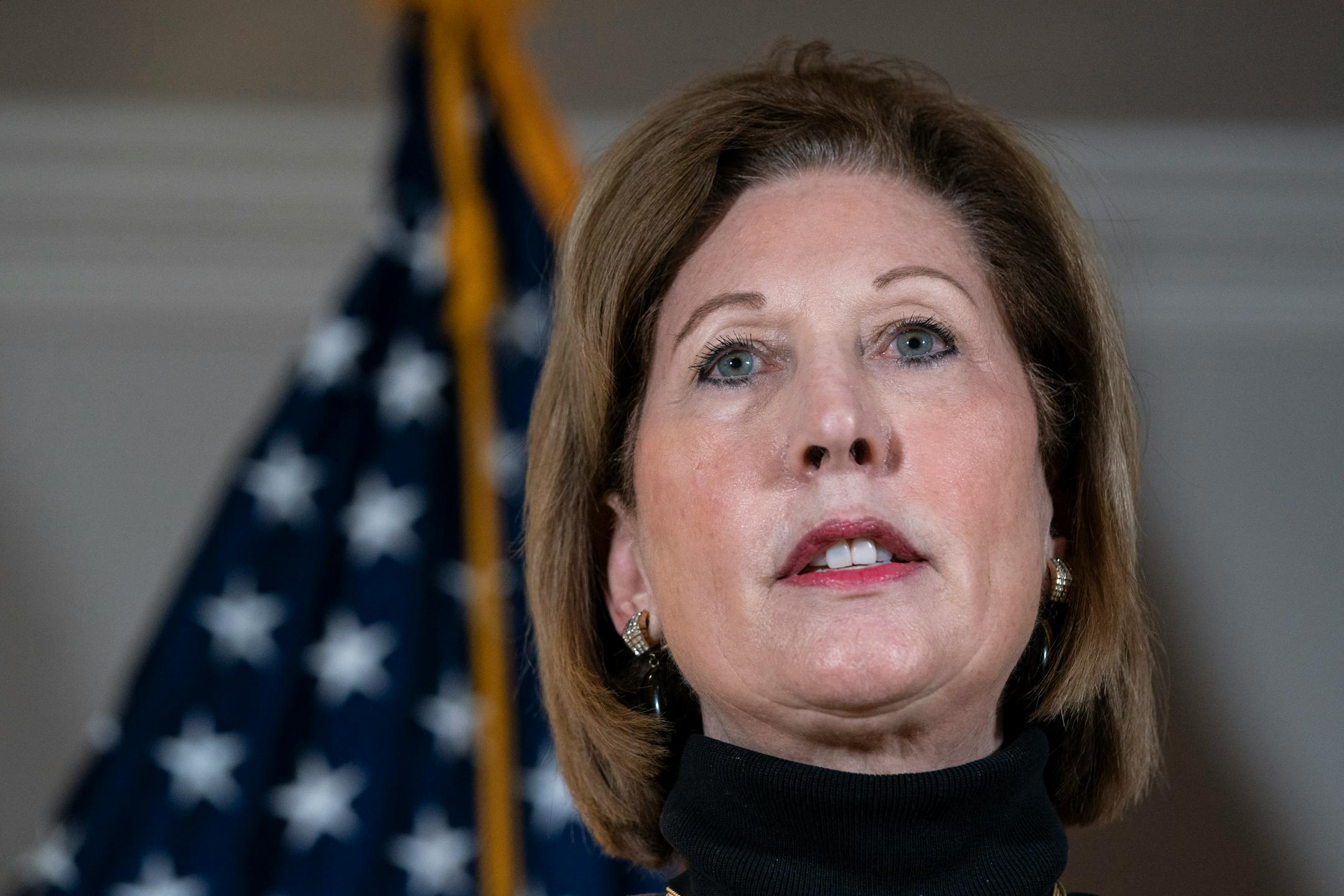
Sidney Powell, one of Donald Trump's former lawyers, is being sued by Dominion Voting Systems for defamation. Her lawyers have entered a truly astonishing defense: that her statements alleging the Democratic Party stole the election using the company's vote counting software can't be defamation because no reasonable person would have believed them.
The defense is legally wrong. Her statements were clearly assertions of fact — and they were believed by many members of the public.
Nevertheless, it is a fascinating argument — an acknowledgement that any claim associated with Trump could be considered mere bluster, even when framed in factual terms. In short, Powell's defense is to throw Trump under the bus. The basic idea: He is such a known liar that any assertion made on his behalf in an election can't be taken as remotely plausible.
Under U.S. Supreme Court precedent, for statements to count as defamation, they must be susceptible of being proven true or false. Opinion statements are protected by the First Amendment from being made subject to libel law. Political opinion is especially protected.
Powell's lawyers say that Colorado law (which they say should apply because it's where Dominion is located) also separately requires the statements to be recognized as factual by a reasonable person. I am not at all sure that's what Colorado law actually says. To me, it sounds much more like the Colorado courts think the way we know whether a statement is factual is to ask whether a reasonable person would find it so. But never mind the quibble. Powell's defense claim requires her to assert that a reasonable person wouldn't think her statements about the election being stolen using the Dominion voting software were credible.
The brief points out that Powell's statements were made as part of Trump's post-election campaign to overturn the result. It insists they were her opinions and legal theories — and, by extension, Trump's. They were, the brief says, merely "claims that await testing by the courts through the adversary process" — as though promising to prove facts in court means those aren't facts at all. The brief also shows screenshots of Powell on Fox News — as if to suggest that nothing said on Fox could be susceptible of being considered fact.
The thrust of the argument is that anything coming from Trump's camp cannot be taken seriously as a factual statement. It was, Powell's lawyers are saying, all rhetoric and opinion all the time, and reasonable people knew it.
You would think that the evident fact that many Republicans do believe exactly what Powell asserted would stand in the way of her argument. Not at all. Her lawyers imply either that those people aren't reasonable, or else that they must be lying about what they think.


