

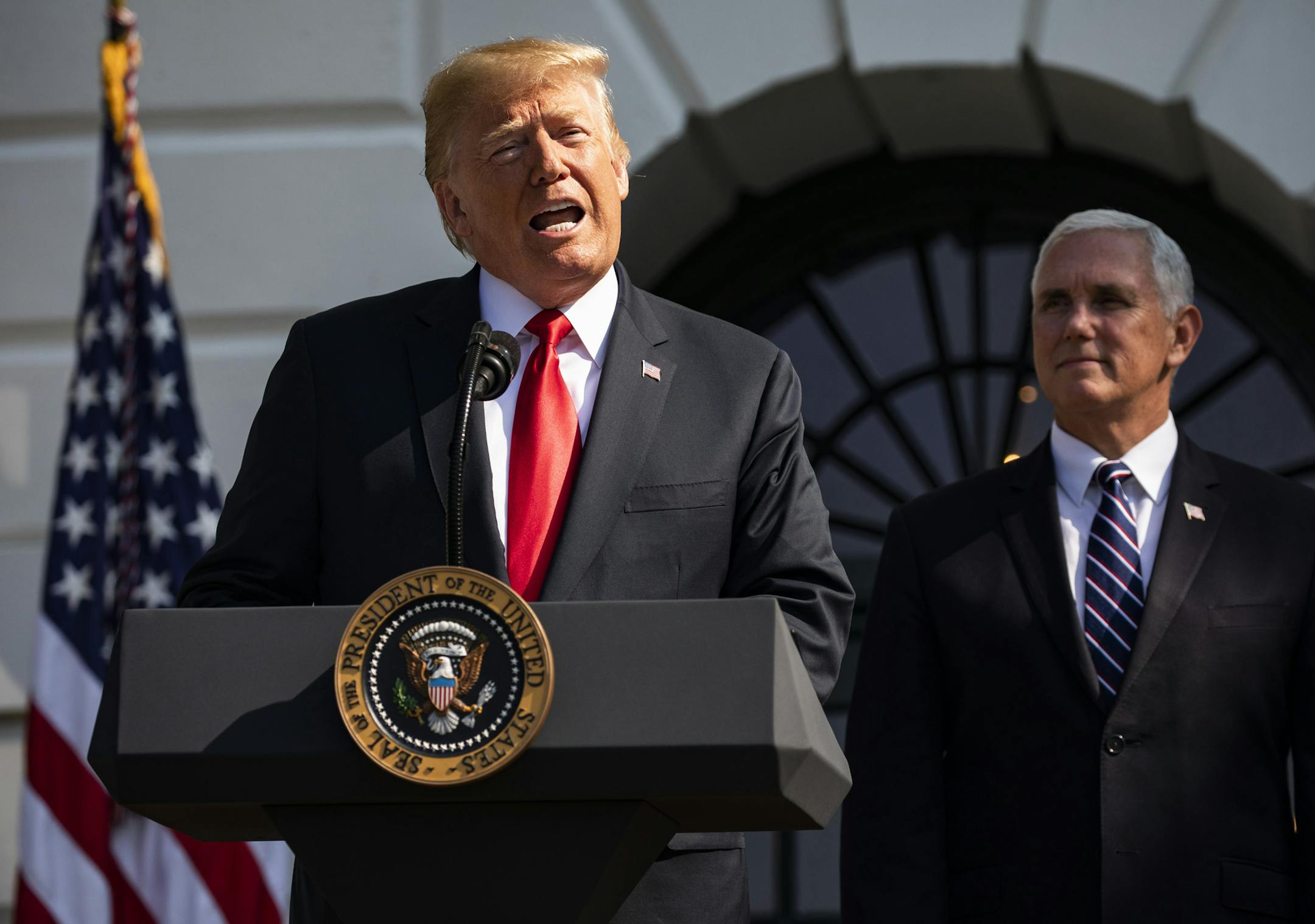
President Donald Trump this week claimed to have a "magic wand" that allowed him to push the economy's growth rate above an annual rate of 4 percent in 2018's second quarter. This is one of the president's more colorful public statements taking credit for the economy's performance. Such statements are as common as they are overstated.
Trump isn't alone in exaggerating the effect a president can have on the state of the economy. The public debate often forgets that the economy is shaped by powerful global forces — peace and turmoil between nations, technological advancement, migration, international trade — and by the decisions of millions of households and businesses.
So I'm not terribly surprised that the economy today looks pretty similar to the economy at the end of the Barack Obama administration. For example, the unemployment rate stands at 3.9 percent, but its 6-percentage-point steady decline began during Obama's first term.
Or consider the most recent GDP release, which found the economy growing at an annual rate of 4.2 percent. That's fast growth, to be sure. But the economy enjoyed an annual rate of growth above 4 percent during four quarters of Obama's presidency.
Trump has been president for 19 months, during which the economy added an average of 189,000 jobs per month. In the final 19 months of the Obama presidency, the economy added 208,000 jobs per month — basically no difference.
I'm going to stop the comparisons here. It's not good practice to analyze economic data grouped by presidential administration, precisely because the president does not control the economy with a wand, magic or otherwise. And the gist of the major economic indicators confirms the story told by the three I've discussed above.
One exception to the continuity is business sentiment. Optimism among small-business owners spiked when Trump was elected and is currently at its highest level in nearly a half-century. It is reasonable to conclude that this has fueled hiring and investment to some degree.
The president can also claim some credit for the economy's performance because of increases in federal spending and the new tax law. Both serve as a form of short-term fiscal stimulus, increasing the size of the economy. Spending increases alone are projected by the nonpartisan Congressional Budget Office to boost the size of the economy by 0.3 percent in 2018 and 0.6 percent in 2019. Fiscal stimulus at this point in the business cycle is ill-advised, but it will juice the economy nonetheless.


