
Opinion | Minnesota’s warm internationalism vs. the haughty hostility of America First 2.0

Our state can be proud of its role in a vision that is now, regrettably, slipping away.

October 5, 2025 at 8:29PM
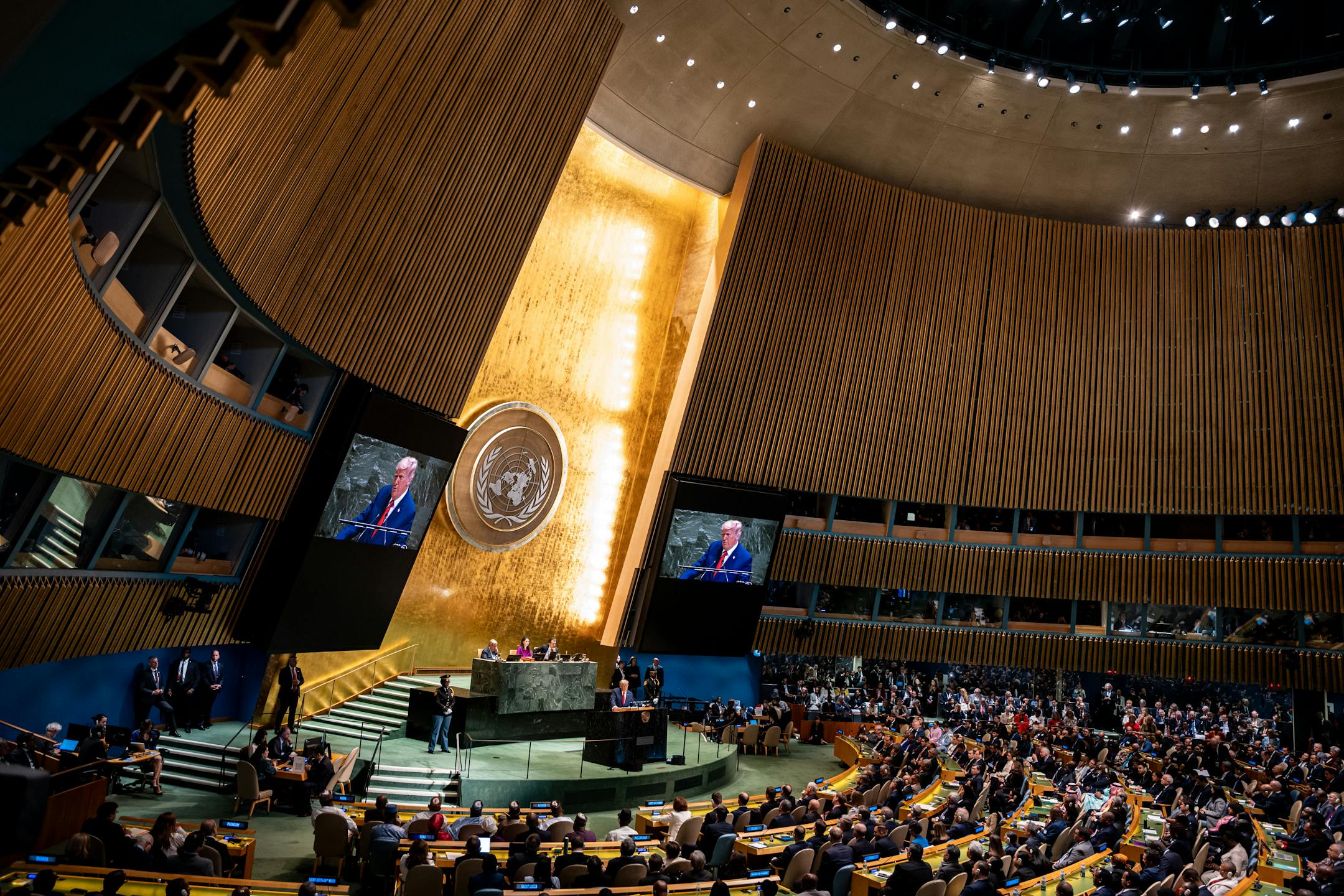
"A haughty and hostile 'America First' foreign policy, on embarrassing display recently when President Donald Trump addressed the U.N. in a rambling and insulting diatribe, is damaging many of our state’s most precious assets," Dane Smith writes. Above, President Trump addresses the 80th session of the United Nations General Assembly on Sept. 23 at U.N. headquarters. (Angelina Katsanis/The Associated Press)

Opinion editor’s note: Strib Voices publishes a mix of guest commentaries online and in print each day. To contribute, click here.

•••

As the United Nations prepares to celebrate its 80th birthday on Oct. 24, Minnesotans can take some pride in both its founding and our kindred spirit ever since. Harold Stassen, the progressive Republican “Boy Governor” from West St. Paul who had resigned his office in 1942 to serve in the U.S. Navy, was a powerful force on the U.S. delegation that helped write the U.N. charter in 1945.

More important are the myriad ways that almost all our leaders since then, from all major political parties and joined by countless Minnesotans, have modeled an open and constructive internationalism.

Keeping this warm face to the world is imperative. A haughty and hostile “America First” foreign policy, on embarrassing display recently when President Donald Trump addressed the U.N. in a rambling and insulting diatribe, is damaging many of our state’s most precious assets.

To wit: our many heroic humanitarian aid agencies, reeling from unprecedented defunding; our Asian, African and Latin American immigrant communities, under constant attack; our agribusiness economy and farmers, now sounding alarms about a trade war “Farmageddon,” and the rapport Minnesotans have built up over generations with people from every part of the globe.

America First 2.0 under Trump in his untethered second term is similar to but more actively malevolent than the isolationist spasm by the same name that preceded World War II (also led by a famous Minnesotan, legendary aviator Charles Lindbergh). The Trump version is less about isolating and more about pushing and shoving, claiming American supremacy and a manifest destiny to dominate the world. It’s often about using our wealth and military power to drive deals in which we win and they lose, not striving for equal benefit. This attitude is making new enemies at record speed, and leaving a “soft power” vacuum in the U.N. that China is eager to fill. The scariest driving force of all is the administration’s fundamentalist Christian nationalism, and the idea of the USA as a nation favored by God over the 96% of humans who are not Americans.

This arrogance portends violence even as Trump shamelessly threatens and begs for an undeserved Nobel Peace Prize. Our Department of Defense, without authorization from Congress, has gone back to calling itself the Department of War, amid incessant calls for “lethality” and “warfighting” by Secretary Pete Hegseth (another Minnesotan out of whack with our norms). The Trump-Hegseth tag-team harangue before the nation’s entire assembled top brass last week reinforced the theme of America as a violent, menacing bully.

America First 2.0 is also steeped in open corruption and might as well be nicknamed “Trump Inc. First.” The president’s solicitation of personal gifts and investments from foreign nations in his enterprises (especially from Middle Eastern “oilagarchies”) is a scandal of truly historic proportions.

All this turbocharged chauvinism has drawn criticism from every direction, including conservative Republicans from previous administrations. But AF2 is especially incongruent with Minnesota’s historic idealism and prevailing worldview. A review of key factors in this tradition of warmer worldliness is in order.

•••

From early statehood in the mid-1800s, educated progressive founders from New England and mid-Atlantic states already were among the more globally aware Americans, interested in and respectful of other cultures. Waves of Scandinavian, German and Eastern European immigrants over the next half-century gave Minnesota a larger percentage of foreign-born residents than most other states by 1920 and strong cultural ties to Europe.

Business interests seeking global connection played a part. Minnesota’s pre-eminent Gilded Age titan, James J. Hill, built the railroad to Seattle and opened up trade for silk and other goods with Asia. The Twin Cities capitalized on its geographic advantage as a terminal for Mississippi River trade to the Gulf of Mexico, and Duluth prospered as the terminal for Great Lakes commerce to the Atlantic. A post-World War II boom and Minnesota’s emergence as a major metropolitan area and headquarters for multinational corporations had major impact. The rapid evolution of air travel and Northwest Orient Airlines’ status as a primary carrier from MSP to Asia and Europe over shorter northern routes gave plausibility to Minnesota’s claim to be the nation’s “North Coast.”

Minnesotans from 1945 on followed in Stassen’s tradition and were often on the leading edge of efforts to strengthen ties to other nations and to help build stronger democracies, healthier economies and environmental protection.

Sen. Hubert Humphrey, later vice president, was the leading sponsor of legislation creating the Peace Corps, sending 250,000 young Americans to help developing nations since 1961. Vice President Walter Mondale under President Jimmy Carter tirelessly pushed for human rights as a goal of U.S. diplomacy, and Mondale later served as President Bill Clinton’s ambassador to Japan.

And when America did blunder into disastrous military adventures overseas, Minnesota U.S. Sens. Gene McCarthy (Vietnam War) and Paul Wellstone (the Second Gulf War) bucked the tide and became courageous and prophetic national leaders of war opposition.

Closer to home, Minnesota’s governors became globalists, beginning in the 1980s with Rudy Perpich, who launched numerous trade missions and hosted Soviet leader Mikhail Gorbachev at the governor’s residence as the Iron Curtain was coming down. Every governor since, including Independence Party maverick Jesse Ventura, promoted trade and cultural exchange.

All along, multitudes of less-famous Minnesotans have connected to the world, often through mainstream churches and dozens of nonprofits. These include Global Minnesota, the International Institute, the Committee on Foreign Relations Minnesota, the Center for Victims of Torture, and the World Press Institute. The website Cause IQ counts 574 “international focused” organizations in Minnesota, with combined assets of almost $400 million.

Especially since the 1970s, Minnesota has been exceptionally hospitable, attracting hundreds of thousands of immigrants who have flourished and enriched Minnesota with their energy and talents. Catholic and Lutheran resettlement agencies led the way, in a spirit very different from fundamentalist Christian nationalism.

Another marker of our sophistication: 55% of our citizens, about 3 million Minnesotans, hold U.S. passports. That’s second only to Illinois among Midwestern states as a percentage of the population.

•••

Internationalists must acknowledge failures and misdeeds in the name of globalism. Cold War policy aligned us too often with freelance dictators and resulted in tragic losses of combatant and civilian life on both sides. Too often our trade agreements primarily served the interests of multinational corporations, not workers or the environment. (AF2 will be far worse on that score, as it actually is in the hands of a billionaire and a kowtowing high-tech “broligarchy” seeking even more world domination.)

America First might produce some silver linings. But it is essentially a chaotic and contradictory mess, and it’s impossible to know how it will play out or how much more harm it will do.

Minnesotans of good will toward humanity must resist. We can reinforce and preserve our warmer worldliness by speaking out, volunteering our time and increasing our support for international organizations.

And we can draw inspiration from the “Seven Points” speeches Harold Stassen was delivering all over the nation in 1945. Time magazine in the spring of that year was impressed with the energetic young Minnesotan’s intelligent vision and bearing, describing a tall and vigorous 37-year-old man “bronzed by months of Pacific service.”

Warning about the dangers of extreme nationalism, Stassen told Time: “We do not subscribe to the extreme view of nationalistic sovereignty. … We realize that neither this nation nor any other nation can be a law unto itself … and that we are willing to delegate a limited portion of our national sovereignty to our United Nations organization.”

Dane Smith is a retired politics and government reporter for Minnesota newspapers and author of “Reappraising Minnesota," a MinnPost series analyzing how Minnesota has evolved over the last half-century.

about the writer

about the writer

Dane Smith

More from Commentaries

See More
card image
DOUG MILLS/The New York Times

Attacks on Somali Americans are a cruel distraction.

card image
card image