

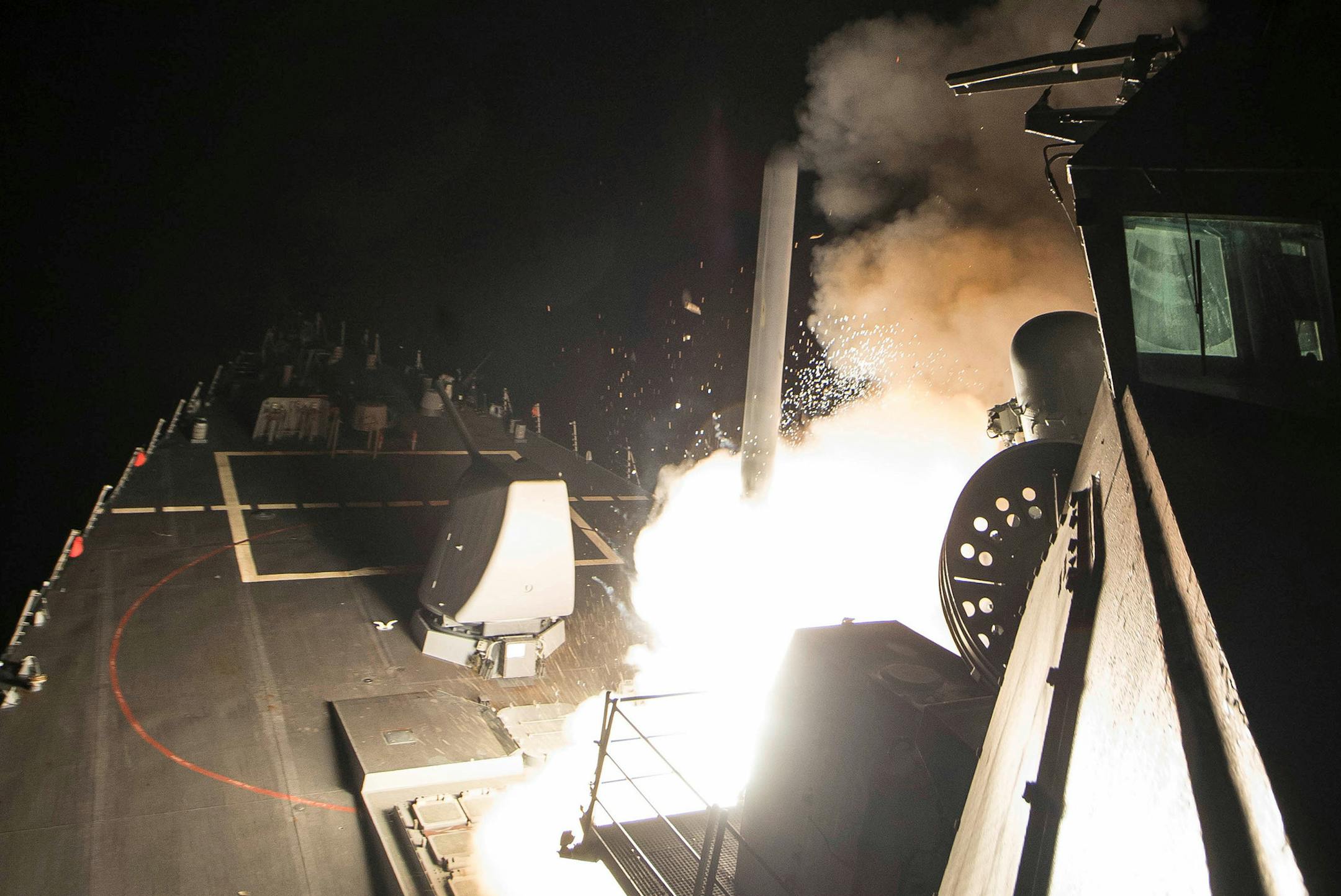
With one missile strike on a Syrian airfield, President Trump called two bluffs at once but likely set back his proclaimed goal of defeating Islamic State of Iraq and Syria (ISIS). The pre-dawn strike on Shayrat Airfield should deal a crushing blow to the narrative that the Kremlin controls Trump or possesses compromising material about him. This is not the kind of risk a man on a blackmailer's hook would take. Nor does Russia's behavior after the strike give credence to the idea now circulating that the strike was a mere PR exercise, fully signed off on by the Kremlin, which evacuated Russian personnel (and warned Assad). This conspiracy theory holds that the collusion would take the pressure off investigations into Trump's Russia connections and clear the way for a grand bargain down the road.
On the surface, Russia appeared to be willing to treat the attack as an isolated incident, especially since the U.S. made sure no Russians would be hurt. That's easier today than forgiving Turkey for shooting down a Russian warplane in 2015. The propaganda line on Friday's strike is that Russia didn't move in to protect Shayrat because Russian servicemen weren't at risk there. The Assad regime's military capability hasn't been greatly affected, either.
And yet, beyond the predictable anti-American rhetoric and denials that Assad had used chemical weapons, Friday's statement from the Russian foreign ministry contains one serious bit of new information. It says Russia has suspended the 2015 memorandum of understanding with the U.S. on air safety in Syria.
The memorandum contained safety protocols for pilots, the use of certain frequencies for communication during close encounters and a line of communication on the ground. This spells the end not just of this particular document, whose scope has been expanded since Trump came to power, but also of the growing cooperation that has developed between U.S. and Russian forces in Syria in recent months.
In other words, Moscow has issued a warning to the U.S.: "From now on, your aircraft are fair game."
U.S. pilots have had nothing to fear from either Syrian or Russian antiaircraft defenses, which assumed that U.S. missions, if any, would be against ISIS, not the Syrian government. The Assad regime probably wouldn't dare attack U.S. planes even now, but Russia has S-300 and S-400 air defense systems deployed to protect its military installations in Syria. If Russia really means to cease communications with the U.S. on air safety, the likelihood of a major incident greatly increases.
Whether Putin can afford open conflict with the U.S. is another matter. Though Russia hardly has the military might for a war with the U.S., and Putin lacks the fiendish mindset needed to launch nuclear missiles, the Kremlin may feel it has no face-saving alternative but to respond. Putin opponents are already gloating about the failure of Russian air defenses to deflect the U.S. strike. "The whole Putin adventure has been completely discredited," Andrei Piontkovsky, a hardcore Putin critic, told the Ukrainian website InfoResist. "Where are the famous S-300 and S-400, which the foreign ministry told us had been supplied to defend Syrian airfields from cruise missiles?"
The ruble dropped in Friday trading, showing a market perception of Russian weakness following the missile strike.


