
Opinion | Trump has little to no leverage on oil

He’ll likely regret his promise to lower energy prices.

January 14, 2026 at 10:59AM
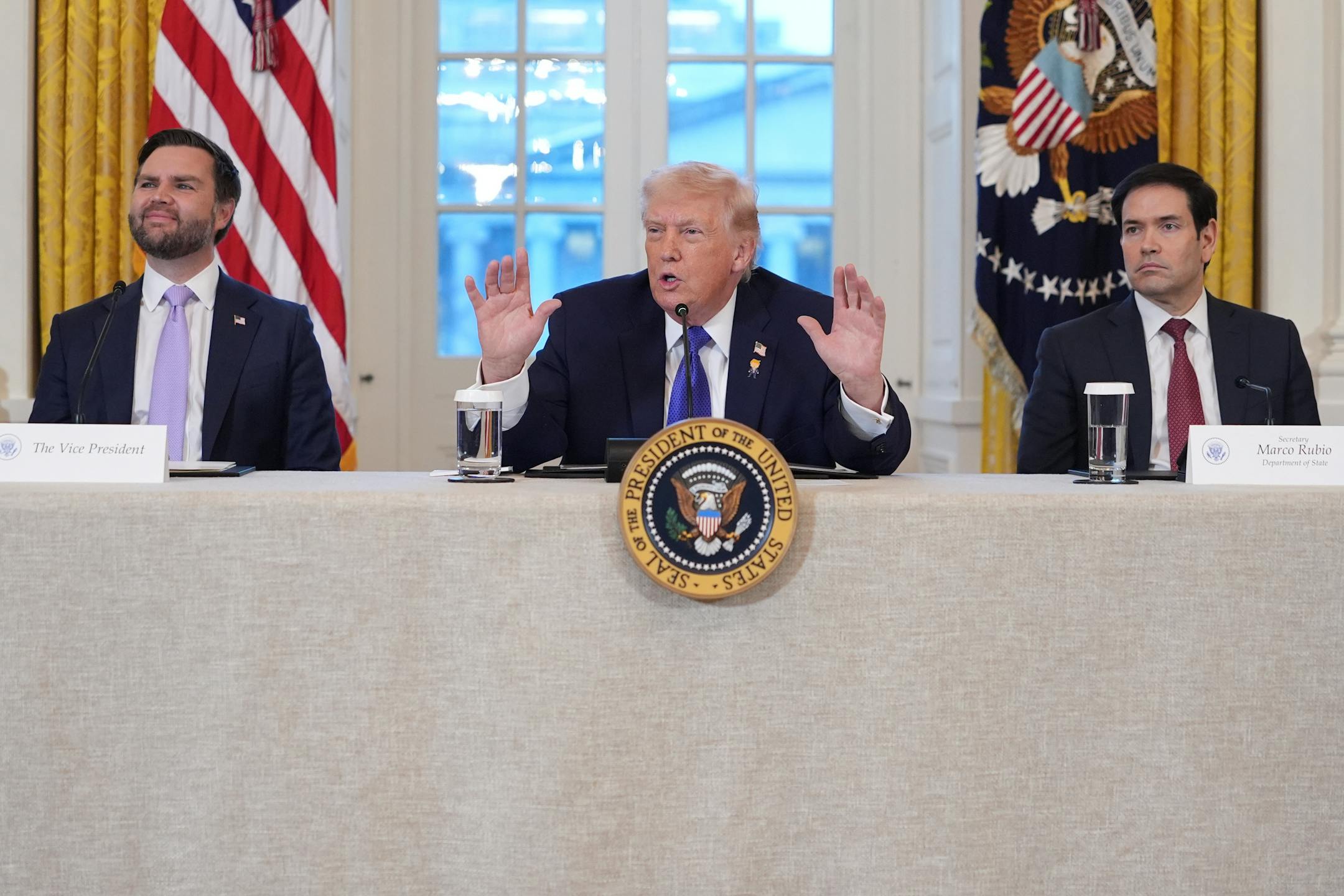
President Donald Trump speaks during a meeting with oil executives in the East Room of the White House on Jan. 9 in Washington as Vice President JD Vance and Secretary of State Marco Rubio listen. (Evan Vucci/The Associated Press)

Opinion editor’s note: Strib Voices publishes a mix of guest commentaries online and in print each day. To contribute, click here.

•••

First was President Donald Trump’s campaign promise to halve energy prices in year one, and it continued into the muddled aftermath of President Maduro’s capture when Trump vowed to restore Venezuela’s oil production to 1990s levels “within 18 months.”

Throughout, Trump’s energy messaging lays bare the maxim that for every major problem there’s often a simple solution that, H.L. Mencken said, “is neat, plausible and wrong.”

No American president has power over complex market forces that establish energy prices. “Any politician who promises [that] is either ignorant or lying, or both,” says Nobel Prize-winning economist Paul Krugman.

How oil is extracted, distributed and priced is woefully misunderstood, largely owing to often purposeful political misinformation.

On Venezuela, Trump claims U.S. control will see a fivefold production increase by mid-2027, with revenues going to mend that country’s economy. The timeline is preposterous, energy experts agree, and the stated use of proceeds competes with Trump’s on-again off-again desire to repay companies for losses when Venezuela nationalized oil in 2007.

Venezuela has the world’s largest known reserves. Prior to nationalization it produced 3.5 million barrels daily. Since, it has fallen by nearly 80% due to mismanagement and deterioration of machinery, pipelines and storage tanks. Experts in and out of the industry agree it’ll take some $50 billion now and $10 billion annually for over a decade to get anywhere near Trump’s boastful production target.

It’s highly improbable that, despite Trump’s pressure, private industry will pony up the needed billions. There’s abundant reluctance to invest in any politically destabilized country, which Venezuela long will be. There’s also investing risk with currently low energy prices, coupled with high costs of producing Venezuela’s extra-heavy crude that’s thick as tar and requires tremendous heat to move in a pipeline.

Domestically, Trump might regret his campaign promise to “cut energy costs in half.” Gas pump prices dropped only slightly in 2025 but electricity prices jumped more than 10%, and burgeoning demand will continue pushing them steeply upward.

Oil is an international commodity with pricing set through global supply and demand, untethered from any one country’s production. Current downward pump prices are due to supply exceeding a stable worldwide demand.

Overall, the ever-changing global price underlies everything, right down to neighborhood gas stations.

Under the simplistic “drill, baby, drill” banner, Trump has issued more federal drilling permits and relaxed regulations all to promote more production so as to, goes the hype, lower domestic pump prices. As many predicted, GasBuddy confirms it hasn’t worked.

The privately owned U.S. oil industry sells its product to the highest bidder, quite apart from parochial political desire. Suppressed world prices makes drilling new wells unprofitable for now, a reason the industry sits on more than 6,000 unused permits. Relaxing regulations may affect the pace of production, but has little effect on pricing.

Calls to lower prices by reducing federal and state gas taxes defy reality. Gas taxes pay for critical roadway improvements, so lost tax revenue would need another source. Plus, fluctuations in state taxes are nearly always too small relative to other forces to move the pricing needle.

However, governments that own and control oil production can and do set their domestic prices, and together they wield outsized power in world pricing.

In 1960, five oil-producing countries formed the Organization of the Petroleum Exporting Countries (OPEC), since joined by other nations owning wells and distribution networks. With nearly half the world’s oil, OPEC can affect global prices simply by adjusting supply (the 1973 Arab oil embargo over disputed Israel policies cut U.S. supply, leading to rationing and long waits for pricey fuel).

Should the U.S. flood oil markets to reduce world price, as Trump hopes, OPEC can easily offset that by cutting its supply. In effect, Trump has little to no leverage.

Prices for another primary energy, electricity, are also influenced by supply and demand. And here, a perfect storm of mushrooming demand and spiking costs will push electricity prices skyward, along with natural gas that’s increasingly used to produce electricity.

The crucial demand stimulant is how information is processed, with mammoth centers that compute, distribute and store data. Enormous electricity runs sprawling computer stacks and cools machines generating extreme temperatures (nearly half the power goes for cooling).

Already, U.S. data centers consume 4% of America’s electricity — enough to power New York City and Chicago — a staggering amount that’s expected to triple by 2030. Minnesota has more than 70 data centers with a dozen “mega” centers in planning; all will increase consumer bills, and also further degrade air and water.

Another impending cost is renovating the national grid that increasingly moves power to serve fluctuating regional demand and cover emergency closures. Aging has seriously affected grid reliability, and needed upgrades will cost upward of $1 trillion.

Old power generators must be brought back online and more plants are needed. Expensive building and refurbishing has become more so due to tariffs on steel. Plus, Trump’s cutback on subsidizing renewables (wind and solar) effectively blunts less expensive energy.

Most power plants are state-regulated utilities, with rates set by calculating costs and allowing marginal profit. Huge, demand-driven expenditures go into baseline costs paid for by consumers.

Absent a seismic technical breakthrough like low-cost nuclear fusion (in some stage of “promising” for decades), it’s certain energy costs will continue rising long into the future — despite political desires wrapped in high-sounding, simplistic rhetoric that’s too often just plain wrong.

Ron Way lives in Minneapolis. He’s at ron-way@comcast.net.

about the writer

about the writer

Ron Way

More from Commentaries

See More
card image
Evan Vucci/The Associated Press

He’ll likely regret his promise to lower energy prices.

card image
card image