
Opinion | Our democracy depends on a free press and diversity. Both are under threat.

From immigrant communities to women and journalists of color, the voices most often marginalized are now among the most openly threatened.

December 15, 2025 at 11:00AM
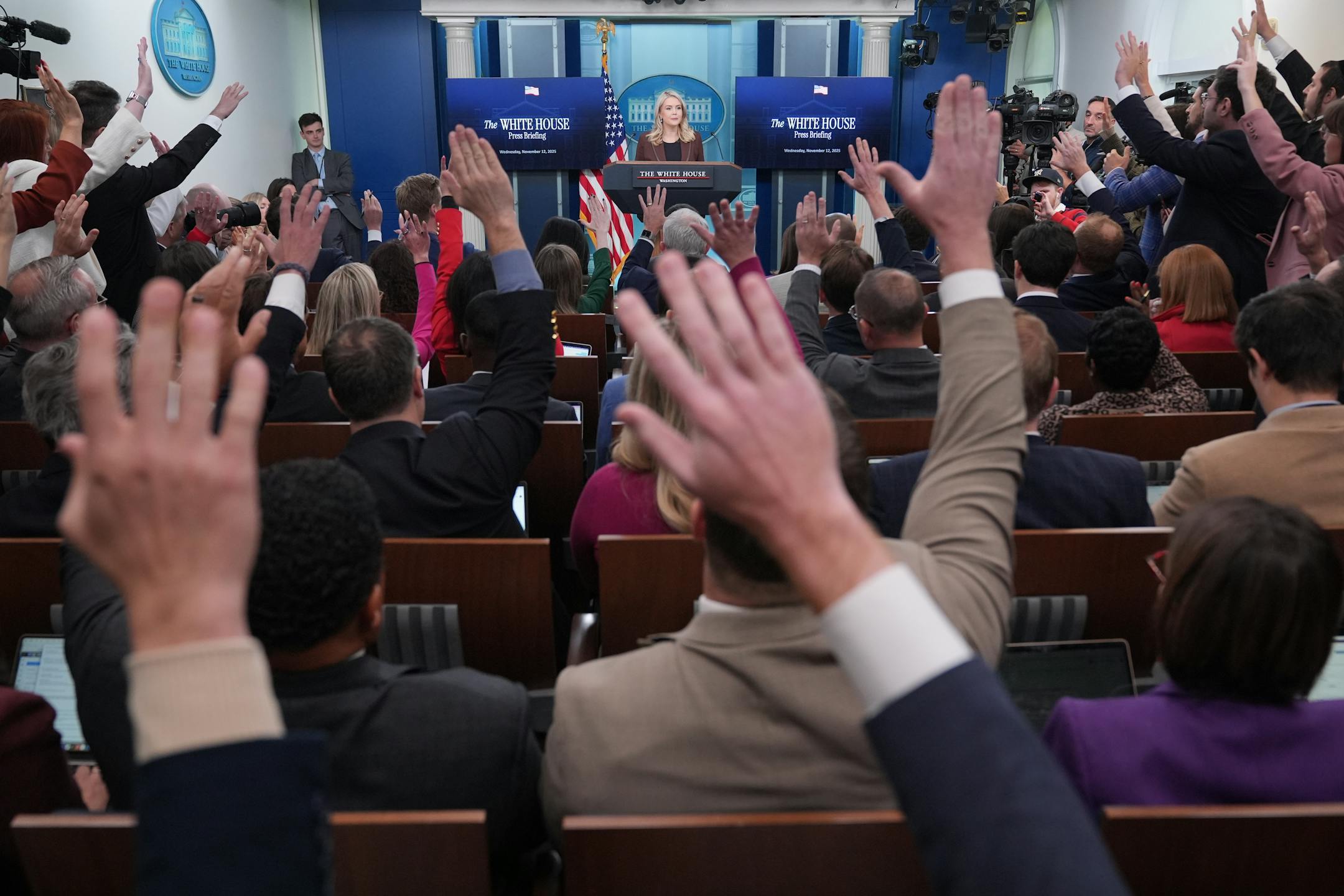
White House press secretary Karoline Leavitt speaks to reporters: When President Donald Trump belittles female journalists, writes Sheree R. Curry, he isn't just insulting individuals. (Jacquelyn Martin/The Associated Press)

Opinion editor’s note: Strib Voices publishes a mix of guest commentaries online and in print each day. To contribute, click here.

•••

When the president of the United States calls Somali immigrants “garbage” and publicly belittles female reporters as “stupid,” “ugly” and “piggy,” he isn’t just insulting individuals, he’s signaling which voices he thinks should be dismissed.

And when the White House follows that rhetoric with an official “media offenders” website, inviting the public to report journalists whose work the administration may deem “biased” or “misleading,” the message is unmistakable: Challenging power may now carry consequences.

The Society of Professional Journalists immediately urged the administration to take down the page, saying it mirrors tactics used by authoritarian regimes and puts journalists at greater risk of harassment and violence. Yet, some pundits are applauding it.

This is not media criticism; it is a government-sanctioned attempt to intimidate the Fourth Estate. And this is exactly why diverse voices in journalism matter more than ever.

For many of us in the media, especially women, immigrants and journalists of color, these threats hit close to home. We are often the ones reporting the stories some would prefer remain unheard.

Elisia Cohen, director of the Hubbard School of Journalism and Mass Communication at the University of Minnesota, recently shared on LinkedIn the well-known warning often attributed to German pastor Martin Niemöller: “First they came for the Socialists, and I did not speak out… Then they came for me — and there was no one left to speak for me.”

When any group is singled out as a target — whether it’s women, Somalis, immigrants, Black journalists, Muslims, Jews or anyone who asks hard questions — our entire society is weakened.

A press corps that reflects America is not simply about diversity for diversity’s sake; it is a safeguard against silence. When fewer voices are at the table, fewer truths are told. And when those voices are attacked or diminished, communities lose the very people best positioned to report their stories with accuracy and humanity.

These patterns are not new. In 1968, the Kerner Commission warned that American journalism was “basking in a white world.” Decades later, inequities persisted as reporters of color carried the dual burden of documenting their communities while defending their right to tell those stories.

In 2005, I wrote a piece for TV Week examining how little progress broadcast newsrooms had made toward hiring and promoting journalists of color. Over the years, it seemed like there had been some progress. In 2023, when I wrote a feature for USA Today about the rise of Black women leading major newsrooms, it felt like a milestone. (The piece included the Minnesota Star Tribunes Maria Reeve, who at the time was serving as executive editor of the Houston Chronicle.) Their leadership wasn’t symbolic; it reshaped coverage and newsroom culture in ways that benefited entire communities.

But today, that progress feels tenuous. Pew Research Center reports that only 6% of U.S. journalists are Black, 8% are Hispanic and 3% Asian American, despite people of color constituting about 40% of the population. And journalists of color disproportionately cover beats on race, social issues and policy. Today, these beats are some of the first to be eliminated, along with their jobs.

Despite commitments made after the murder of George Floyd, the headline of a recent Nieman Lab analysis described the industry’s shift on DEI from “reckoning to retreat.” The firing of Karen Attiah, a Washington Post columnist, along with the departure of several other high-profile Black journalists has raised alarms, as have exits at CBS, BET and other outlets.

Leaders from several journalist associations of color recently expressed joint concern over NBC News’ decision to eliminate staff dedicated to its verticals covering Black, Latino, Asian American and LGBTQ+ communities. Additionally, the Radio Television Digital News Association reported this year that after reaching a record high in 2024, minority representation in local radio news fell in 2025.

Minnesota is not immune to the instability. We’ve seen respected journalists of color lose their roles or step away. At the end of this month, KARE 11’s sports director and sports anchor, Reggie Wilson, will sign off for the final time. This is after his wife, news anchor and community relations manager Alexis Rogers, was let go earlier this year. Rogers has found a new direction, launching a podcast this month with former anchor Dawn Stevens to tell community-rooted stories.

This year, the National Association of Black Journalists marked its 50th anniversary. Founded after the Kerner Commission, NABJ has spent five decades advocating for equitable coverage and newsroom cultures where Black journalists can thrive. As co-president of NABJ-Minnesota, I know how essential this work is. We’re expanding opportunities to support emerging journalists of color. This fall, we welcomed a $5,000 sponsorship from the Center for Broadcast Journalism, founded by independent journalist Georgia Fort, whose mission to train, develop and support the next generation of diverse storytellers aligns with ours.

Minnesota is fortunate to have other community journalism outlets like Sahan Journal, ThreeSixty Journalism, North News, Insight News and the Minnesota Spokesman-Recorder investing directly in the voices who tell the stories of our diverse communities.

These efforts matter because when political leaders disparage immigrants, mock women reporters or compile watchlists of “problem journalists,” the people most targeted are often the very voices our democracy can least afford to lose.

A representative press doesn’t just benefit journalists, it benefits the public. It ensures the stories we tell about safety, schools, justice, democracy and immigrant success reflect the lived experiences of all who call this country home.

A free press cannot survive on its own. It’s a symbiotic relationship that depends on communities that value truth and the institutions willing to stand up for, and invest in, the journalists who tell it. So the question becomes whether we, as a society, will stand with the press.

If we fail to speak up for journalists now, we may soon find no one left to speak up for us.

Sheree R. Curry is co-president of the National Association of Black Journalists-Minnesota (NABJ-MN). As an independent journalist, she often covers news about diversity and corporate America for local and national media outlets.

about the writer

about the writer

Sheree R. Curry

More from Commentaries

See More
card image
Jacquelyn Martin/The Associated Press

From immigrant communities to women and journalists of color, the voices most often marginalized are now among the most openly threatened.

Left, U.S. Rep. Tom Emmer. Right, Minnesota House Speaker Lisa Demuth.
card image