

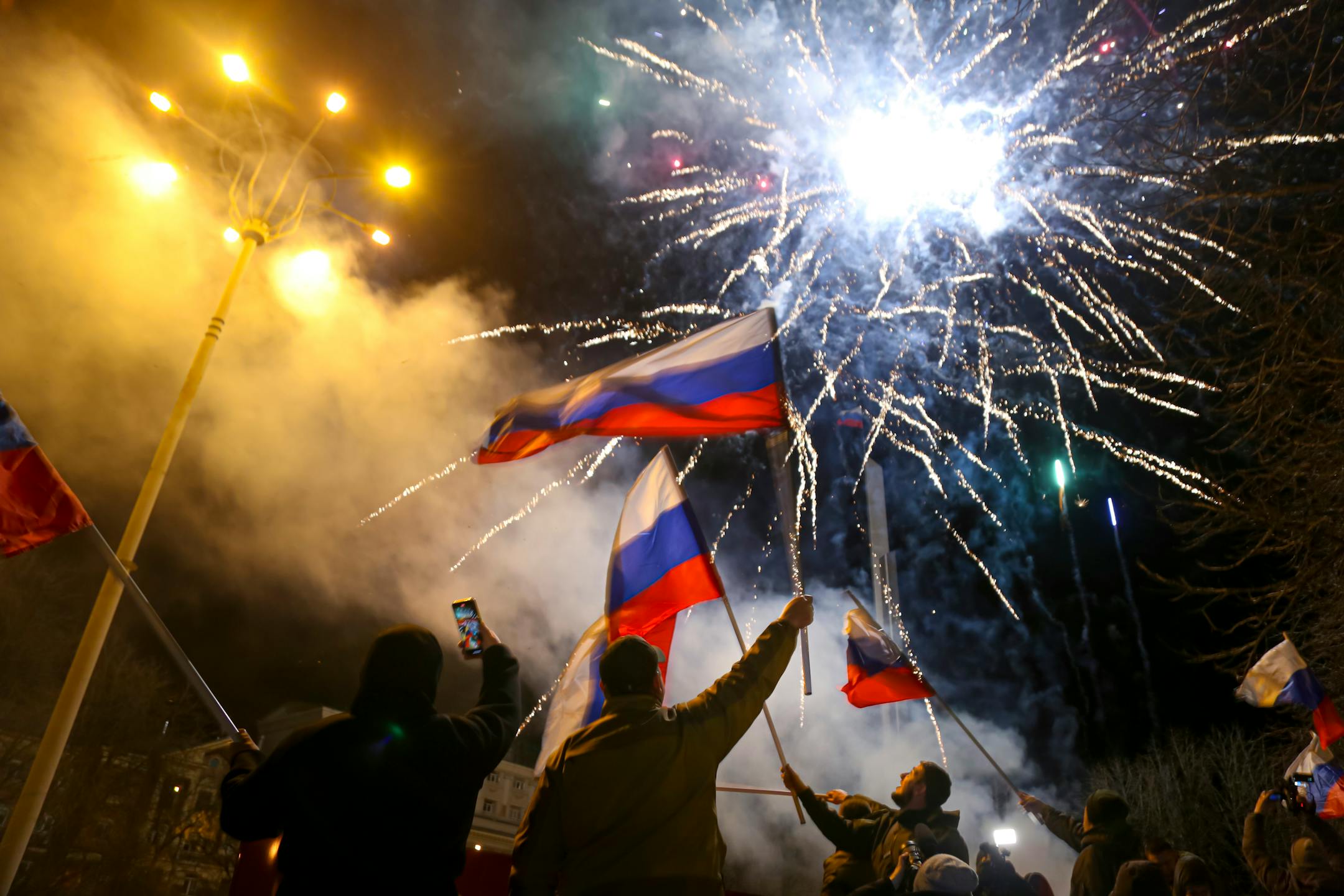
Anyone who has seen an old friend in recovery fall off the wagon is seeing something familiar in the way Europeans are experiencing the war in Ukraine.
It's one of the insidious facts of alcoholism that even though a person doesn't drink for years, if there's a relapse, the problem re-emerges within days that has a consequence as bad as if the person had never stopped drinking. For that reason, the illness is called "progressive." It never goes away. It's hidden. Getting worse. Waiting for the next chance to show itself. A person can last for decades — have a career, a family and what we would call a "normal life" — then, boom, in an unguarded moment risk losing it all over what seemed like a simple little indulgence that resulted in an out-of-control bender. And, as people with experience will tell you, very often the people worst affected are close relatives, co-workers, neighbors and friends.
While Europeans over the years have invented thousands of ways of enjoying alcohol, that's not the irresistible toxin that's threatening to kill them once again: It's what I would call "cultural nationalism." For a sweet, prosperous, 70-odd-year period, under the unspoken shadow of a permanently garrisoned American army and a financial system based on and completely integrated into the American financial system, Europe was at peace. It was integrating in a way not seen before. Unseemly nationalistic impulses were minimized, swept under the rug. Almost universally, Europeans were seeing their nationalistic, corrosive, incredibly destructive history as something of the increasingly distant past, something that could never happen again in the current "post-historical" age.
A "minor slip," if we could call it that, happened in the Balkans. No one familiar with that part of the world will ever forget the haunting image of world culture sites like Dubrovnik, among the most beautiful cities in the world, or the ancient bridge at Mostar, being shelled or destroyed. The fierce, cruel and crude Serbian and Croatian war, with attendant "ethnic cleansing," paralyzed Europe, still unable to deal with its nationalists, and was only finally suppressed with, yet again, the application of American military power. The Balkans, too, were swept under the rug. You could almost hear the collective sigh of relief when the shooting stopped and the world went on with its business, ignoring what that local war should have taught us all. But even there, something hauntingly familiar made it difficult to let go of.
Like an alcoholic deciding it is safe to leave the safety of good habits and recovery, pretending that the deeply interwoven and embedded cultures and subcultures of Europe can be ignored is a good way to guarantee they will emerge again unchecked, worse than ever. A person's culture is as much a part of him or her as the language of the voice in their head when they're talking to themselves, the food they like to eat, how they feel about where they live and their relationship with friends and family members. Take any of that from them, particularly by force, and you threaten the very fiber of their beings. The response can be violent.
Modern, progressive Europeans live in a world of hundreds of such cultures, which they view fondly as one of the continent's strengths, minimizing the darker, far more dangerous part of the picture. Take Italy, a place where I have lived. Even now, there are 34 distinct native languages or dialects, mostly not mutually comprehensible. Italian, as an actual spoken national language, is quite young. Not until the 1950s did a majority of Italians grow up actually speaking Italian as their first language. The internal cultural differences are significant, particularly between areas of the European north and the Mediterranean south, which has resulted in major tensions in politics. Within my lifetime, bombs were planted in Italian government and media offices by alpine-based German-speaking groups in the north seeking separation.
In Italy.
And we don't need to go into any nasty details with France's problems in Corsica or Britain's in Scotland and Ireland, for starters.


