
Tolkkinen: Big Ag has a tight hold on Minnesota farms, but we need to let in newcomers

Farmers are aging but young people can’t get in to the business.

Columnist Icon
The Minnesota Star Tribune
August 9, 2025 at 3:27PM
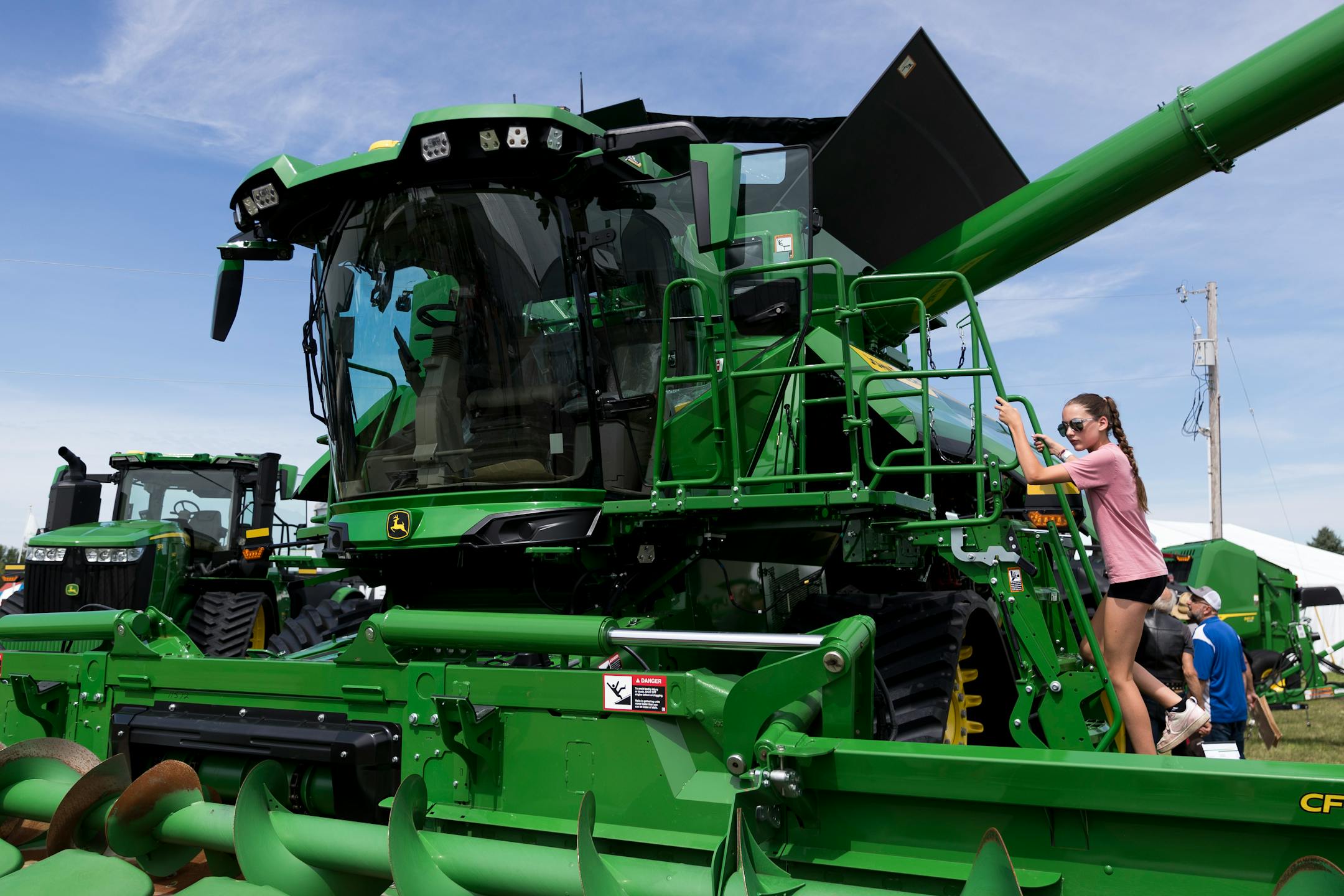
Kirstyn Bade, 12, of Janesville, Minn., climbs onto farm machinery during Farmfest in Morgan, Minn. on Wednesday, Aug. 6, 2025. Big farms pay hundreds of thousands of dollars for new equipment. (Rebecca Villagracia/The Minnesota Star Tribune)

MORGAN, MINN – Walking through Minnesota Farmfest, you get a sense of how many jobs and how much money rely on agricultural production.

The gleaming $500,000 harvesters for sale. The sales reps eager to demonstrate their planters. The tents of tax preparers, insurance companies, and lenders. The politicians courting the farm vote. The researchers, state agency representatives, the various agricultural organizations that turn out.

Agriculture brings tens of billions of dollars to Minnesota every year, mostly through sales of corn, soybeans and hogs. The industry is so massive, its interests so entrenched, that it seems to steamroll right over the losers: the environment, people who want to farm but can’t get land, and Minnesotans who can’t drink their own contaminated tap water.

Finding a way into the industry requires a combination of luck, skill and relationships.

In the Minnesota Farmers Union tent, a young farmer named Wyatt Parks was filling the ear of state Sen. Aric Putnam of St. Cloud, chair of the Minnesota Senate Agriculture Committee, who has personally visited 100 Minnesota farms.

Parks is a rarity in Minnesota, a first-generation farmer.

If agriculture keeps going the way it’s going, only the wealthy will be able to farm, he told Putnam. Land prices are too high, the acreages too enormous, the pockets of investors too deep for the little guy to take part.

And too much farmland is owned by people who don’t farm it. They rent it out to farmers who pay them an average of $200 per acre annually. Run the numbers, and someone who lives in Florida and owns 500 acres in Renville County would make about $100,000 a year. That’s great for the heir, but it creates an uncertain situation for farmers who are unable to make long-term decisions about the land, like investing in irrigation, farm roads or culverts. It also ties up the land, blocking ownership from a new generation of farmers, and sucks money away from the state.

But Parks, 33, and his wife, Tessa Parks, 29, found a way in.

In Northfield, an unusual venture called Sharing Our Roots Farm allows new farmers access to land.

The 163-acre nonprofit farm is turning depleted agriculture land into land that supports a variety of organic farming ventures for people who otherwise wouldn’t have access. The Parkses are able to pasture their cattle on Sharing Our Roots fields and they also cut and bale hay to sell. They rent additional land from three other landlords.

The two grew up in the suburbs of Washington state, although Wyatt also had some rural experience. Their dads drove trucks; his mom worked in sales and her mom taught band. Two or three generations removed from farming, they had no family members to teach them the ropes, so they learned from others.

One day, they hope to own a farm that will pay for itself.

It’s no secret that Minnesota farmers are aging, even as many younger farmers long, often futilely, to break into the industry. About 15 years ago, Minnesota State Community and Technology College in Fergus Falls offered a sustainable agriculture program that graduated one class before ending the program. Many graduates have been unable to buy their own land and ended up working in agriculture-adjacent fields. I got to know a few of them when my husband and I sold bread and produce at the Battle Lake farmers market.

Many of these new farmers are interested in running smaller farms that are kinder to the earth and water quality than the conventional corn, soybean and feedlot-style agriculture that dominates rural communities.

Smaller farms mean more people in rural communities and, often, more kids for rural schools and more customers for rural stores.

I don’t want to badmouth the families who grow corn and soybeans. At Farmfest I met a couple of longtime farmers from Iowa who I liked so well I got their addresses so I can send them Christmas cards. But they have zero interest in farming practices that benefit the environment. None of the farmers near them even talk about it, they told me.

Cracking open that seemingly invincible wall of conventional agriculture seems daunting. But a good first step would be policies that reward farm heirs for selling their land to new farmers, and also measures to support new farmers.

We taxpayers have helped create the large-scale agriculture on display at Farmfest. According to the Environmental Working Group, which tracks subsidies, Minnesota farmers have received $16.5 billion in taxpayer subsidies from 1995-2024.

I couldn’t help but think what a different vibe the event would have if we propped up sustainable farming the same way.

I bet there’d be a lot less talk about growing corn for sustainable aviation fuel and a lot more talk about growing food for neighbors.

There’d be fewer gigantic combines for sale and more small-scale equipment for people who just want to grow 5 acres of beans instead of 5,000.

There’d be a lot more locally grown, healthy food. And, because sustainable farmers seem to love their community dances, I bet there’d be a lot more fiddles.

about the writer

about the writer

Karen Tolkkinen

Columnist

Karen Tolkkinen is a columnist for the Minnesota Star Tribune, focused on the issues and people of greater Minnesota.

See Moreicon

More from Greater Minnesota

See More
card image
Jp Lawrence/The Minnesota Star Tribune

The Minnesota State Patrol said the driver and passenger in one vehicle weren’t wearing seatbelts.

card image