

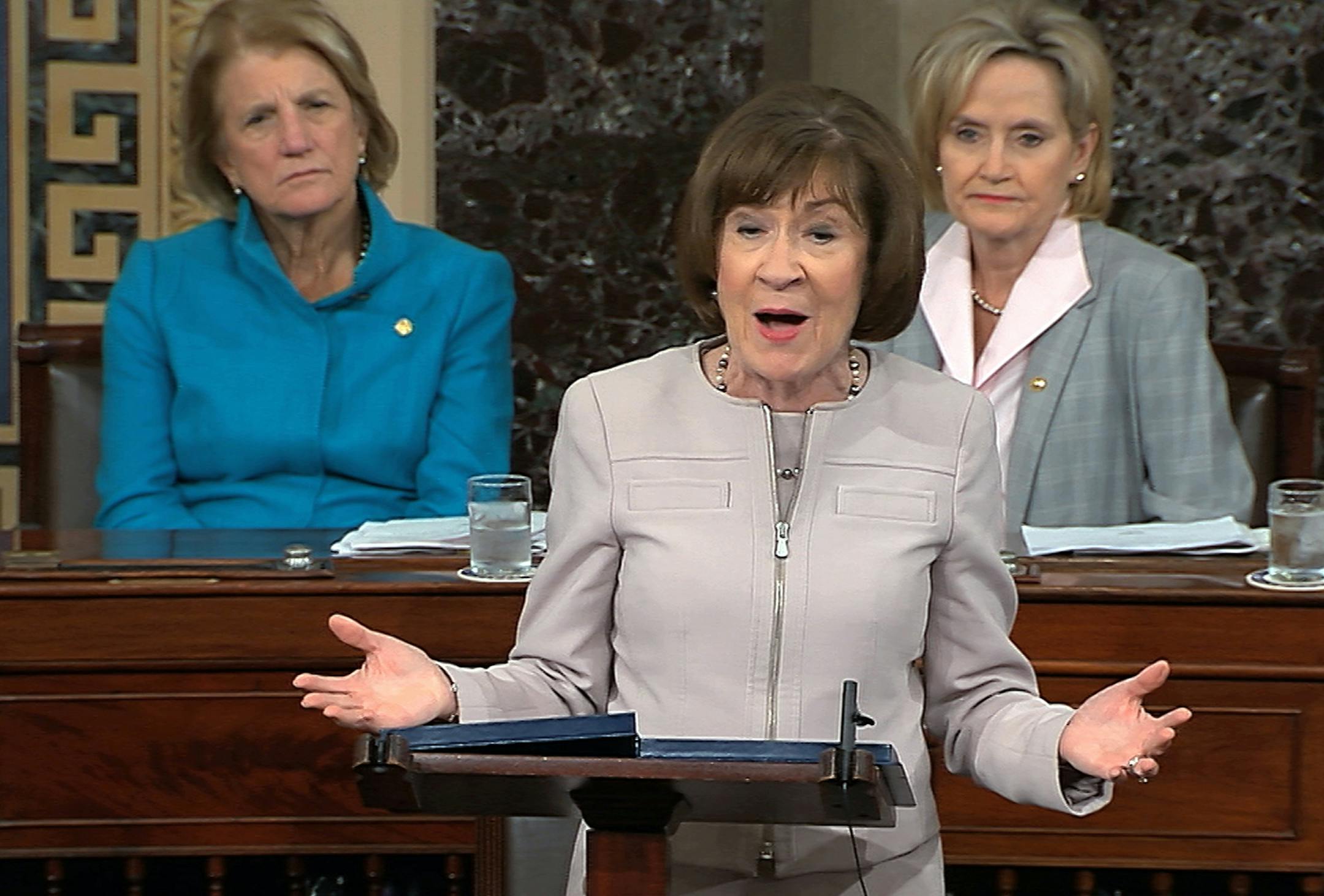
Traitors have always been despised far more thoroughly than mere enemies. So perhaps it is unsurprising that after the Senate voted narrowly to confirm Brett Kavanaugh to the Supreme Court, Sen. Susan Collins, R-Maine, became the focus of the opposition's ire.
"She is a disgrace (and) her legacy will be that she was a traitor to women and marginalized communities" tweeted Linda Sarsour, a board member of the Women's March organization, as Collins explained on Friday why she was supporting Kavanaugh's nomination, despite allegations by Christine Blasey Ford that he had sexually assaulted her when they were teenagers. Barely an hour later, Women's March tweeted an image branding Collins a "rape apologist."
"Gender traitors," said Alexis Grenell on the opinion pages of The New York Times, deriding the five female senators who had supported Kavanaugh's confirmation as part of the 53 percent of white women who "put their racial privilege ahead of their second-class gender status in 2016 by voting to uphold a system that values only their whiteness, just as they have for decades."
Within a day, activists had crowdfunded millions of dollars to defeat Collins in 2020.
It's not unreasonable, of course, to think that womanhood gives one a different perspective from men. That perspective must necessarily influence one's beliefs about policy, and particularly about policies that affect women. In what became known as Miles' Law, Rufus Miles Jr., an official in the Bureau of the Budget, noted in 1948 that, in politics, "where you stand depends on where you sit."
Women know, in a visceral way that men never can, what it is like to live your life in consciousness of a single, inescapable fact: that virtually every man you meet is capable of physically overpowering you and taking what you won't give them freely. We also know that if some man attacks us, it is likely to be in a private place, with no witnesses, and that the physical evidence will often be little different from the aftermath of consensual sex.
And so we know that our safety inescapably rests on two fragile foundations: the goodwill of those men who refrain from doing what they could; and if they don't refrain, our ability to persuade strangers to believe us rather than our attackers. I certainly hope Collins' decision was informed by her knowledge of what it is to be afraid; if it wasn't, she was not giving the people of Maine, or the people of the United States, the benefit of her fully informed judgment.
But, of course, as women, we know something else, too: that we are not the plaster saints the Victorians tried to make of us. To be a woman is to know, from the inside and all too well, that women are fallible.


