

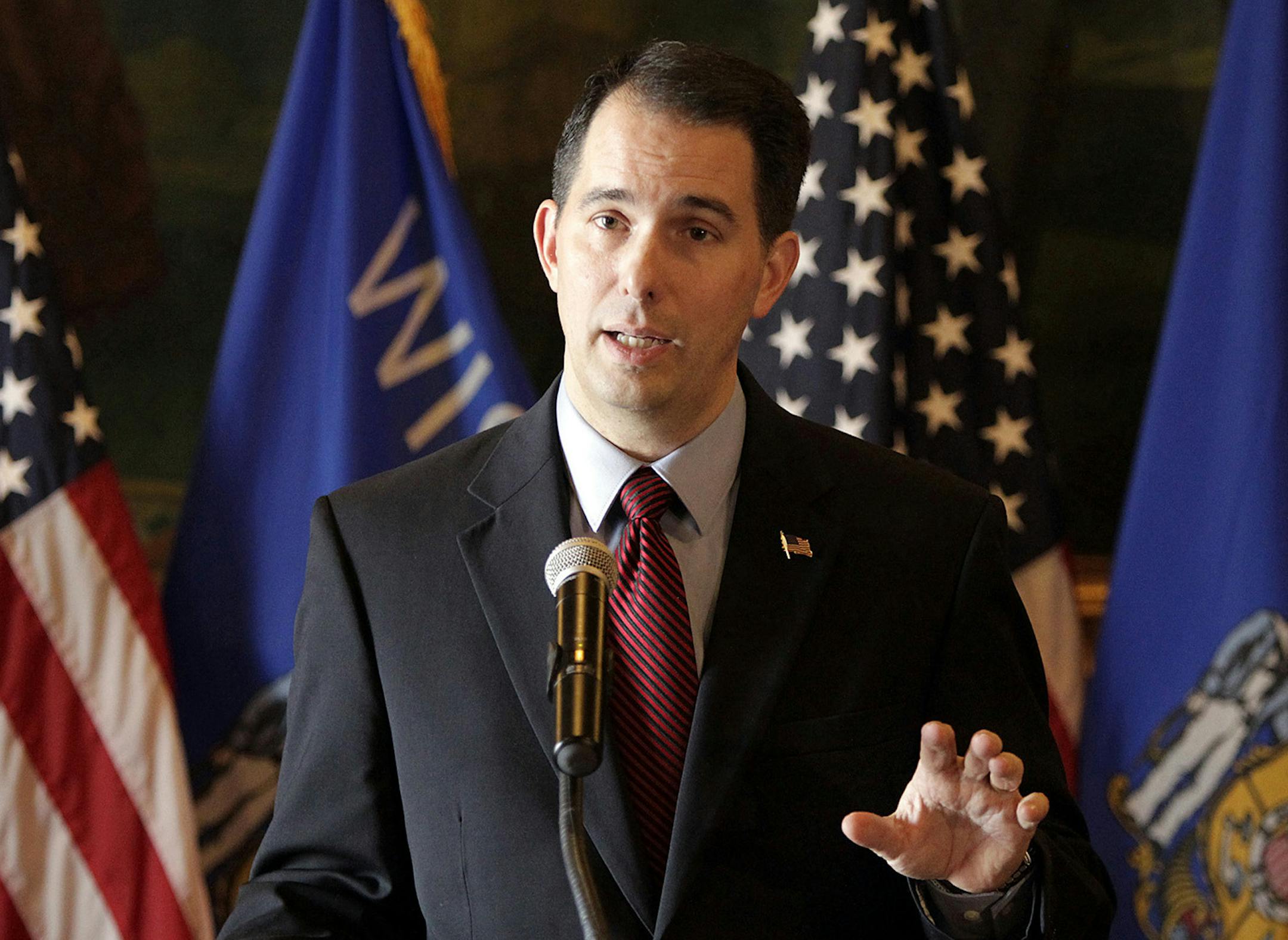
If you are a Republican and you like New Jersey Gov. Chris Christie, then you probably already have your candidate for the 2016 presidential campaign. If you do not like Christie, then your candidate for 2016 is Wisconsin Gov. Scott Walker.
Now that we've worked that out, you can ignore the next two years of GOP infighting. You can spend your free time canning beans or mastering the miter saw. It's a very premature conclusion, but the Wisconsin governor appears to be the only likely conservative alternative to Christie who also has a chance at getting elected. If you are uncomfortable with Christie as the default establishment choice, there is an incentive to choose someone else early. Because if the New Jersey governor's opponents divide their votes among several candidates in the primaries, Christie will be the GOP nominee.
The anti-Christie fragmentation is already underway. Once he was re-elected governor, the auditions to play the role of ABC (Anybody But Christie) started pretty quickly. Sen. Ted Cruz drew a fundamental distinction. "I think it is terrific that he is brash, that he is outspoken, and that he won his race," said the Texas senator of Christie. "But I think we need more leaders in Washington with the courage to stand for principle."
Florida Sen. Marco Rubio tried to make the blue state of New Jersey a jail cell. "Clearly, he was able to speak to the hopes and aspirations of people within New Jersey," said Rubio. "That's important. We want to win everywhere, and Gov. Chris Christie has certainly shown he has a way of winning in New Jersey, in states like New Jersey."
Kentucky Sen. Rand Paul said it was good to have a "moderate" like Christie in the party. Later he said Christie never would have won re-election were it not for the federal largess that paid for the recovery from Hurricane Sandy.
The senators have spoken. The problem is that's what senators are mostly known for doing: talking. They may make good presidential candidates, but in 2016 the political bias is going to be for chief executives.
Republican voters tend to be fond of governors; they see the job as good training for the White House. You sharpen a set of skills that more closely track with the ones you'll need in the Oval Office. With the voters so sick of Washington politicians, the political incentive is to stay away from senators because — no matter how much they behave like insurgents — they still have the smell of Washington on them. Finally, Republicans have been vocal for a long time that President Obama's failures flow from his lack of executive experience. Given this, it is hard to imagine that enough voters would want to replace him with another one-term senator who has built his reputation on nothing more than the quality of his speeches. (Unsurprisingly, Walker thinks the GOP is going to nominate a governor in 2016, too.)
That narrows the field down to the pool of leading current and former Republican governors: Jeb Bush, Bobby Jindal, John Kasich, Rick Perry and Walker. All of those men have something to recommend them, but "no one checks as many boxes as Walker does," as an Iowa GOP strategist puts it. Walker has near hero status in the grassroots for taking on Wisconsin's public sector unions. Cruz talks about taking stands on principle, but he lost his fight. Walker took a stand, was targeted by the full force of the Democratic machine, and stayed alive. He won a recall election with a larger margin than his original victory. He raised $30 million for that race, so he knows how to tap wealthy donors.


