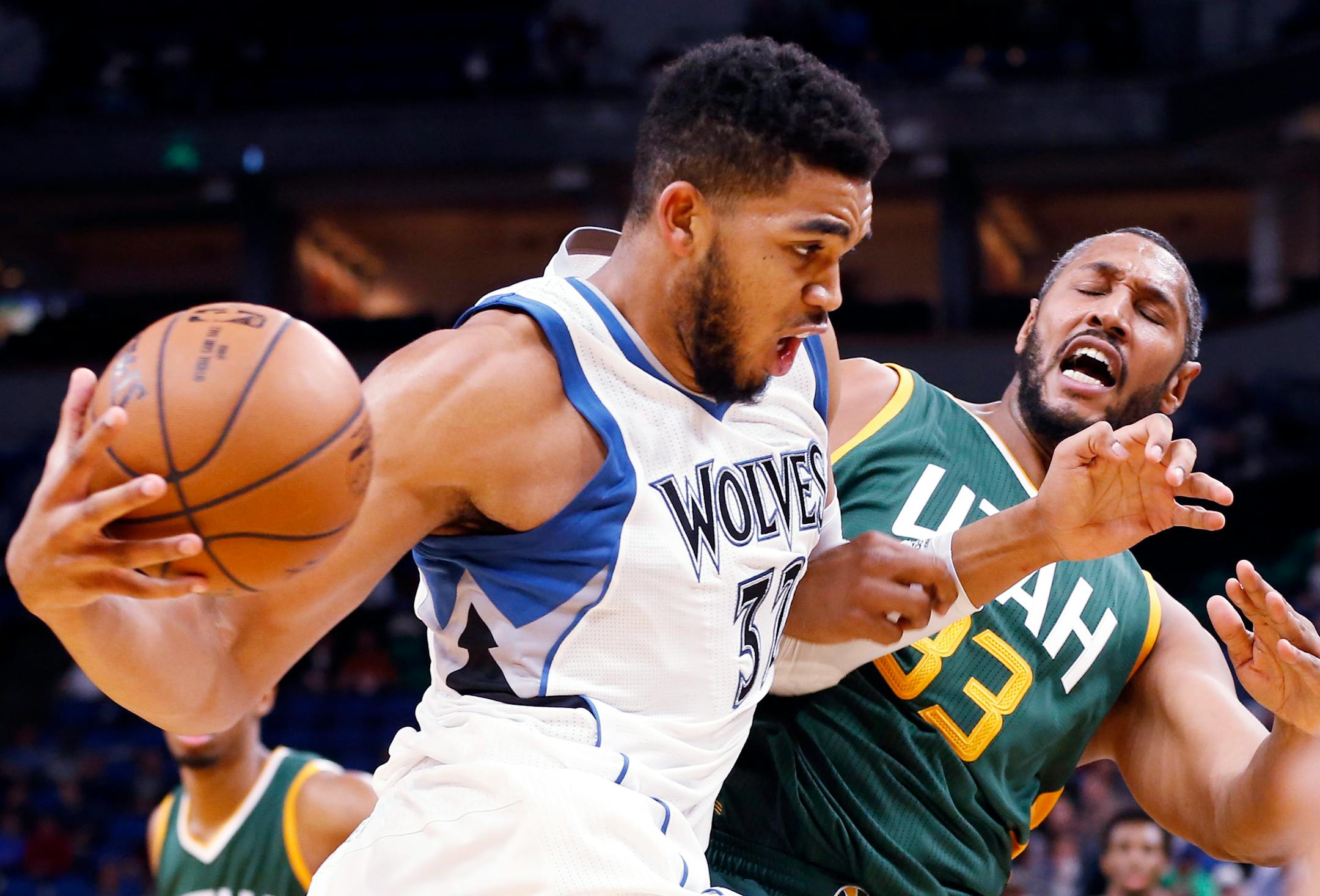
After the Wolves had allowed the Utah Jazz nearly unfettered access to the paint in Monday's 112-103 loss — the team's second straight and fifth in six games — Karl-Anthony Towns sat at his locker for a while, still in his uniform, his head in his hands.
"I just couldn't move," he said. "I was just thinking. I'm a very emotional player. I play with a lot of passion. I came in this locker room after the game and I was just emotionally drained. I give us everything I've got, and I just want to see us win."
The Wolves' difficult 5-12 start has everyone frustrated. And that was expressed in different ways. Coach Tom Thibodeau decried the defense and vowed to take a look at everything the team was doing, though he was more measured after Tuesday's practice. Some of the players agreed that the defense needed to improve but seemed to struggle to explain how.
Towns took all of the frustration, all of the blame for the team's slow start and put it on himself.
"The more losses keep accumulating, the more it feels like it's my fault," he said. "I have to play at a level where we can't lose, help my teammates out the best I can. I didn't do that tonight. … All these losses fall on my shoulders. It's no one else's fault. Not the coaching staff, not my teammates, this is my fault. It's something I have to fix."
Clearly frustrated, this might have been Towns' way of expressing it. But it appears to run counter to Thibodeau's mantra, which stresses five connected players working as a unit. Indeed, one player trying to do too much has, at times, been the culprit when the Wolves' defense struggles.
When asked about Towns' comments, Thibodeau didn't respond directly, instead discussing the breakdowns that have plagued the defense.
"It's not the words, it's the actions," he said. "When you say you care about winning, you have to make sure you're doing the things that are necessary to win.
![Ricky Rubio, Brandon Rush and Adreian Payne sat on the bench late in the fourth quarter. Utah beat Minnesota by a final score of 112-103. ] CARLOS GONZALEZ cgonzalez@startribune.com - November 28, 2016, Minneapolis, MN, Target Center, NBA, Minnesota Timberwolves vs. Utah Jazz](https://arc.stimg.co/startribunemedia/HIIV7C6FDE6GS4NQUJ7VBWUPGU.jpg?&w=1080)