
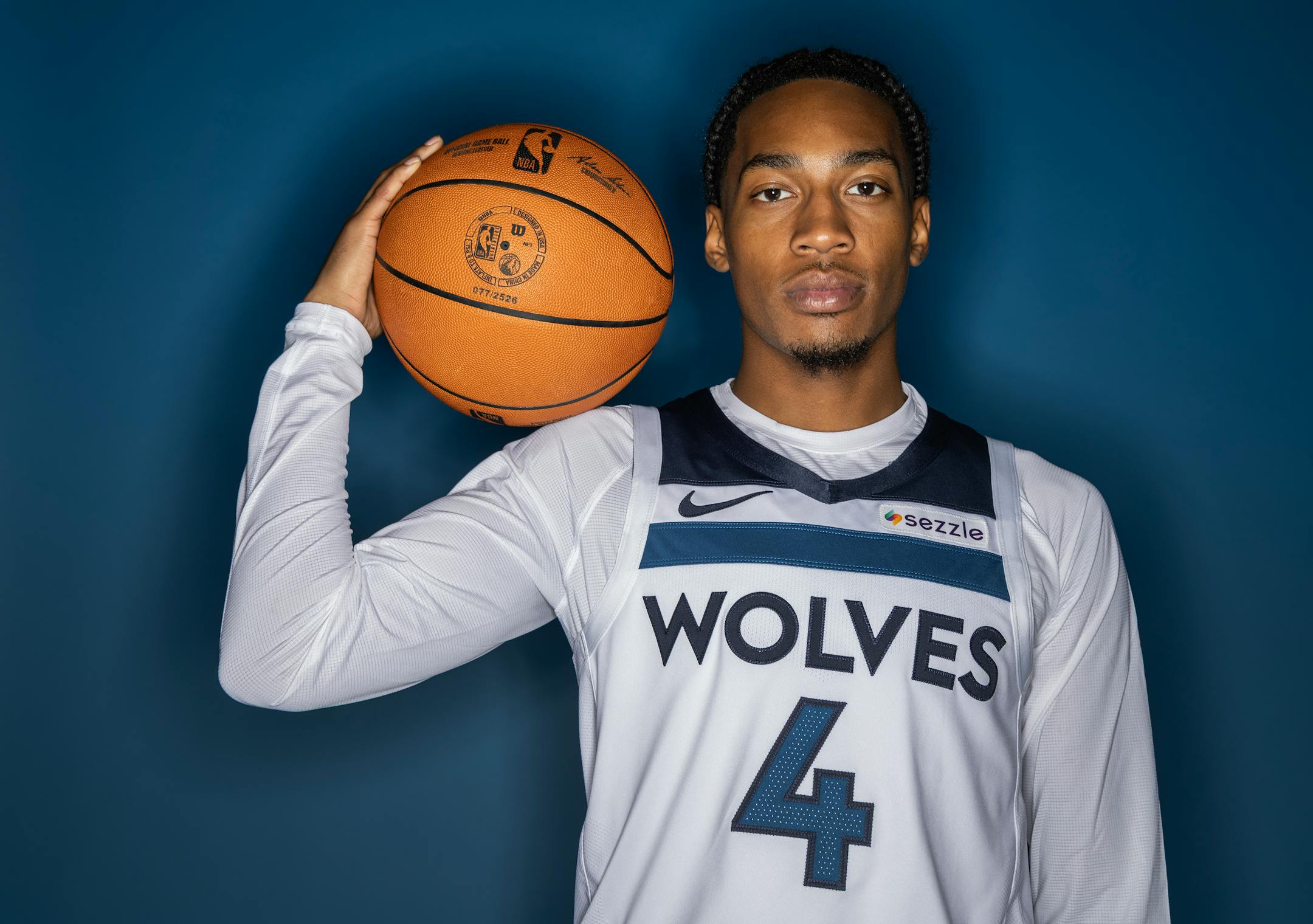
How does Rob Dillingham fit in with the Timberwolves in Year 2?

The second-year player from Kentucky was not in the rotation last season, and for the first time in his life had to sit and watch more than play.

The Minnesota Star Tribune
October 11, 2025 at 4:01PM
Rob Dillingham is photographed at the Wolves media day on Sept. 29 at Target Center. (Carlos Gonzalez/The Minnesota Star Tribune)

After consecutive NBA Western Conference finals appearances, the Timberwolves are a team in win-now mode.

They have three starters in their 30s (Rudy Gobert, Julius Randle and Mike Conley) and a franchise player in Anthony Edwards, who has shown he is capable of leading the team on playoff runs.

But in the summer of 2024, the Wolves made a move that had more of an eye toward the future than on the present when they traded for the No. 8 pick from the Spurs to draft guard Rob Dillingham. He didn’t see the floor as much as he would have liked last season, and he hasn’t sugarcoated his answers when discussing that this preseason.

“It’s hard to explain. For y’all, if y’all have something you love to do and you do it every single day and then y’all just can’t do it, but you’re still working out at it, but you don’t get to perform, you gonna feel something inside,” Dillingham said. “It’s not towards people, it’s just life.”

Dillingham, who averaged 4.5 points on 10.5 minutes per game, was in an odd position for a top-10 pick a year ago. Normally, players who go that high in the draft are going to teams that didn’t make the playoffs the previous season, and they get plenty of playing time when the stakes for the franchise are lower.

But that wasn’t where Dillingham was. Instead, he was on a team with deep playoff aspirations, and a team that was trying to figure out a lot after a major trade for Randle and Donte DiVincenzo — not just trying to chart how Dillingham would fit into the rotation.

Moreover, it’s not typical for rookies to be efficient players once they enter the NBA. That’s not a knock on Dillingham, it’s just a fact of NBA life. Last season, Dillingham said he felt like a “robot” at times trying to do the things he needed to do to make sure he earned playing time.

“In my head I’ve always played. So not playing, you don’t want to not play,” Dillingham said. “I want to play. So whatever I got to do to play, whether [coach Chris Finch] wants me to do — pass the ball, pick up [on defense], I’m just gonna have to do."

ADVERTISEMENT

The issue the Wolves found themselves in — and still do as Dillingham enters Year 2 — is that he needs the leeway to develop at the NBA level to play through and learn from mistakes. That goes double for point guards, a position where decision-making is critical.

Finch has often said the keys for young players to get playing time is to figure out what they do well and not be a negative on the floor. Dillingham’s turnover numbers were one reason for his limited minutes. His turnover percentage of .164 was in the 15th percentile among all point guards, according to advanced statistical website Cleaning the Glass. By contrast, Conley’s .112 turnover percentage was in the 79th percentile.

Finch said Dillingham is figuring out who he is as an NBA player.

“Rob is getting there,” Finch said. “Rob is one of those guys — he has a lot of game. As I like to say, he has a lot of wiggle to his game. There will be a time and place for all of that. But he has skills that we absolutely need.”

Among them: playing with pace and driving ability to get into the paint either to find his own shot or make plays for others. He also won’t have to create all his own open looks, since the attention Edwards and Randle draw will create shots for Dillingham.

“Be ready to make shots off the ball, particularly when you’re playing out there alongside guys like Julius and Ant who are going to have the ball in their hands a lot,” Finch said the staff told Dillingham. “Keep it simple and use your speed, which is what we need you to do and what you have naturally comes to you.”

Dillingham earned praise from Finch for his effort on the defensive end, but that’s a work in progress.

“The physicality, getting over screens,” Finch said. “How NBA defense is, is nowhere near college or anywhere else. You really got to be able to practice this and do it to learn it, because it’s not something you can talk and tell someone how to do it.”

Conley has been giving him plenty of pointers, even with Dillingham being the apparent heir to Conley at point guard. During five-on-five drills, Conley said he’ll stop and explain to Dillingham what he could be doing defensively. Conley said part of his responsibility is getting Dillingham ready for the future, both immediate and long-term.

“I’m telling him, ‘Hey, the screen’s coming’ and ‘Get your leg over this way,’ just trying to make sure he’s getting the stuff right in real time,” Conley said. “Because I know this will be his show, whether it’s now or six months or a year, whatever it is, it’s his thing.

“So he’s got to be able to process and be able to, for the moment, learn as much as he can.”

about the writer

about the writer

Chris Hine

Sports reporter

Chris Hine is the Timberwolves reporter at the Minnesota Star Tribune.

See Moreicon

More from Wolves

See More
card image
Ella Hall/The Associated Press

The Wolves again made life tough on themselves vs. the worst team in the West, but they left New Orleans with two victories in two games.

card image
card image