

For 165 Senegalese, the journey of a lifetime ended in a fluorescent-lit, green-carpeted barn at the edge of Dakar's international airport. Dressed uniformly in new white sneakers and hoodies reading "RISING" in large letters, they perched on plastic chairs and ate their first meal back on home soil out of foil containers.
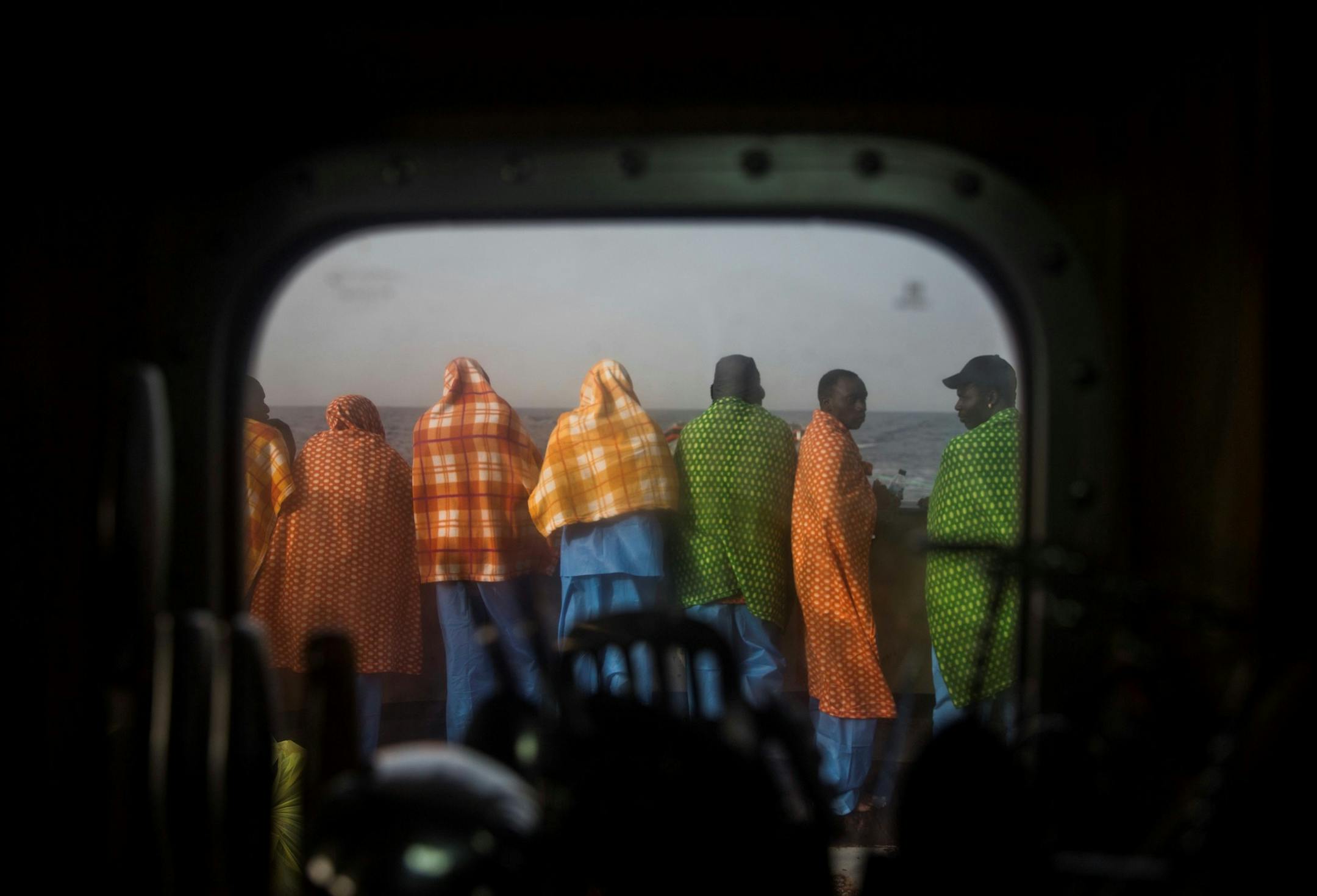
They had just returned from Tripoli, Libya, on a flight put on by the International Organization for Migration, a U.N. body. Of the 165, all but one were men, and all were young. They had been trying to get onto boats bound for Europe. Instead they had spent months — over a year for some — living on starvation rations in Libyan prisons.
And yet by their accounts, they are the lucky ones.
"Today, to be back here, it is as good as if I made it to Europe," said Mohammed Sylla, a 30-year-old trader. "Why did I want to go to Italy anyway? I was stupid." He headed for Libya after trying to get to Europe through Morocco, but the moment he crossed the border from Algeria, it became "a hell." He describes being beaten repeatedly by soldiers, and hiding in a forest for six days without food. Two other migrants he was with, from Guinea, were shot by militiamen in front of him. "I thought I would die for sure," he said, his voice dipping to a whisper. Black people are imprisoned, he continues, and sold for labor or ransom.
Centuries ago, Senegal, on the western edge of Africa, was a stopping point for European ships taking slaves to the new world. On Goree Island, off the coast of Dakar, tourists can gawk at buildings where humans were once kept like cattle. Today, Senegalese go on grim journeys of their own volition, in hope of a better life.
Of 37,000 arrivals to Italy in the first four months of this year, around 7 percent were from Senegal. In that time the number of migrants, mostly from the Middle East, crossing to Greece from Turkey dropped by more than 90 percent compared with last year. By contrast, the number going to Italy increased — most of them from west Africa.
In Senegal, it is possible to get a hint of what leads people to risk the journey to Europe. Kayar, a fishing village about 40 miles outside Dakar, is a place from where people have been seeking a way north for decades. On the beach, hundreds of wooden pirogues painted in dazzling colors crowd the sand; the buzz of saws at makeshift workshops fills the air. But fishing provides work only for a few months of the year, leaving young men with little to do. Instead, they dream up schemes for traveling north.
Ali Diong, a 35-year-old fisherman, often chats on WhatsApp with friends who have made it to Spain and Italy. "They can send money to their wives, they can pay for baptisms," he says. "We who are still here depend entirely on our parents." Every migrant's plan is different, he said, but in order to pay for their journeys, people sell assets, such as their boats or motorcycles, or families chip in to raise the fare. It is risky, he admitted. "But here there is nothing. You have to do something, and emigration is all you have."


