

Throughout Latin America, infrastructure lags much of the world

Progress is often slowed by politics and corruption.

March 13, 2018 at 1:14AM
Argentina's President Mauricio Macri speaks during a closing campaign rally for congressional candidates of the Cambiemos ruling party, in Buenos Aires, Argentina, Tuesday, Oct. 17, 2017. Argentines go to the polls Sunday to cast their votes in the congressional midterm elections. (AP Photo/Natacha Pisarenko) ORG XMIT: XNP106
Argentina’s President Mauricio Macri launched an infrastructure plan called Plan Belgrano for the country’s struggling north. (The Minnesota Star Tribune)

The Transnordestina railway is supposed to carry soybeans, iron ore and other commodities from farms and mines in northeast Brazil to ports in Ceará and Pernambuco, and then on to markets in China. Brazil has spent more than $1.8 billion on the project since work began a decade ago. But cows still amble along its unfinished tracks.

In Lima, Peru, and Bogotá, Colombia, workers can spend half as much time commuting as they do at the office. In Brito, a village on Nicaragua's Pacific coast, there are no paved roads, electricity or running water. "It's like we're still living in the era of Columbus," laments a fisherman.

Latin America is hobbled by its inadequate infrastructure. More than 60 percent of the region's roads are unpaved, compared with 46 percent in emerging economies in Asia and 17 percent in Europe. Two-thirds of sewage is untreated.

Poor sanitation and lack of clean water are the second-biggest killer of children under 5 years old, according to the World Health Organization. Losses of electricity from transmission and distribution networks are among the highest in the world. Latin America spends a smaller share of GDP on infrastructure than any other region except sub-Saharan Africa.

There are some bright spots. Chile's roads are better than those of Belgium, New Zealand and China, according to the World Economic Forum. Uruguay's electricity and telecoms outclass those in the United States and Canada. But in general, the quality of infrastructure is more of a drag on than a boost to Latin American economies.

Recently a window of opportunity to upgrade it opened up. Global interest rates have been unusually low, which makes it cheap to raise money to repair old infrastructure or start new projects. Market-friendly presidents have taken office in several countries, including Brazil, Argentina and Peru. They have made improving infrastructure a priority.

Pedro Pablo Kuczynski, Peru's president since July 2016, promised to turn the country into a "construction camp." Mauricio Macri, elected Argentina's president in 2015, launched an infrastructure plan called Plan Belgrano for the country's poorly connected north. His cabinet chief, Marcos Peña, calls it "the most ambitious in Argentina's history." In Colombia a promise to build rural infrastructure is part of the peace agreement between the government and the FARC, a leftist guerrilla group that had been at war with the state since 1964.

But the region's governments have not made the most of the opportunity. A big setback was the Lava Jato (Car Wash) investigation, which began as a money-laundering case in Brazil and has engulfed the governments of a dozen Latin American countries. Odebrecht, a Brazilian firm that built highways, dams, power plants and sanitation facilities across the region, admitted to paying $788 million in bribes. The scandal has left a trail of unfinished projects, frightened politicians and bureaucrats, and wary bankers.
Governments also worry that a rise in interest rates will raise the cost of borrowing to build infrastructure and that a reduction in corporate tax in the United States, signed into law by Donald Trump in December, will pull capital away from Latin America. They are racing to get their infrastructure plans back on track before the opportunity passes.

The biggest need, said economists, is for roads, railways, ports and urban transport to speed exports and the travels of workers.

A big difficulty in widening such bottlenecks is cumbersome procedures, legal hurdles and ponderous bureaucracies. A new airport near Cusco, Peru's most popular tourist destination, was proposed in the 1970s; a contract to build it was signed in 2014 but scrapped last year.

Not all the news is bad, however. One reason for cheer is that infrastructure can be less expensive than governments think. With conventional policies, South America needs to spend at least $23 billion a year to upgrade its electricity networks, according to the World Bank.

But if the region manages demand better, introduces renewable sources of energy and promotes conservation, it can cut that cost to $8 billion to 9 billion.

A second source of encouragement is China. Its banks invest more in Latin America's infrastructure than the World Bank and IDB combined, according to David Dollar of the Brookings Institution, a think tank in Washington. Last year Chinese companies invested at least $21bn in Brazil, not least in power plants and ports.

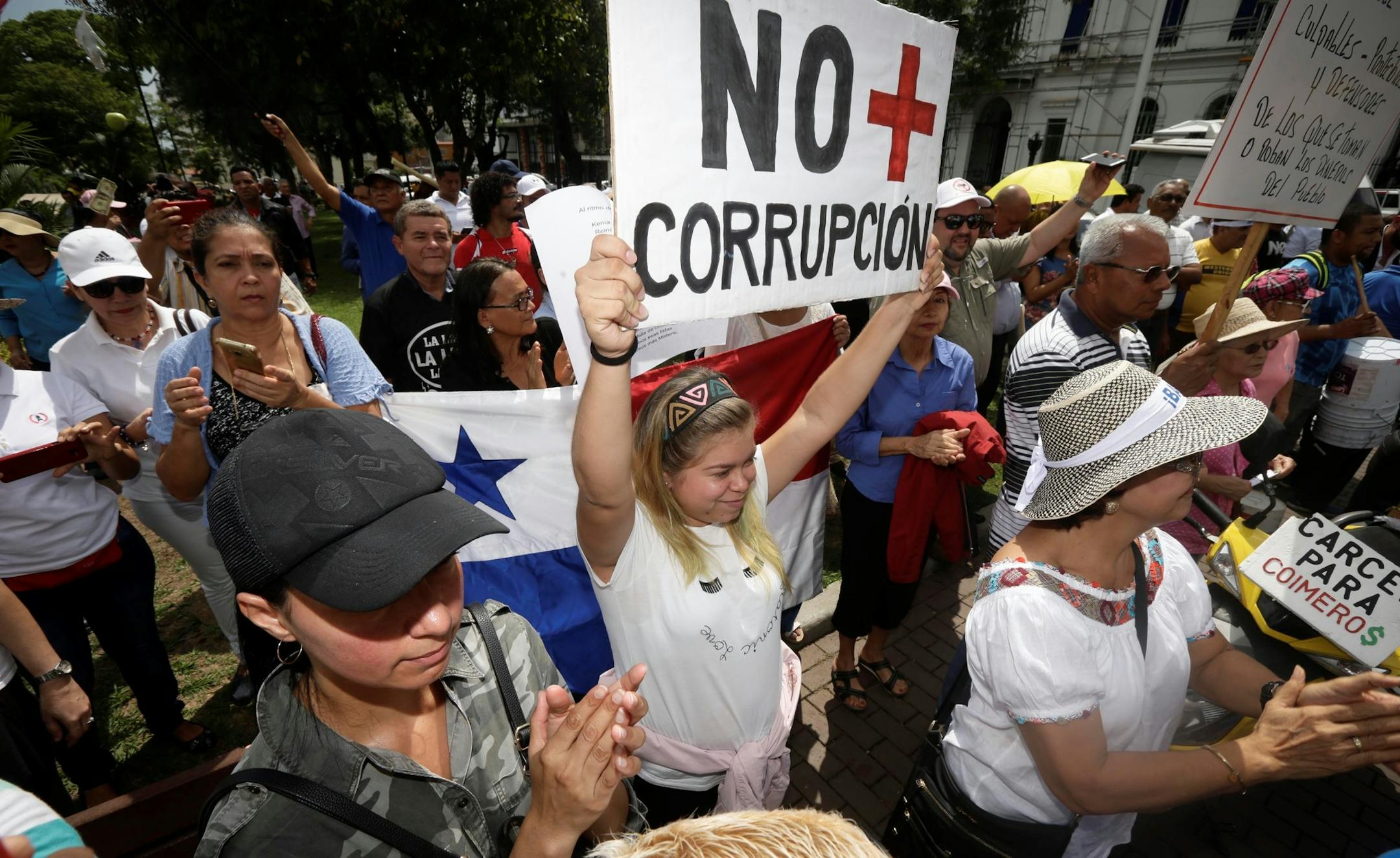
A protester holds up a sign that reads in Spanish "No more corruption" during a demonstration against corruption outside the attorney general's office in Panama City, Tuesday, Jan. 23, 2018. Demonstrators are protesting corruption tied to the Brazilian construction company Odebrecht, involved in Latin America's biggest corruption scandal. (AP Photo/Arnulfo Franco) ORG XMIT: PAN101
A protester held up a sign that reads in Spanish “No more corruption” during a demonstration against outside the attorney general’s office in Panama City earlier this year. (The Minnesota Star Tribune)
about the writer

about the writer

Economist

More from Business

See More
card image
Fairview Health Services

The school is changing an elective course while still working with the Eden Prairie-based health care giant after students raised concerns.

This transmission electron microscope image shows SARS-CoV-2, the virus that causes COVID-19, isolated from a patient in the U.S., emerging from the surface of cells cultured in the lab. (NIAID/TNS) ORG XMIT: 1659810
card image