

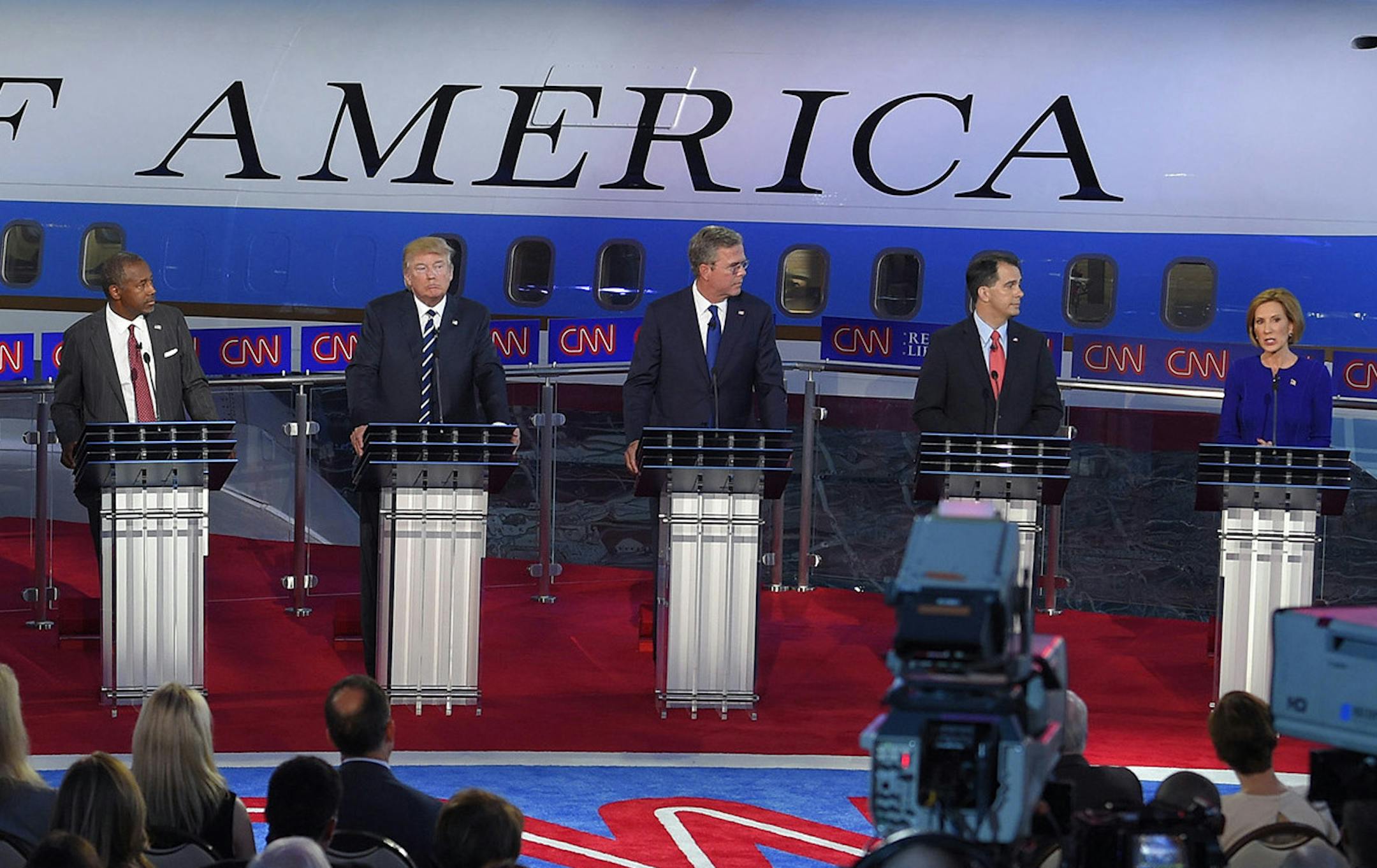
The staying power of the three outsider candidates in the Republican presidential race is supposed to signal voters' yearning for fresh, bold solutions to the nation's problems.
So what do Donald Trump, Carly Fiorina and Ben Carson have to offer that the conventional Republican candidates don't? The answer may surprise you.
On economic policy at least, the three outsiders are pretty much middle-of-the-road conservatives. With some notable exceptions, their views on taxes, trade, energy, health care, the minimum wage, immigration and regulation aren't markedly different from those of Jeb Bush, Marco Rubio and Chris Christie.
Take health care. Trump, Carson and Fiorina say they would repeal Obamacare because they abhor government interference in the health care market (though Trump has made favorable noises about single-payer systems in other countries). They would replace the law with vague, market-oriented alternatives. Their views closely parallel those of mainstreamers Bush, Rubio and Christie.
The two camps also overlap on energy and climate change. The outsiders would encourage more domestic crude oil production and roll back environmental regulations. They are all climate-change doubters: Carson says it's a distraction, Trump calls it a hoax and Fiorina wants to examine the science more closely. They all favor the Keystone pipeline, while Fiorina and Carson would also end subsidies for renewable energy.
Among the mainstreamers, Bush and Christie accept that humans are causing at least some climate change and that the U.S. has to take a lead role in negotiating cuts in carbon emissions with other countries. Rubio is less willing to accept that people contribute to global warming, yet agrees we all have a responsibility to protect the environment. All three mainstreamers, however, are as adamant as Trump, Carson and Fiorina about not imposing environmental rules that might crimp economic growth, cause job losses or reduce the ability of companies to compete abroad. Like the outsiders, the mainstreamers support the Keystone pipeline.
On taxes, both groups broadly agree that rates should be lower for most individuals and corporations. All six of them would simplify the tax code by collapsing income-tax brackets, lowering rates and eliminating deductions.
They part company after that, but it's hard to say who's more moderate, conservative or inconsistent among the lot. Carson's 10 percent tithe would certainly be the simplest tax system, but also the most regressive. Trump's tax proposals are, shall we say, evolving: He has angered the anti-tax Club for Growth for advocating tax increases for the rich while also enraging liberals for having once favored a tax of only 15 percent on incomes above $1 million. Lately Trump has said he would maintain the tax code's current progressivity.


