
This tiny town wants to be the first in Minnesota to evict Xcel Energy and start its own utility

A four-hour wait to shut off power to a burning utility pole was one of the last straws for Slayton.

The Minnesota Star Tribune
August 8, 2025 at 11:00AM
An Xcel Energy truck drives through town in Slayton, Minn. on July 30. (Renée Jones Schneider/The Minnesota Star Tribune)

SLAYTON, Minn. — Fire Chief Chris LeTendre said he felt helpless watching the top of a utility pole burn, dropping embers near an apartment complex. Dousing the pole meant risking electrocution, so he sprayed the ground with water and waited for Xcel Energy to arrive to cut the power.

That took more than four hours. In the meantime, the burning pole shorted the system and knocked out power for the town’s entire west side, he said.

The utility pole debacle is among the reasons Slayton wants to kick Xcel out of its city and form a new government-run electric provider. It is an extraordinary step and one driven by frustration with Xcel’s everyday service and emergency response.

Many in the town of 2,000 people feel they were left behind, stuck with crumbling infrastructure compared to Xcel’s bigger cities, and far away from help.

If Slayton succeeds, it would be the first in Minnesota, and unusual around the country.

A few large, wealthy and politically progressive cities such as Minneapolis and Boulder, Colo. have explored creating a municipal utility in hope of speeding the use of renewable energy. In the face of Xcel’s opposition and the cost of that change, those two cities failed.

Slayton’s fate now rests with state utility regulators, who will weigh in on a critical disagreement: how much it should cost the city to oust its power company.

Xcel tried to convince the city it’s worth sticking by their side, and spent millions to improve its local infrastructure amid the dispute. In a statement, Xcel spokesman Kevin Coss said the company respects Slayton’s right to municipalize.
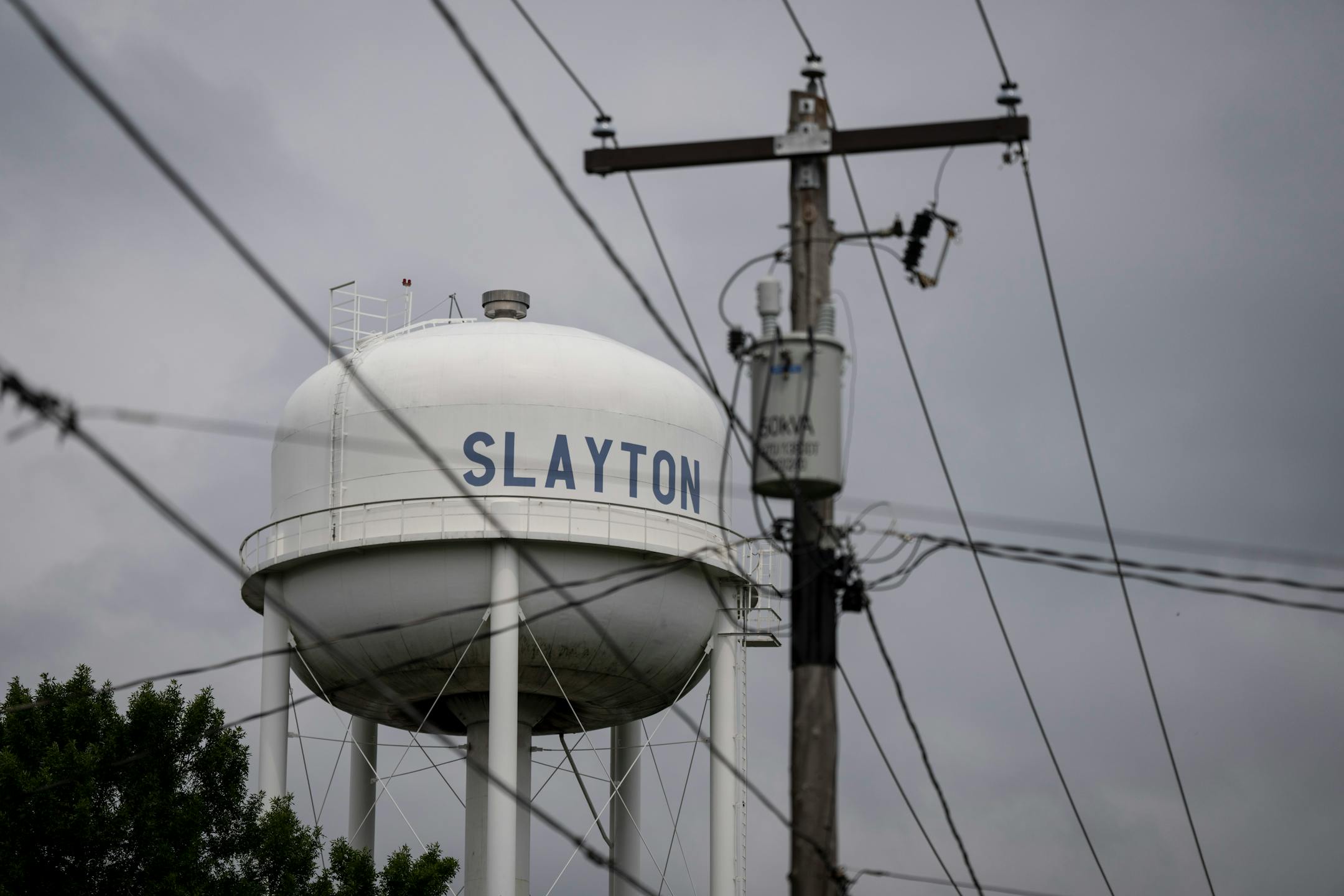

“It’s our mission to serve our customers well and work to meet the needs of communities big and small,” he said. John Marshall, Xcel’s regional vice president in charge of community relations, told a crowd in Slayton last year: “We do very much want to continue being your electric provider.”

The Slayton watertower framed with electrical wires from a post from 1967 and marked for replacement by Xcel Energy in 2023. (Renée Jones Schneider/The Minnesota Star Tribune)

Service complaints lead to frustration

Slayton first considered splitting with Xcel in 2021.

LeTendre described four safety incidents, starting in 2018. After a tornado in 2019, the fire department responded to a downed power line in neighboring Hadley that had “energized” a tree, LeTendre said.

“It looks like a Christmas tree because it’s flickering and on fire,” LeTendre said. “None of which we can do anything about.”

The tree burned for nine hours before a fuse tripped and killed the power, he said. The fire went out. Firefighters never saw Xcel on the scene, he said.

At one public hearing last year, a city consultant said data show Slayton in 2022 had nearly twice as many outages compared to the state average, that they lasted longer, and that Xcel’s response time to outages was almost twice as long for Slayton as the state average.

“It did not start at all with ‘We’re paying too much money,’” city administrator Josh Malchow said in an interview.

Coss said Slayton’s data interpretation is misleading. Xcel data shows the city’s outage time for the average customer is longer in some years and shorter in others. Slayton is below the average for southern Minnesota but above the state average over the last decade. Coss said the incidents highlighted by the fire department were “select examples,” some of which “show there were opportunities for enhanced service” from Xcel.

Minnesota law allows cities to start their own municipal utilities after a city-wide referendum.

Then, cities must buy all the infrastructure, like utility poles and power lines, of the provider they are removing. The PUC will also have to consider the cost of Xcel’s lost revenue.

Xcel’s early estimate was about $20 million, though Coss said the company won’t disclose its latest number because of confidential negotiations. Slayton argues the total value is less than $7 million.

Slayton tries what others failed

A disagreement over price is part of what sank the hopes of other cities that explored starting municipal utilities.

When Minneapolis considered buying Xcel’s infrastructure in 2013, Xcel said it would move its downtown headquarters as a result. The city quickly gave up.

Boulder tried for a decade to ditch Xcel and create a city-run electric provider.

Bob Yates, a city councilman there from 2015 until 2023, said Xcel and state utility regulators resisted the effort. Boulder spent $30 million on attorneys, accountants, engineering plans and the Colorado regulatory process, Yates said.

He said Xcel said it would cost much more for Boulder to buy their infrastructure than the city anticipated. Boulder also would have had to pay for operating a new utility, which includes employees, service trucks and a network operations center.

“The longer it went on, the more people realized that while it might be nice to go greener faster, it was just going to be tremendously expensive,” Yates said.

Slayton Council Member Blake Heronimus points out an old post that was marked as built in 1951 that the city had been waiting for a month to have electrical hooked up to add power to the building for the county cattlemen's association at the county fairgrounds in Slayton. (Renée Jones Schneider/The Minnesota Star Tribune)

Slayton wins a campaign to ditch Xcel

Malchow said they will drop the fight if replacing Xcel means higher property taxes or electric bills.

The city plans to contract with Nobles Cooperative Electric, a nonprofit serving the area outside of Slayton, to handle operations and maintenance. That could save Slayton from many of the troubles Boulder ran into. City officials believe their plan would lead to lower bills, if the purchase price is low enough.

Before a May 2024 public referendum, the city held a series of public hearings where Slayton, Xcel and the Nobles co-op wooed voters as if campaigning for office.

Adam Tromblay, general manager at Nobles, focused on service during a hearing shortly before the vote, saying the nonprofit has five linemen that live in Slayton.

“You have a squirrel outage and it’s a two-hour deal because [Xcel is] coming from Mankato, you’re coming from Sioux Falls,” Tromblay said. “We’re coming from our shop here three minutes up the road.”

During a January meeting, Tromblay talked about how many children of Nobles’ employees attend local schools and highlighted community charity programs like raising money for winter coats or sponsoring the rib fest at the county fair.

Xcel’s Marshall said the company has the ability to gather huge amounts of people and resources to respond to storms. Marshall said Xcel’s $20 million estimate was not a scare tactic.

Brad Sylliaasen, director of design and construction at Xcel, said the company spent “many millions of dollars” on the southwestern Minnesota transmission system. Xcel says it replaced more than 200 poles in the last two years and that reliability is at more than 99% in Slayton.

The evidence of that long-planned work is visible in Slayton, where the brown wood of new poles along city streets contrast with older gray ones. Some older poles are marked with a large white ‘X’ for removal.

Coss said Xcel has a district representative in Slayton and provides crews for much of the rest of the area’s work from a service center in Pipestone. They don’t send teams from Mankato, he said.

Malchow said Xcel’s system is more reliable now, but response to customers is still slow. For example, Slayton Council Member Blake Heronimus said the county Cattlemen’s Association waited an “unreasonable” amount of time for Xcel to hook up their new building on the county fairgrounds ahead of the fair next week.

City administrator Josh Malchow and Council Member Blake Heronimus point out a working electical pole from 1957 that is severely damaged and was marked for replacement in 2023 in Slayton. (Renée Jones Schneider/The Minnesota Star Tribune)

Nearly 75% of the 409 people who voted in Slayton backed the city’s plan, which includes borrowing up to $7 million. The city would pay back those bonds with revenue from electric bills.

Malchow said the main divide between Xcel and Slayton has been whether the city has to pay for the company’s lost revenue, and if so, how expensive that should be. If the PUC decides the final price is out of Slayton’s budget, the city can walk away, but not for free.

Malchow said they have spent more than $215,000 in federal COVID-19 relief dollars and local tax dollars to pay for city time, attorneys’ fees, the election and consultant costs.

“I don’t see a time when we stop,” said Heronimus, the councilman. “When you get into something like this that feels very much like the right thing to do, there’s no reason to quit.”

about the writer

about the writer

Walker Orenstein

Reporter

Walker Orenstein covers energy, natural resources and sustainability for the Star Tribune. Before that, he was a reporter at MinnPost and at news outlets in Washington state.

See Moreicon

More from Environment

See More
Rising above the treeline (Top of this photo), on the shore of Birch Lake, the Twin Metals Copper Nickel Mine Plant site and Tailings Management site is part of the proposed plan. ] In theory, the copper-nickel mine Twin Metals wants to build in the headwaters of the Boundary Waters Canoe Area Wilderness is a zero-discharge mine — a closed loop that will endlessly recycle millions of gallons of water, including rainwater and the polluted process water it uses to extract ore and
Brian Peterson/The Minnesota Star Tribune

The copper-nickel mine is controversial for its proximity to the Boundary Waters Canoe Area Wilderness, and the Biden Administration had canceled its leases.

card image
card image